Posted on

Baking by Guesswork

Last weekend, I was up early; earlier than normal. And instead of tossing and wishing I could go back to sleep I got up. I had even turned off my alarm the night before, hoping that I could sleep past 5am. 4:30 came and I was awake, but so was the morning sky. It was definitely worth the earlier start to my day, but truth be told, I will try and get in a siesta later. 

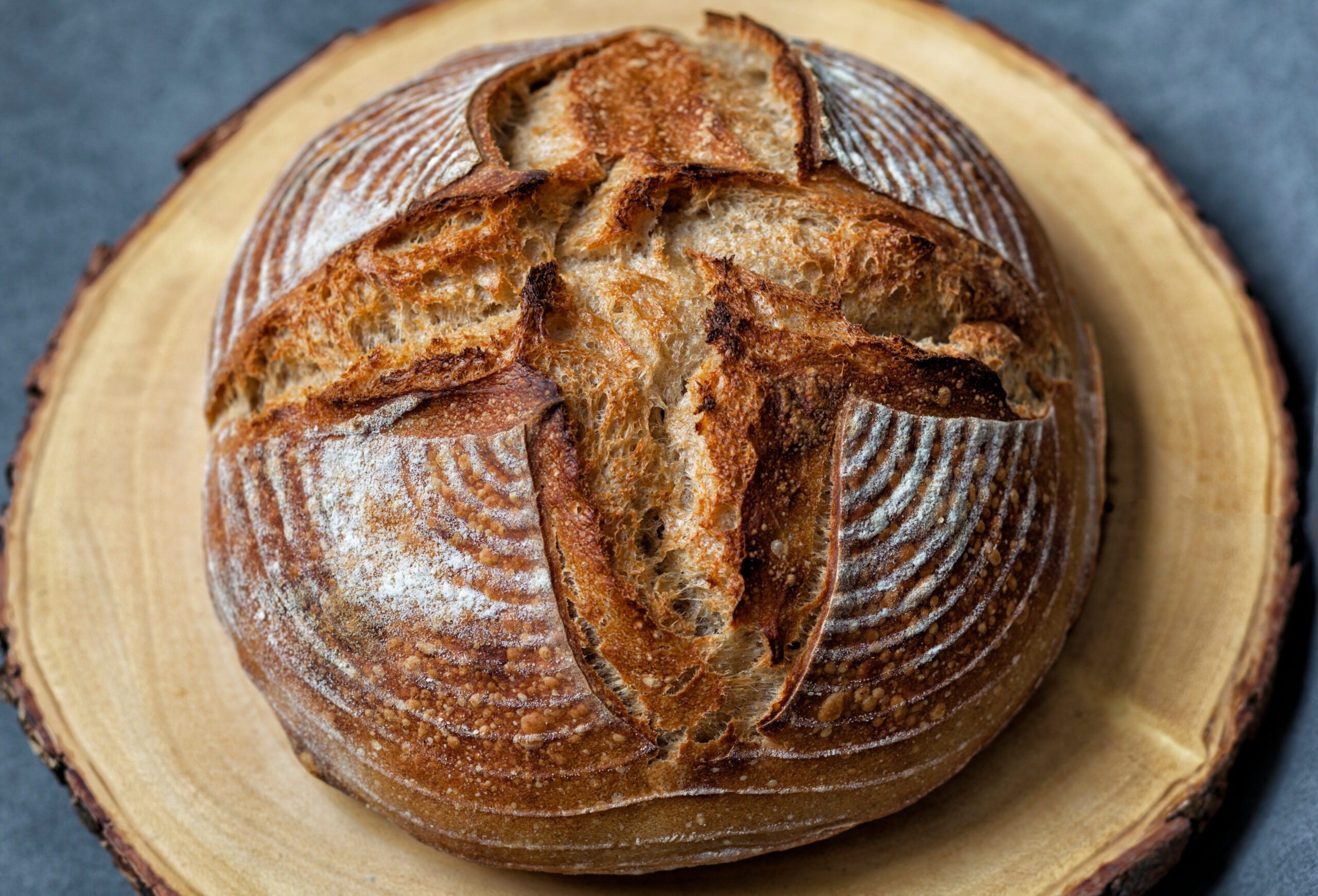
This morning I took advantage of the earlier start and started making sourdough bread, which in reality started a few days ago, when I “woke up” my starter and started prepping it for Sunday baking. That was a whole lot using the word starter, but you have to start somewhere. 😊 Baking is relaxing for me, I am not a pastry type of baker and I am certainly not a detail person, but I do like to follow a recipe at least once. 

I measure my ingredients using a scale. The baker’s formula is so simple 100% four, and then 80% water, 20% starter and 2% salt. So, in a real-world application it looks like this; 1200 grams of flour, 960 grams of water, 240 grams of starter and 24 grams of salt. As is my practice, I add the water, then the starter so it equals 1200 grams. Then I reset the scale to 0 and add the 1200 grams of flour, but this morning I turned off the scale by mistake and started adding flour. The reset and off buttons are right next to each other. I realized that it was turned off fairly quickly, but now I had no way of knowing how much flour I added. EEK! But in reality, close enough will work, so I added more flour and added more flour and then I thought, “this looks close enough.” Life can be similar to a recipe, and processes and habits are important, but when things shift or go awry, it will mostly work out. We will have fresh baked bread and the the kiddos and grand kiddos will make quick work of it.  

Healthy eating is similar to my bread baking experience, we need nutrition, and getting a Box of Good delivered is a great strategy to eating healthier. And because life is always happening, your delivery makes it easier to automate your health because good food is scheduled to arrive at your door. And much like the Baker’s formula helps a baker produce consistent loaves, your Box of Good helps you eat healthier. And for me staying as healthy and strong, as long as I can, is my goal, and it all starts with good food.  

This week we have fun, local purple carrots! I am attaching an article on Purple Carrots I found at https://www.organicfacts.net/purple-carrot.html  

Purple Carrot Nutrition 

Purple carrots have a similar nutrient profile to other types of carrots, with a few important distinctions. These carrots are a rich source of dietary fibervitamin Cpotassiummanganese, and vitamin K. There is a low level of calories – only 25 calories per cup – and only 5 grams of carbohydrates. When it comes to antioxidants, however, purple carrots have a good lutein and beta-carotene content. Purple carrots also contain more phenolic compounds, such as anthocyanins, than any other carrot variety, except for black carrots[2] 

Purple Carrot Health Benefits 

The most impressive health benefits of purple carrots include its effects on weight loss, chronic disease, cardiovascular disease, inflammatory conditions, vision, and circulation, among others. 

Weight Loss 

Purple carrots are particularly prized for their place in a weight-loss diet. This low-calorie, low-fat, and high-fiber vegetable is an excellent way to fill yourself up without compromising your dietary goals. Furthermore, digesting all of that fiber can help to speed up your metabolism, which can help with passive fat-burning if you’re trying to shed pounds. 

Cardiovascular Disease 

With high levels of dietary fiber and antioxidants that can help protect the integrity of the cardiovascular system, purple carrots are great for heart health. The fiber can help to lower overall cholesterol levels, which will lower your risk of atherosclerosis, heart attacks, and strokes, as well as cardiovascular diseases. The vitamin C in these carrots is also critical for the strength of the artery and blood vessel walls. [3] 

Reduces Inflammation 

Research has shown that anthocyanins, which are found in high concentrations in purple carrots, can help relieve many different inflammatory conditions, including arthritis, gout, headaches, and even hemorrhoids. [4] 

Improves Vision 

Although purple carrots contain less beta-carotene than orange and yellow varieties, there is also a significant amount of lutein and zeaxanthin in these carrots, all of which can help to improve vision. These antioxidants will reduce oxidative stress in the retina, preventing macular degeneration and lowering your risk of cataracts[5] 

Improves Circulation 

There is a decent amount of iron in purple carrots, which is great for boosting circulation, but the presence of vitamin C and other antioxidants will also help to prevent breakage and blockage within the circulatory system, ensuring that all your metabolic processes continue normally. [6] 

Treats Chronic Disease 

The high level of anthocyanins found in these colored carrots means that they are excellent antioxidants; these compounds are able to seek out and neutralize free radicals, which are responsible for cellular mutation and other forms of chronic disease, such as heart diseases, and rheumatoid arthritis. [7] 

How to add Purple Carrots to your diet? 

Adding purple carrots to your diet is very easy and healthy as well. Here are some simple ways to add them to your diet. 

  • Purple carrot salads: You can dice some purple carrots and add to any salad of your choice 
  • Roasted purple carrots: Slice the carrots and roast them with some olive oilsalt, and pepper 
  • Stir-fries: You can add purple carrots to while making any stir fry along with your favorite vegetables or meats 
  • Carrots and hummus: You can serve sliced purple carrots alongside hummus 
  • Soups and stews: Purple carrots can be added while preparing any soup or stew 

There are many ways to enjoy purple carrots, so start cooking and enjoy! 

Posted on

Hot, Cold & Cabbage 

This weather has felt more like spring than a start to our summer. One thing for sure is our farm team has a lot of weeding to do. 

The boxes are trending towards more and more local and definitely a lot of summer fruit are showing up from the farmers in California. We have been buying from some of these farmers for over 2 decades. They are great at what they do and have the climate and soil types to grow these crops. We are so blessed in America that we have such a diverse farming community and equally diverse regions to draw fruits and vegetables from as well. 

As the climate changes, having many geographic regions will help America to be able to feed itself as well as other countries. Our geographic diversity is so important to not only navigate the effects of climate change, but for our health because we should continue to have access to fresh fruits and vegetables year around.  

If the American population could make one change to their diets it would be to add a few more servings of fruits and vegetables.   

In an article I read recently it says:

Rockville, Maryland (June 7, 2021) — Only 5% of men and 9% of women are getting the recommended daily amount of dietary fiber, according to a study being presented at NUTRITION 2021 LIVE ONLINE. Insufficient fiber intake is associated with a higher risk of heart disease and diabetes, two of the most common diseases in the U.S. 

“These findings should remind people to choose fiber-rich foods like whole grains, fruits and vegetables to reduce their risk for heart disease,” said Derek Miketinas, PhD, RD, an assistant professor at Texas Woman’s University, the study’s lead author. “Based on our findings, fewer than 1 in 10 U.S. adults meet their daily recommendations for fiber intake. For those with diabetes, it is especially important to eat enough fiber since they are at a greater risk for heart disease.” 

The daily fiber goal for females is 21 to 25 grams per day and for males is between 30-35 grams. Your Box of Good is filled with fruits and vegetables that will help you reach the recommended daily fiber goals. As an example, the local green cabbage from Ralph’s Greenhouse this week is packed with fiber. Here is the nutritional profile for 1 cup of raw cabbage. 

  • Calories: 22. 
  • Protein: 1 gram. 
  • Fiber: 2 grams. 
  • Vitamin K: 85% of the RDI. 
  • Vitamin C: 54% of the RDI. 
  • Folate: 10% of the RDI. 
  • Manganese: 7% of the RDI. 
  • Vitamin B6: 6% of the RDI. 

Tristan 

Posted on

Mud

In the last 20 years I cannot remember a spring like this. We have had wet Aprils or Mays or even June’s. But I can’t remember a season when all three months were wet. It is what it is, some farmers are skipping whole plantings because the crop they grow like potatoes requires more time to grow than what is left of the growing season. Farming is a unique industry and when you miss the planting window, you have to wait till next year.  

If you were thinking about taking a drive through the river valley’s right now, you might want to wait to wash your car until you get back. I took one of the back roads to town and the road was caked in mud. It was like driving over several of those road “turtles”. You couldn’t miss them if you tried 🙁. But right now, it is go time and if a farmer gets a weather window to plant or cut grass for silage, they are taking it. Which means mud on equipment from the fields will be deposited on the roads. There are more than a few farmers this spring that have chained up their equipment to pull it out of the field. Ironically, mud and chains are more synonymous with the Fall harvest when the rainy season starts early in September. I am praying for a long, extended summer! 

But back to this spring, we are getting close to being fully planted on our farm. We have settled for “good enough” with our seedbeds and hope the vegetables can work it out with the weather to come. As a small farmer, we use smaller equipment, which works to our advantage during these seasons. Having a lighter footprint is kinder to the soil, but also allows us to get in sooner. We also plant our crops by hand.  

Larger Farms have to use the big “toys” to farm as much ground as they do, which means I can get into my fields sooner because of our scale. But we are also feeding thousands of people and they are feeding hundreds of thousands of people. Our communities need all types of farms growing all types of foods.  

Our country is also blessed because we have a lot of growing regions and when one region is off anohter is on. Take last year, the Barley and wheat farmers in Eastern WA had poor yields because of the hot summer, this year they are ecstatic because of the plentiful rain fall.  

Which brings to another point, we need to conserve as much farmland as possible everywhere possible to make sure we can feed ourselves as a nation and the best way to conserve farmland is to support organic farmers like you are doing with each Box of Good delivery you get. Profit is the simplest way to encourage a farmer to keep farming. We farm because of you, our network of local farms keeps farming because of you.  

We are thankful for you.  

Tristan 

Posted on

The Shift is on! 

This has certainly been one of the most challenging starts to a farm season we have encountered. We intentionally started later this year, apparently it wasn’t late enough. We are starting to see crops emerge and get established. Our initial waterlogged plantings have been weathering the onslaught of colder and wetter than expected weather with grace and are starting to respond, to at least, warmer rain! 

The only critter that is really happy is slugs! Thankfully the slugs have not been a problem for our crops, but Joelle’s flower beds have been their primary target. The slug issue is primarily a perennial plant’s nightmare. In the fields we work up large swaths of land that disrupts their habitat, but flowers and berries where they are in same place for multiple seasons tend to create nooks and crannies for them to hide. But I digress. 

From our inception, we have always been a conduit to healthy farmers for you. We consciously chose to work with our neighboring farms and not to grow everything on our farm. Being vertically integrated has its advantages but also its challenges. We run a modified vertically integrated business, with a farm and our home delivery distribution business, but we are primarily a home delivery company.  

I do scratch my itch to farm by growing lettuce, cucumbers, onions, squash, beets and a few other crops for your family. But our primary focus is on being that conduit of good food from farmers who grow organically and deliver their produce to you. 

Every week we talk with our network of local farmers and our suppliers to build our weekly menus. Our focus is always on locally produced food first and then we branch outside our regions to supplement our offerings. We will never be a 100% locally grown company. Bananas, citrus and mangos are some of our most popular produce items, so we source them from organic farmers to add them to the Box of Good. 

With that said, our product shifts as the seasons shift and for the next few months till October-ish the Box of Good will become more local and our menus will be featuring many vegetables and fruit from our network of local farmers. And yes, while this farm season is off to a painfully (wet) slow start, we are seeing more and more local produce coming onboard, which means the shift to local is on! 

During this season we become not only your source for quality organically grown foods, we become your source for a lot more locally organically grown organic produce.  

Enjoy some of the healthiest and locally grown produce, 

Tristan 

Posted on

Mange Tout or Mangetout 

I have been perusing my new cookbook One-Pot Vegetarian by Sabrina Fauda-Role. I absolutely love the simplicity of one-pot cooking. And thanks to this book I am learning a few new words to add to my repertoire. Double cream was a word that caught my interest early on. Apparently in England they have a thicker cream than “heavy” and it cooks differently as well. The reason I know this is because Sabrina the author says, “put all the ingredients in the pot, bring to a boil and then reduce to simmer.” If you were substituting “heavy” cream then you would end up curdling the cream. Best to add cream at the end.  

The word I am writing about in this newsletter is mangetout. I had no idea what this word meant. I read and reread the recipe, studied the picture and nothing looked out of the ordinary. I knew what all the ingredients were, except snow peas were not listed but were definitely an ingredient. Then taking a page out of my kids’ book, “duh, just google it.” 

With my trusty I-phone in hand, I looked up mangetout. And low and behold it was referring to young snow or sugar peas. I am still scratching my head over the name of snow peas in England. However, the French word mange tout means to “eat all”. Which would certainly apply to what you do with snow peas – eat all of it. I also find it interesting that in France they call snow peas, sugar peas, referring to their delicate sweetness. 

The French mange tout is certainly a good admonition for all of us. I am going to heartily enjoy my latest one-pot wonder and eat it all, including the snow, sugar or mangetout peas! 

Thanks for choosing Box of Good to help feed your family, 

Tristan 

Posted on

Organic, Purity, Nutrition, Soil Heath, Taste, Freshness

Each of these items are a newsletter unto themselves. What do they have in common? Each of them leads to our experience when eating, affecting much more than our taste buds. While a ripe peach or sweet carrot can provide immediate satisfaction, so much more is going on with every bite.

For the last 25 years, we have been focused on delivering food that “moves the needle” on your health and we are certainly not going to change our standards now. Your health is important to us and we aim to make sure our offerings check all of those boxes mentioned in the title.

Because we are growers and also buyers of produce and groceries, we understand freshness and taste and how important those two factors are, but we also understand what goes into growing or raising or producing food that not only tastes amazing and is ultra-fresh, but it is packed with nutrients. 

Nutrition is every bit important and drives much of our growing and purchasing decisions, as is the taste and freshness of your produce. But even going a layer deeper, the purity of our products begins to get to the core of how choosing Box of Good impacts your health. By definition, organic food is free of synthetic pesticides, herbicides and fungicides as well as genetically modified crops, and that is very important for our health.

Organic farming is a system that restores the health of soil and maintains it well into the future. The soil responds so favorably to organic farming practice that it shows up in soil health, and as the diversity of soil bacteria, fungi and earth worms begin to respond to respectful farming practices, the plants grow healthier and more nutritious.

And once this cycle is encouraged year after year and decade over decade, it shows up in nutrition and taste. And because you are a part of the Box of Good community you get all of these benefits. And quite naturally, because we are either harvesting your food or sourcing it at its peak, the freshness ties it all together.

Now I haven’t yet mentioned convenience as a benefit, but getting a weekly delivery, you are literally automating your health, and because we build our boxes around the freshest produce, you are also getting variety with each delivery. . . and eating the rainbow is always a beautiful thing.

Enjoy this week’s bounty,

Tristan, Joelle and Box of Good crew

Posted on

Mange Tout or Mangetout

I have been perusing my new cookbook One-Pot Vegetarian by Sabrina Fauda-Role. I absolutely love the simplicity of one-pot cooking. And thanks to this book I am learning a few new words to add to my repertoire. Double cream was a word that caught my interest early on. Apparently in England they have a thicker cream than “heavy” and it cooks differently as well. The reason I know this is because Sabrina the author says, “put all the ingredients in the pot, bring to a boil and then reduce to simmer.” If you were substituting “heavy” cream then you would end up curdling the cream. Best to add cream at the end. 

The word I am writing about in this newsletter is mangetout. I had no idea what this word meant. I read and reread the recipe, studied the picture and nothing looked out of the ordinary. I knew what all the ingredients were, except snow peas were not listed but were definitely an ingredient. Then taking a page out of my kids’ book, “duh, just google it.”

With my trusty I-phone in hand, I looked up mangetout. And low and behold it was referring to young snow or sugar peas. I am still scratching my head over the name of snow peas in England. However, the French word mange tout means to “eat all”. Which would certainly apply to what you do with snow peas – eat all of it. I also find it interesting that in France they call snow peas, sugar peas, referring to their delicate sweetness.

The French mange tout is certainly a good admonition for all of us. I am going to heartily enjoy my latest one-pot wonder and eat it all, including the snow, sugar or mangetout peas!

Thanks for choosing Box of Good to help feed your family,

Tristan, Joelle and Box of Good crew

Posted on

At Last

Last Saturday, while starting out on the colder side warmed up nicely and was fitting end to a full few days of uninterrupted farming. We were able to get a 800 more lettuce transplants in the ground and direct seed some peas, beets and kohlrabi. It feels like I have been standing at the starting line with all the other farms with each of us wondering if we missed the Starters gun????, but at least the race has begun now. Tomatoes will go in one of the greenhouses later this week. 

Normally by this time we would be about 50% planted and begin harvesting our first lettuces shortly – not so much this year. In a strange sort of irony, we will probably be on track for the Cucumbers, winter squash and bean plantings and will have missed out entirely on the early crops. Perhaps it will even itself out and we will have really good planting, weeding and harvesting going forward. Time will tell.

The whole valley is in rotation. Our neighbors are mowing our pastures for silage for their beef farm.  While we rarely rent other ground, it is a common practice for most of my farming neighbors to swap land for corn or grass seed or Spinach seed for Cabbage seed, etc. Crop rotation is so important to crop health. We are blessed in the PNW that we can grow so many crops and have such a diverse farming community.

As an example, Spinach seed typically requires a 10 to 15 year rotation to break the disease cycle before returning to the same ground. That means for every acre of spinach seed grown in the valley we need to have 15 acres set aside or be growing something else. And due to issues of proximity you need a few acres of separation, too. Potatoes require 4 years between crops. We have our farm sectioned in quadrants to help us facilitate crop rotations and soil health. 

I remember one conversation with an old timer, he said. “I haven’t farmed some of my own ground for 15 years.” Through a series of swaps each farmer is planting somewhere new. The bedrock of the system is diversity and dairy. The Dairy industry is the primary driver keeping so much ground in pasture for silage and hay. The vegetable and grain farmers would eagerly look forward to rotate into ground that had been rejuvenated by a long rotation of grass and manure applications.

Sadly, most of Skagit county is losing their Dairy base. Thankfully, my valley still has a strong dairy presence and even more thankfully, we have a strong Certified Organic dairy industry as well. If you ever hear me waxing on and on about the importance of preserving farmland it is because we need so much ground to farm to keep our industry healthy and do the important work of feeding people. 

It looks like the weather is moderating and the farming community is kicking it into another gear.

Tristan, Joelle and Box of Good crew

Posted on

Wildflowers

The wildflowers in the Leavenworth, Cashmere and Wenatchee area are out and beautiful, barring any late frosts, and the next few weeks should be gorgeous, as well. Joelle and I have made a habit of spending a few days around Mother’s Day hiking and hunting for the best trails to experience the Balsom Root flowers, in particular, but there are so many more that are peaking at the same time or just a little before or after.  

This trip was a little early to catch them in all their glory, while last year Mother’s Day was perfect. We did see over a dozen different wildflowers in bloom and the telltale signs of more to come. So, if hiking and flower hunting interest you, we hope you can make it over the pass in the next few weeks, the lower elevations should be producing now and the upper elevations soon.  

We’d recommend Ski Hill, Sauer’s Mountain, Nahahum Canyon, Horse Lake trails, and Sage Hills as excellent choices in the Leavenworth-Wenatchee area. Check elevation and distance and look at trail reports from the Washington Trails Association to determine what would be best for you or your family. Being on a trail surrounded by wild flowers is awe inspiring, not to mention the exercise and fresh air you get! The views, the clouds, the colors, all of it is breathtaking (quite literally). 

And last week, one of our teenagers came bounding in the front door and proclaimed, “I love lilacs! The smell on the way to the front porch is amazing!” I love their smell, too, as it conjures up rich memories. Isn’t it funny how the senses “can bring you right back to the kitchen” or in this case the smell of lilacs? My earliest memories of lilacs take me back to 1994 and our little house in Vancouver, WA. I just got my start in the produce business. I was one of those guys putting fruit and vegetables out at a small boutique produce store in NW Portland.  It is where it all began; where I met my first organic farmers and where I sold my first crop – purple lilac blossoms from that little home in Vancouver.  

We have never looked back. That first sale and those first encounters with organic farmers got me hooked. It was pretty special to have my daughter come bursting in after having her senses awakened by the subtle yet distinctive smells of a lilac almost 30 years later. 

While in Leavenworth, and really any town we visit, I also like to wander through bookstores. On this trip I picked up a vegetarian book on “one pot meals”. I was probably drawn to it because it feels like winter lately.  

I have made a few already, and they are quite simple and tasty. It has an English flavor to it. During this season, we need simple recipes, and a 30-minute, one pot nutritious meal is perfect, with leftovers to boot. 

As far as the farm season goes, our attempt to avoid a wet spring hasn’t been so successful. We have gotten enough dry weather to “mud in” a few thousand lettuce and onions transplants. The worst part about mudding in transplants is the weeding that shortly follows. With this wet weather, it has been hard to knock back the weeds and grasses, which means we will be spending a lot of time using our hoes. I guess this season will be “a long row to hoe”. (Well…more than one!) 

Thank you for choosing us to help feed your family, 

Tristan, Joelle and Box of Good crew 

Posted on

Wet and Cold Part 3

A few months ago, I was thankful to have made a conscious choice to hold off planting till much later in the spring. I was not overly happy with the wet April, but as farmers we do our best and work around the weather. 

I am not overly ecstatic that we are two weeks into May and it, the weather, has only marginally improved. Now, we are going to be “Mudding” in our transplants into less-than-ideal seedbeds. It will be fine, but I was hoping for a reprieve in the weather by now and been able avoid this unusually wet spring.

It will come together and because we are starting later, we haven’t had to replant any crops, but we will have to rework all the soil to help it dry out so we can begin the planting process again. With organic farming, more tillage and weeding are required, and because we are choosing to not use any of the “cides” (pesticides, herbicides, fungicides) everything takes longer. The soil is healthier, and the bacteria and fungi have free reign to work their magic. 

This week we are hoping to get our second planting of lettuce in and first plantings of onions. We have been busy with a bunch of farm things, mostly getting ahead of the fence line and tree rows to keep the black berries at bay. We have removed thousands of feet of barbwire fences and hundreds of t-posts and wood posts this spring to make it easier to maintain and cut for hay. While I am grateful to have had the time to get some maintenance and major projects finished, I am ready to grow vegetables.

We are plowing forward with the expectation that the weather will moderate and we will have enough good weather to get our crops in the ground. I do know that when the weather breaks it is going to be an all-out sprint to plant as much as we can. 

Thankfully, America encompasses many different climates and time zones and as a whole we are blessed to have different regions around our country growing food at different times. I find it fascinating that farms in Skagit County that have sandier soils are able to plant earlier than I am, even though we are basically neighbors. The soil type is the deciding factor. Our soil is heavier and tends to hold more moisture, theirs is sandier. Sandier is great for early spring, but less ideal for hotter weather, our soil is the exact opposite, we are slower out of the gate, but do not dry out as quickly when the weather turns hotter. We need all types of farms, soil and regions to feed people. 

Thank you,

Tristan, Joelle, and Box of Good crew  

Posted on

Wet and Cold Part 2

I am officially switching to shorts and T-shirts in hopes of warmer weather. My clothing strategy hasn’t been very successful, though! We are still waiting for a good stretch of warm weather to kick it into another gear. However, with that said, the valley farmers are getting active and doing as much as we can to get ready for planting. On our farm we will be planting lettuce this week. The soil is still relatively cold, but we can get a decent seedbed ready for transplants. I am less optimistic for planting any direct seedings and will be waiting a few more days in hopes of dryer weather. Plants are pretty resilient and seeds can germinate through the most inhospitable conditions, but I have found that less stress on the plants equals better crops, so we prepare and wait.  

For now, lettuce and onions are going in, but beets, peas, kohlrabi will have to wait for slightly warmer weather. As will green beans, cucumbers, summer and winter squash. One thing I am expecting is that when the weather does turn warmer this farm season is going to feel like a sprint and less like a marathon. We will go from plodding to planting to weeding in the blink of an eye. Stay tuned. 

(Resharing from last week) Supply chain issues are popping in ways that I have never experienced. I was talking to another grower and I was commenting on some of my germination issues with the first round of lettuce plants and, he shared that he was also having issues.  

He had been using the same potting/transplant mix for the last decade, but this year Vermiculite wasn’t available, Vermiculite lets in air and keeps the soil from compacting. This year he did everything the same, but he is having to learn how to grow transplants with the new formulation. The only reason I even know about this is because I was hunting for a few more trays to offset our own lettuce woes! 

Another friend of mine, who has farmed for decades, who I can usually count on for extra plant starts, shared with me that he hadn’t even started a single tray! He has been bitten by the labor shortage and may call it a year after the nursery season is over.  

Inflation, labor, and supply chain issues affect all of us. Our team is working hard to grow and source food for your family and balance the increasing supply challenges. For now, we are going to hold our prices steady and continue to source the highest quality produce, and soon we will be harvesting produce from our own farm! 

Thank you for supporting Box of Good. 

Tristan, Joelle and the Box of Good crew 

Posted on

Wet and Cold

When our farm team (John and I) fortuitously made a decision to wait till the first day of spring to start even a single plant, and then plan to get those plants in the ground around May 1, we had no idea just how wet April would be. Last year it was shorts and T-shirts in April. This year, people are still hitting the slopes! We made the choice to delay the start of the season partially because of how difficult it is to find farm help, but also knowing the weather risk! It’s easy to get lured into early planting when the first sun of spring comes out, but it’s not unusual for April showers to rule the day! “Mudding” in plants is not pleasant or profitable. Sadly, I’ve talked to several gardeners that planted early and had seed and plants rot or freeze, and will need to replant. 

I remember one year, before I started doing my own transplants, I pre-ordered 4 flats of lettuce trays to put in the greenhouses in April. I got a call, in early February, that my 40 flats were ready to be picked up! My friend had written the order down wrong and now I had 5,000 plants instead of 500 that needed a home and it was FEBRUARY! We definitely mudded those plants in that year. That was the ugliest seed bed I have prepped and planted. . . and then the weeds.

Somehow it worked out and we did have the earliest lettuce in the valley! I remember our future son-in- law showed up to help us harvest those plants at 5am. That was impressive! I am more than aware that May has the potential to be just as cold and I have farmed through more than one June-uary, as we like to refer to a wet and cold June.

With all that said…we are thankful that this weekend the temperatures warmed, we broke ground, got the cover crop turned in, and we are closer to planting! 

Supply chain issues are popping in ways that I have never experienced. I was talking to another grower and I was commenting on some of my germination issues with the first round of lettuce plants and, he shared that he was also having issues. 

He had been using the same potting/transplant mix for the last decade, but this year Vermiculite wasn’t available, Vermiculite lets in air and keeps the soil from compacting. This year he did everything the same, but he is having to learn how to grow transplants with the new formulation. The only reason I even know about this is because I was hunting for a few more trays to offset our own lettuce woes!

Another friend of mine, who has farmed for decades, who I can usually count on for extra plant starts, shared with me that he hadn’t even started a single tray! He has been bitten by the labor shortage and may call it a year after the nursery season is over. 

Inflation, labor, and supply chain issues affect all of us. Our team is working hard to grow and source food for your family and balance the increasing supply challenges. For now, we are going to hold our prices steady and continue to source the highest quality produce, and soon we will be harvesting produce from our own farm!

Thank you for supporting Box of Good.

Tristan, Joelle and Box of Good crew

Posted on

Off to See Family

We spent the better part of the last two days buttoning up loose ends. The usual affairs of planning, organizing, coordinating, and cleaning before our trip to NC, VA, and PA to see family and friends. This is going to be more of a whirlwind than relaxing, but it is farming season and spring break, which means that a week away is what the calendar allows. 

It has been far too long since we have seen our oldest Son, Micah, and his wife, Elise who relocated to Charlotte. I wouldn’t be surprised if they ended up in West Africa given their gradual migration east. We will spend a few days with them before Elise heads off on a medical mission trip and we head off to VA to visit friends in Richmond for two days. 

And then we will finish off the last leg visiting another son, Andrew, his wife, Abby and their new baby Kylan Rhys. Joelle was able to catch a red eye back in early February, when we got word that he was on his way, a few days earlier than expected. She missed the birth of our 8th grandchild, only by a few hours. Still amazing, considering we are 3 time zones away. 

Getting to meet Kylan for myself and introduce him to his aunts and uncles, Maleah, Stephen and Joanna is the primary driver for this trip. This is our first grandchild born and living outside of WA. Not sure how I feel about that, I would love to have their family closer, and while facetime is a good substitute, it is a distant second at best. 

Our crew finally got packed and off to bed for the 4 am start. One of our kiddos greeted me immediately when I started to roust them. Mind you this is not the norm, all of them require a few reminders to get them moving normally. Not this time, that one loves an adventure and I about fell over when she greeted me wide eyed and bushy tailed, “Good Morning!” The other two got moving after only one reminder :).

We planned our trip to leave a few days before the official spring break, but even then, the park n ride we use was already chock full. I was thinking “Oh My, we should have left earlier to get through the TSA line.” However, I was pleasantly surprised when we arrived at SeaTac and got through fairly quickly.

Maleah, was teasing me, “Dad’, are you one of those dads who gets our family to the airport 6 hours early.” I retorted, “No, I am one of those dads who prays for no traffic and gives myself an extra hour 😉”. We had an hour to spare. 

Joelle is the organized one in our family; she can think of things I didn’t know were things to think about. Her thoroughness always pays off.

Well with the farm and Box of Good in good hands, we are going to relax, visit and love on the newest Klesick.

Signing off on this edition of the newsletter somewhere over Utah!

Tristan, Joelle and the Box of Good crew

Posted on

Off to the Races

Well, sort of off to the races. We have started the first 1000 lettuce and onion transplants. We will be planting transplant trays of lettuce every 10 days for the next two months. Round two is in the queue! We have a mountain of compost that needs to be spread and we will need to start mowing the cover crops to feed the soil, and eventually the plants, and eventually our customers!

We will be holding off any field work until the ground dries a bit more. Okay, quite a bit more! When I walk out in the fields it is more like a slog; squish, squish, squish. I am fine with it for now. Last year it heated up in April and sucked all the moisture out of the soil, which was great for April, but when August rolled around, that April heat wave didn’t leave much moisture. And I really don’t have any control of the weather anyway. But we are ready when the timing is right!

Managing moisture is one reason why cover cropping is so important. A cover crop is a crop of wheat, or rye, or vetch or weeds, that is planted in the late fall, to protect the soil from rain (compaction), to store nutrients and to feed the soil bacteria and mycorrhizal fungal populations that break down the nutrients that the plants need to grow. 

Currently, the cover crops, like most of your lawns, are loving this wetter spring. While it can be challenging to find a dry time to mow our yard, I want the cover crops to grow as much as possible.  And then when the timing is right, we will mow them down, spread the compost, and begin to till the fields. It will be a feast for all those bacteria and fungi I mentioned earlier. 

Healthy soils are the key to healthy people. 

International troubles are being felt on local farms

The Ukrainian-Russia war is highlighting how interdependent the world has become. With Russia’s vast oil and natural gas supplies and the Ukraine’s farmland, we are seeing the ripple effect everywhere. I just ordered the first round of diesel for the farm season and a pallet of organic fertilizer –Ouch! (I would gladly pay more if it would end the conflict). For us the costs are felt, for sure, but I can only imagine the farmers who farm thousands of acres. And then you have to factor in the types of farms, wheat, corn, and soybean farmers will see higher input costs, but will also see greater demand from the shortage, especially if the conflict doesn’t resolve before planting season in the Ukraine. 

And if the war is resolved, then all of us farmers will have paid a premium for our fuel and fertilizers with prices decreasing. The other challenge is that while U.S. grain farmers will likely benefit from the shortage caused by the war, dairies, poultry, hog, and beef type farms will be adversely impacted due to the increasing cost of fuel and feed. But then next year, the grain farmers will have to save their seed or buy more to plant their crops and the cost of the seed will then be higher for them because of the farm costs from this year, but hopefully fuel and fertilizer costs will stabilize.

I could write and write about this. Nothing is simple any longer. For now, we are praying for peace and planning to grow food. 

Tristan, Joelle and the Box of Good crew

Posted on

Time to Start

I have been sitting on my hands. For the first time in as long as I can remember we haven’t fired up a tractor this late into the season. I am not anticipating starting for another 2-3 weeks. And while we are a few weeks away from working the soil, we will start to seed our transplant trays with lettuces and onions with the hope having them ready to go out by the end of April. Of course, it is all weather dependent and I have been at this long enough to the 2022 farm plan loosely.

I have seen April’s as wet as the wettest of wet months and I have seen it as dry as August. But as the calendar moves forward, I am confident that the combination of warming weather and rain will work itself out and we will find a window or two to get those first crops planted. We are about to get busy and then it will all cascade from there.

Since we are talking about farming, this season tends to be a bit rough on the salad farmers in AZ and CA. You can set your clock by it. The salad bowl of America begins to transition, the lettuces in particular are the most challenged. Every week we work hard to find the best quality produce from our organic network of farmers and suppliers. Lettuce and spinach farmers are more impacted by the rising heat of the desert and the still colder fields of CA. This year has been no exception. We have been featuring a lot of red butter lettuce, mostly because it is the best quality right now. 

As a rule, we rotate through the vegetables and types of lettuce, but during this transitioning season, we never deviate from our high-quality standards. We may even skip a week or two if we are not happy with the quality of a produce item. 

Our high standards are not unreasonable, but they are high. For me, having run my own produce store, before I became a farmer, is just a part of me. I judge quality by sight, touch or smell. There are a handful of organic farmers that always deliver the highest quality and there are others that we won’t touch with a ten-foot pole.  

Last week, I was walking the floor and picked up a lemon, its feel, its intense smell delivered this farmer/foodie a wow moment. And last weekend we made a lemon cake with lemon filling and lemon glaze. It also happened to be an Australian themed project for our daughter’s homeschool co-op. Sunshine was on the menu! 

Earning your trust, every time we make a delivery is important to us.

Tristan, Joelle and The Box of Good Crew

Posted on

Train Your Taste Buds

You can train your body to crave healthy food. First, get in touch with how healthy food makes you feel.  Nutrient dense food gives more energy, helps with mood, aides in gut health, makes you less sluggish, improves quality of sleep, and helps with weight management! 

Eating healthy also helps prevent, delay, and manage heart disease, type 2 diabetes, and other chronic diseases. The more conscious you become of how healthy eating literally fuels your body and brain, the more you will want it.

Don’t burn yourself out, you don’t need to switch your eating habits 180 degrees overnight. Start to incorporate new healthy habits to eventually create an overall healthy lifestyle. I am a big proponent of stating goals in the affirmative. I never thrived in a “buck up, buttercup” regime.

Save your will power for when you really need it. Take a few minutes and write down a list of things you know will be better for your health. Drink more water or eat an apple or veggie snack every day rather than a processed treat. Make meals with veggies or salad each day. Eat clean and lean meats, and whole grains. Eat meals between noon and 6pm to give your body a break, intermittent fast.

The list can be as long or short. I would encourage you to keep it short and specific, something that you can easily check off in your head. The Standard American Diet (SAD) is overly processed and filled with sweet, salty and sugary foods, and it can be so hard for your taste buds to get past all those, dare I say addictive, flavors. Which is why I am encouraging you to add in, on purpose, foods in their preprocessed form. It can be hard to retrain our taste buds, but it’s possible!

If you are feeling the need for change, start small, be kind to yourself and don’t give up. Adding healthy food is always a win and if you find yourself eating the old way, take a deep breath and assess why, and then start again.

Your health is so important.

We’re all in different places and our lists will look different. What’s on my list? 1. Drink a fruit/veggie smoothie 5x/week, 2. Drink herbal tea 5x/week, 3. Eat between noon and 6pm most days, 4. Create meals that are made up of 75% fruit, vegetables and salads.

Thank you,

Tristan, Joelle and The Box of Good Crew

Posted on

A Look Back

When we moved to our current farm, it was about as close to heaven on earth, as one could get. It had a great building where we could pack all of our produce, and use it as a home base. The initial 23 acres that came with our farm were idyllic. The kids had so much room to roam. You might be wondering why I haven’t mentioned the farmhouse. 

Funny story about that, the land and out buildings were the jewels of the 130-year-old homestead. We had been hunting for a farm to buy for 5 years. Land is so critical for a farm. It literally will define what type of farm you are going to be. Dairies and crop farmers staked out claims in the river valleys and beef, chicken, lamb and Christmas tree farmers made the hillsides their homes. We looked long and hard from Okanagan to Goldendale to Montesano, even as far south as Scio in Oregon. 

It was exhausting, everything just out of our reach or didn’t have the right soil type. We finally just paused and prayed this simple prayer, “Lord, if you want us to farm in Snohomish County, you are going to have to provide a way.” It wasn’t more than a week later that a friend of ours was out planting trees on the river banks and had parked across the street in the driveway of what is today our farm. 

I had let all of my farming friends know that we were looking. It just so happened that this particular farm was a rental and the renters had moved out unannounced.. Our friend just happened to be taking a break when the owners, took a break from working and wandered out and struck up a conversation.

She asked, “Do you know anyone looking to buy a farm?” That encounter changed our lives. It had a great building, incredible land, and it was in a part of the flood plain that didn’t have any dikes. Joelle grew up in the Snohomish River valley and she remembered the horrific floods of the 70’s, 80’s and 90’s and how devastating it was for those families with flood waters flowing through the rafters. We knew we didn’t want to be buying or moving to a farm that was situated behind dikes you can’t see over. 

This farm checked all the boxes, occasional minor flooding, a great barn to work in, and rich soils. The old farmhouse, to quote my mom when we showed her what we had just agreed to buy said, “Are you going to tear it down and put a mobile home on it?” It was in pretty bad shape. To quote another friend of ours, “Fools rush in, where pro’s never tread!” We didn’t know enough to make an informed decision or we didn’t care. WE HAD FINALLY FOUND OUR FARM!

My mom and our dear friend were both right, it was a fixer, but the house had good bones, and we had considerable energy back then (today not so much). 

We no longer use the out buildings for packing, and have since moved that part of our operation to downtown Stanwood. And now the farm is where we grow food for you. It is also where we live. It’s become a place where the third generation runs and plays, recreating many of the same memories that their parents had.

As we draw closer to our 22nd year of growing vegetables, that one prayer back in 2003, changed everything.

-Tristan, Joelle and the Box of Good crew