Posted on Leave a comment

The FIFA World Cup of Food

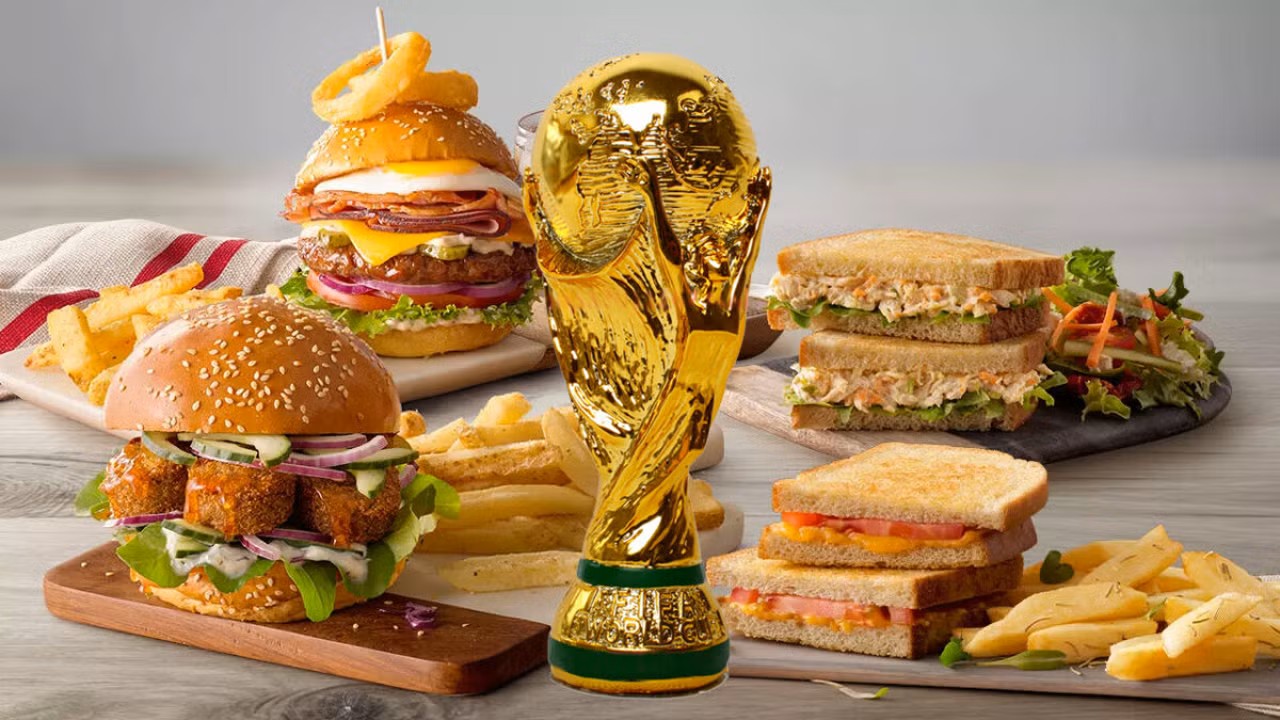
It’s hard to ignore the pressure building around the Puget Sound region as we anticipate the start of the FIFA World Cup in June. Seattle is hosting 6 games across 3 weeks, and the city has pulled out all the stops. You know it’s a big deal when Seattle is forcing pauses on all construction projects and roadworks during the next month, requiring roads and sidewalks to be cleaned up. I have a handful of friends who have traveled all over the world to attend the World Cup, and now it’s right in our backyard. 

I have been playing soccer for over 30 years, and coaching off and on for 15 years, while hosting weekly adult drop-in soccer, playing in leagues up and down the I-5 corridor, playing under a street lamp in a parking lot, or playing on a slanted dirt field in Mexico with a ravine running down the middle. I walked down the aisle of my high school graduation with my soccer ball, wrote a love poem for my English class about my soccer ball, and brought a soccer ball to every class my senior year. Needless to say, I was very excited when it was announced that Seattle would host World Cup matches.

This particular World Cup, however, has made it plainly obvious that FIFA, the organization behind it, is less interested in providing a valuable game of soccer and a good matchday experience for fans and supporters, and far more interested in offering an “exclusive” product and fleecing as many people along the way as possible. FIFA doesn’t provide the best soccer; they provide the best marketed and most expensive soccer. They are firm believers in “more” quantity, not more quality.  And sometimes we confuse “best marketed” and “most expensive” as “best quality”. Oh, but how wrong we are! FIFA has become a conveyor belt: low-quality soccer wrapped in world-class marketing and sold back to fans increasingly priced out of the experience. Right now, the cheapest ticket for a 90-minute match between United States vs. Australia is $1,200, before parking, food, taxes and fees are added. Good luck taking your family to a game! Once the FIFA conveyor belt is in place, its purpose is simple: grow endlessly. More tournaments, more teams, more host countries, higher ticket prices, larger licensing deals, bigger sponsors. Fans and supporters increasingly feel less like participants and more like fuel for the machine.

Unfortunately, the US didn’t win the bid to host the World Cup because we were the best fit; we were the only other bid. Countries are catching on that hosting the World Cup is not as great an investment as it was originally marketed. The host country takes on all the risks, and FIFA contractually takes home all the rewards. It’s less about soccer, supporters, or kids and families seeing their home-grown players, and more about keeping the existing Machine running. Where else have we seen this pattern of institutions becoming so large that they no longer serve their original purpose? Tech? Healthcare? Finance? Agriculture?

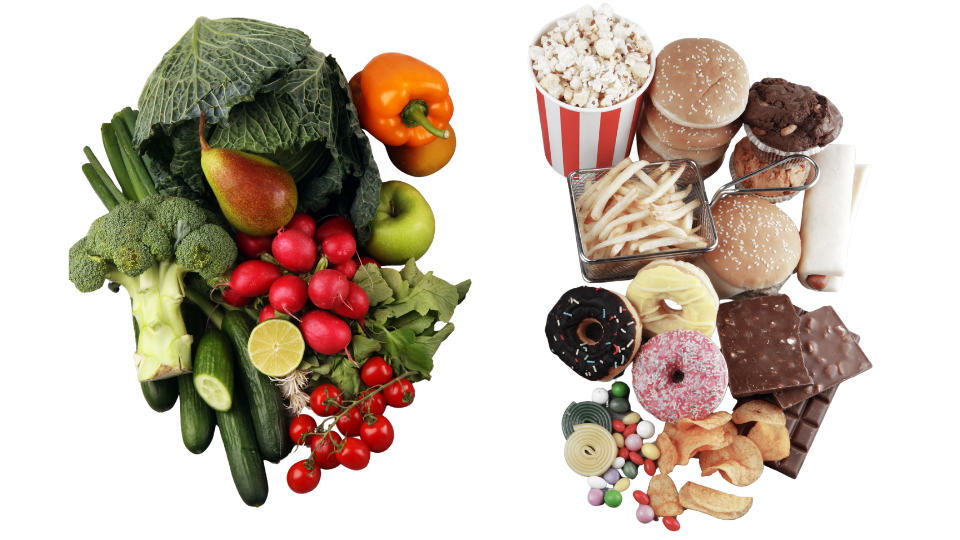
How similar our current food system works, with many “FIFA’s” funneling and shoveling “food substances” down a complex system of distribution. Modern food is barely “grown” anymore, having been replaced with food that is “made”. There are literal and national distribution conveyor belts designed to feed more products that appear to be food, to a population that’s forgetting that food was supposed to nourish you. The food giants ask, “What else can we easily shove down this conveyor belt?”, rather than, “What would be good for the person at the end of this conveyor belt?” The FIFA World Cup of Food looks like Nestle, Unilever, Sysco, Kraft Heinz, General Mills, Tyson, JBS, Kroger, Coca-Cola, or Danone, and that conveyor belt is not stopping until you decide to get off. They are winning at a game designed to make you lose. The house always wins. The only way to win is to stop playing the game.

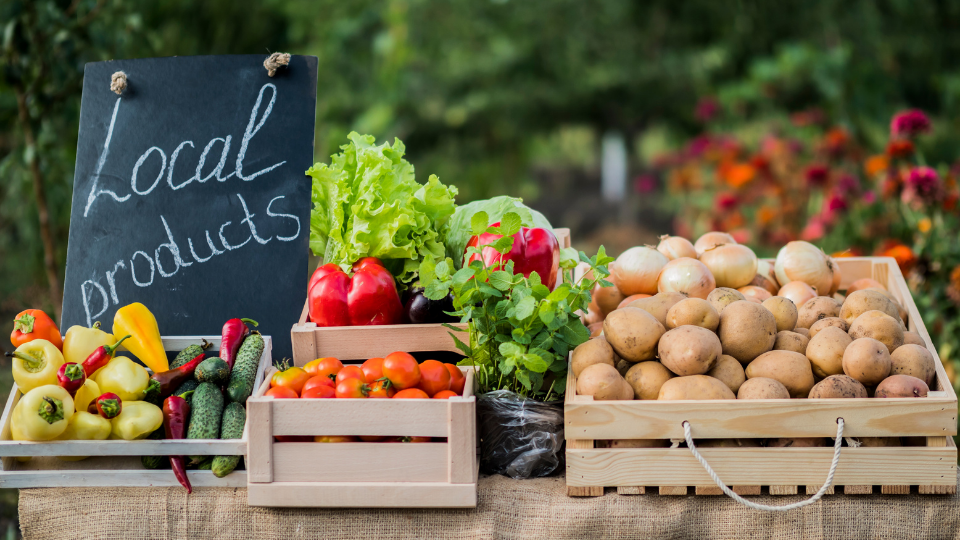
One of the best games of soccer that Emily and I got to attend was a non-league match between two local no-name teams on the outskirts of Manchester. We just walked up to the entrance gate and paid cash, barely any, for seats right up against the field. We could nearly touch the players warming up on the sideline and hear the mud squish under their cleats. We were surrounded by tons of families, little kids fetching stray balls during warm-ups, and entire youth soccer teams coming as a group after their own game. We didn’t pay for parking, the bus was $3.00, and there was no traffic. There were no TV crews or commercial breaks, and we didn’t have to go through security or pay for a clear plastic bag for our belongings. We didn’t have to download an app, or sign up for an account, or agree to let them siphon all the personal data from our phones in order to email us “other events you might like in the area”. That soccer game was designed for us and our enjoyment.  Real food feels the same way that little soccer match did: local, imperfect, accessible, human, and built for the people participating in it. The good news is that getting off the conveyor belt is entirely in your control and usually starts small: buying from someone you know, cooking one real meal, supporting local growers, or gathering around a table instead of a brand or a drive-thru. 

~ Tobin Fekkes

Posted on

Artificial Ingestion: Your Food and AI

It seems we can hardly go a day without hearing about some newfangled way that Artificial Intelligence is going to take all our jobs, then give us lives of all play and no work, then ultimately end humanity as we know it. Whether we like it or not, we now have new terms to keep track of like AI, GPT, LLM, Copilot, Gemini, Grok, and Claude.

When people talk about AI, what they’re really talking about are Large Language Models, or LLMs. Literally, large models of language. These models consist of a massive corpus of text (think all of Wikipedia), which are then distilled into “tokens” made up of each little variation of letters and symbols. Then count, sort, and categorize those tokens, and you’ve got yourself a Large Language Model.

How did we get here?

In 2018, a little-known company called OpenAI released a Large Language Model called GPT1 to little fanfare, then followed that with GPT2 in 2019. These first two models were largely focused on text prediction, or as Google says, “they excel at generating coherent, human-like text from prompts”. Pay attention to that wording: generating; coherent; human-like. The world really took notice during Christmas break of 2022 when OpenAI graced us with GPT3. It was no longer just some math whizzes and programmers building a text-prediction and translation tool. LLMs would soon be shoved into every nook and cranny of every piece of software you’ve ever used, whether you asked for it or not.

How does it work?

Imagine taking a batch of Wikipedia articles on the history of the United States, and cataloging how often each word appears,  how likely each word is to appear next to other words, and in which order. Next, use those probabilities as weights to predict the next word in a given sentence. Now, do that over and over and eventually you can generate a new wiki, but for, say, the history of Canada instead. What you will end up with is a document that reads like a plausible and grammatically accurate article, but with gaping holes in accuracy. However, these gaping holes will only be recognizable to those who know their Canadian history. To the untrained eye, the article will initially feel like it has substance, texture, story, meaning; as if you’re learning so much about Canada without trying very hard! How convenient! Upon closer inspection, you may be disappointed to find out that many of the facts, dates, and stats in the History of Canada are not, in fact, real. ChatGPT even states this right up front: “ChatGPT can make mistakes.” It’s a black box that gives you what it thinks you want, rather than what you need. It breaks down our language into its base parts, and then reconstructs a plausible facsimile, the mere appearance, of the real thing.

How about another example?

Let’s say you gave the entire Shakespeare catalog to an LLM, then said, “generate another play”. It’s true that our new generated play would have similar words and structure of Shakespeare, the plausible flow of a classic play, the recognizable roller coaster of emotions, and character development to boot. However, it would also lack intentionality. It would have all the literary aspects of a masterpiece, except the integrity, the substance, or the taste. It would appear delicious to the eyes and ears but would be bland to the heart and soul. A document with big words, but lacking nourishment. Masquerading as something that it’s not.  Sounds a lot like our food labels.

Why do I tell you all this?

We’ve lived this world already, but with our food system. We already know how this play ends. Our food system is designed to break down our food into its base nutrients, and then design, stack, and build back up the perfect ratio of what will look good, taste sweet, last long, transport safely, and store easily. After all that is complete, it also needs the appearance of “food”. Just look at a label for coffee creamers, protein drinks, nut butters, salad dressings, or any snacks. This system, taken to its extreme, looks like food that has very little in common with what our body needs; Instead, it is food that is very expensive, food that we have no say in, and food we don’t know or even recognize. Eventually, we will be unable to recognize the difference between what is “real” food and what is “generated” food. Worse still, we may be unwilling to care.

But our story is not done being written, and we still have a choice. We can choose not to attend that play, and instead write our own play, with more taste. Eating local food is the best way to know your food and your makers and growers, and ensure the food is actually real.           

~ Tobin Fekkes

Posted on Leave a comment

Meet Your Local Grower

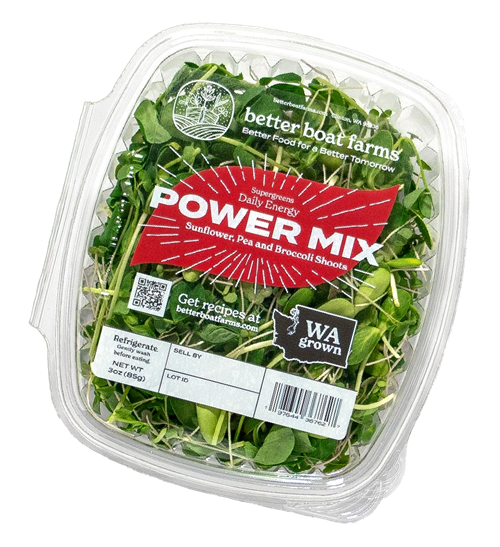
Support a local business and add a boost of flavor to your next Box of Good delivery with the tiny but mighty plant shoots from Better Boat Farms, available now!

Open your next box and find these vibrant greens, harvested from Whidbey Island’s shores. 

New to shoots? Select your first box with Better Boat Farms greens

A Grower’s Story on Whidbey Island

Every misty morning on Whidbey Island, the ocean breeze stirs the air.  Demien is our local farmer at Better Boat Farms that tends vertical rows of young plant shoots bursting with life. It’s here among the walls of fresh greens that your next meal is nurtured from organic, non-GMO seeds. Grown delicately, sown with care, clipped at perfection, and packed sustainably.

At Box of Good, we partner with local producers like Better Boat Farms to bring stories like this to your doorstep all over the Puget Sound . It isn’t just farming; it’s a quiet revolution in freshness, and we strive to connect you directly to the hands that grow your food.  

It’s the story of good food doing good—nutritious, sustainable, and shared.

Not Your Average Greens

Young plant shoots aren’t your average greens. They are highly nutritious, harvested at the start of maturity allowing for a higher amount of vitamins and minerals compared to older greens.  Delivering peak nutrition in every crisp bite. Here’s what makes the Better Boat Farms Plant shoots unforgettable:

  • A daily staple for health, adding tender flavor and nutrients to your every day meals.
  • Grown with sustainable practices and lush, organic compost .
  • Bright, slightly sweet notes that elevate any dish.
  • Boost salads, bowls, sandwiches effortlessly. 
  • 24–48 hours from harvest to your Box.
  • Locally grown on Whidbey Island!

Pair shoots with other Box of Good locals: raw honey, rolled oatscustomize here.

Healthy Food Everyday 

Delivered fresh, your young plant shoots will stay vibrant all week and are preservative free. Allowing you to turn ordinary meals into health inspired dishes.​

  • Salads that have peppery zing.
  • Sandwiches layered with garden crunch.
  • Grain bowls topped with color.
  • Eggs or soups finished with flair.

One box fuels a busy family’s plant-powered week. Ready to bring this story home? Customize your first Box of Good—your farmer’s waiting.

Roots That Reach Us All

There is a quiet satisfaction in knowing where your food comes from. Knowing the hands that harvested it and how your weekly box of good choices sends ripples among the community.

As you choose to support local farmers such as Better Boat Farms, you are helping sustain more than just crops. You are helping sustain courage— the courage it takes to run a small farm, to nurture something from seed, to invest in a place and its people. Your support allows our local ecosystem to flourish and for the community to show up for each other.

And that’s something truly worth tending.

Related Box of Good Reads

Posted on Leave a comment

What Your Produce Dollar Really Supports

Why choose local when it comes to the increasing options for produce delivery? 

The marketing has been loud from some national mega companies, encouraging consumers to purchase produce that is ugly or imperfect in order to address our country’s food waste epidemic. However, the source of our country’s food waste stems from our broken food system and overproduction. We already have a system set up to use blemished products. It goes to our food banks and is used for frozen goods, canned goods, pet foods, and every type of processed food you can imagine. Unfortunately, the feel-good messaging from the venture capital-backed ugly produce movement will leave in its wake many local farms and small businesses. 

We’d like to encourage you to consider the long-term cost benefit of choosing to support local farms/businesses, the environmental impact, and benevolent impact it has in our own communities. Consider the Box of Good. 

Because of our passion to keep local farmland viable, the platform we’ve been given in our business, community involvement, and countless volunteer hours, over the years we have been able to play a pivotal role in impacting future generations, through farmland preservation initiatives, right in our own Stillaguamish and Snohomish Valleys. (Ask us about this if you’d like to know more!) 

The number of for-profit family farms is shrinking at an alarming rate! We need local farms. In the PNW consumer production farming in the winter is nearly impossible, however, the home delivery business model makes it possible for us to farm in the spring, summer, and fall and then source in the winter. This model keeps local farmland in production, which helps maintain future food security. 

In addition to farming in this community, we are honored to partner with our customers to help meet the needs of those experiencing financial hardship. Before we started donating to our local food bank, 23 years ago, they told us that they only had canned goods for their customers, and a few, barely edible, produce items. Our imperfect produce goes to the food bank twice a week, and we also have customers who donate delivery boxes. We do give some trimmings to local animal farmers and we also compost in order to provide additional soil nutrients for next year’s crops! NOTHING goes to waste! And, last year alone, we were able to donate over $32,000 worth of high-quality organic produce to 12 local food banks, with the help of our customers! 

Included in the Box of Good is our weekly newsletter including information about our own farm, farming and land use issues, PNW agriculture, understanding our government food policies, nutrition, the how and why of healthy eating, inspiration for healthy living, recipes and tips for preparing your produce.  We love sharing our passion for farming and health! 

Our produce is always certified organic because that’s what we believe in!  When ordering from Klesick’s you can be assured that your produce will be fresh, carefully selected, and handled with care, both in our packing facility and in our own delivery vans, while on route to your home. Orders can be simply placed online, or our helpful office staff is available to work with you to create the perfect box for your family.  We are always happy to address any concerns or answer any questions! 

At Box of Good we offer high quality/nutrient dense home-delivered organic produce at competitive pricing!  We are a local farm and a local business with a heart for the people and the community we live in. We are honored when you choose us to supply you with not just a box of produce, but with a Box of Good! 

Posted on Leave a comment

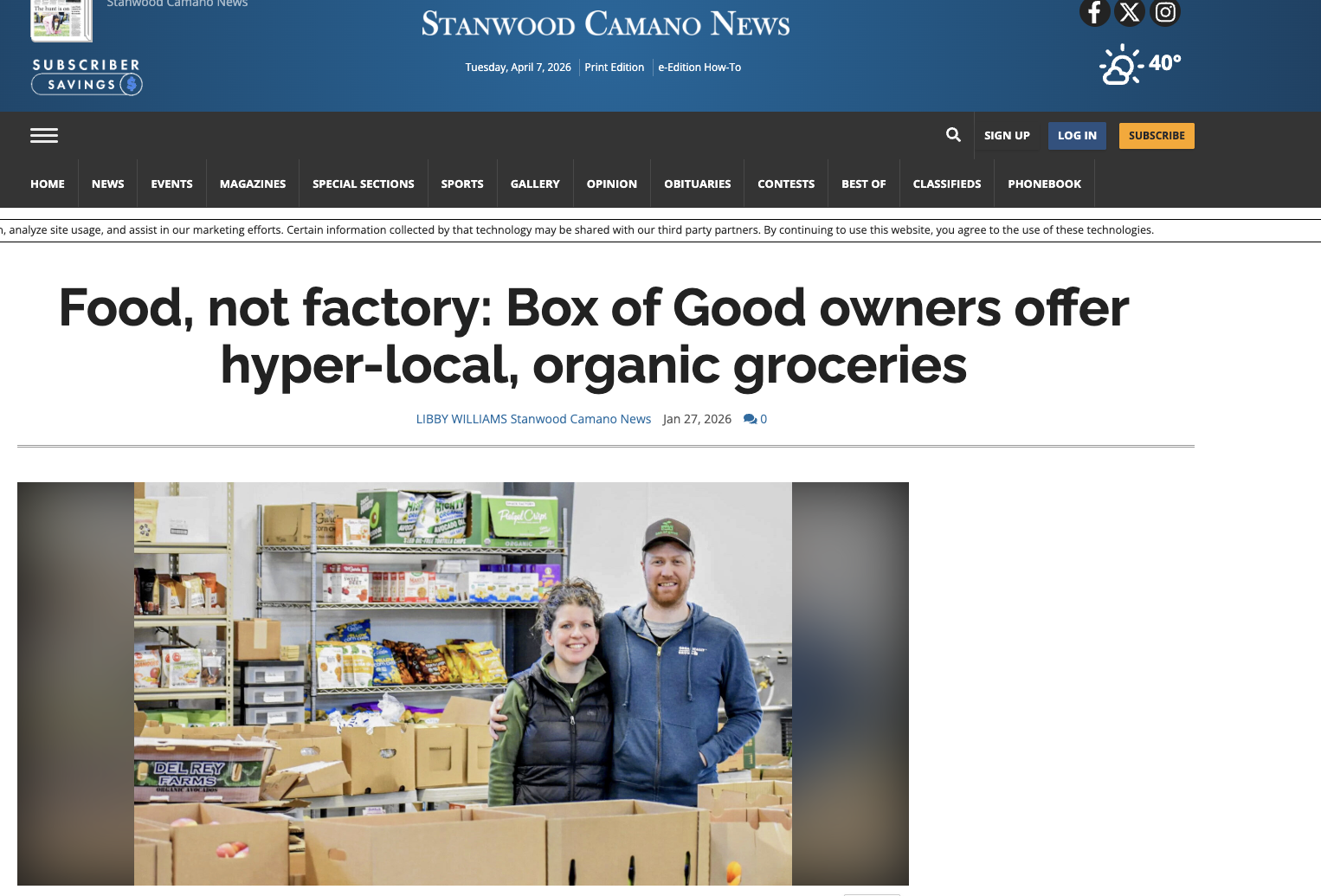
Food, not factory: Box of Good owners offer hyper-local, organic groceries

Tobin Fekkes is in no short supply of “soap box” moments when it comes to talking about locally sourced food and supporting farmers.

Fekkes said he doesn’t remember when the passion began, but it’s driven him to become the owner of Box of Good Foods along with his wife, Emily Fekkes.

Box of Good is a local, organic food and grocery delivery service based in Stanwood.

Tobin Fekkes got involved back in 2016, when the company was called Klesick Farms.

This past week, the couple finalized the process to become the sole owners of the business.

They said their goal is to combat a problem they’re seeing: food at the grocery stores isn’t really food anymore.

“The food that gets into the grocery store is designed for the transportation and not for your body,” Tobin Fekkes said. “And, to get food to last as long as it needs to in a freezer or a truck or on a pallet or on a warehouse shelf, you have to turn food into factory food.”

He gave the example of tomatoes that are picked green and “ripen” throughout the transportation process, so people may eat a red tomato, but it tastes green.

The couple’s solution is simple: simplify the process.

“(We’re) sourcing hyper-local stuff … and you can cut your distribution from weeks or months or years, in some cases, down to days or hours,” Tobin Fekkes said.

“We pick up carrots from Mount Vernon on a Wednesday, they were picked Wednesday morning, go in a box on Thursday, and they’re at your house on Friday morning.”

Boxes are customizable depending on a customer’s need, down to the ripeness of the bananas, so the Fekkeses can time them out for the week.

A small team of delivery drivers brings the food to homes within an hour’s radius of Stanwood.

Tobin Fekkes said a sign of quality in Box of Good’s products is their ability to go bad.

“If your stuff doesn’t go moldy, then it’s not really that organic. Organic mold is actually a good sign because your food is real food,” he said.

He said the company differs from community-supported agriculture, or CSA, because, unlike a CSA that can only provide produce during the growing season, they’re able to source produce year-round.

Emily Fekkes said this is due in part to how many new farmers and providers the company has gained throughout the years.

“It’s grown a lot, we have bread, and we have raw milk from Camano Island Creamery, and we have eggs and cheese from Samish Bay and fresh pasta from Whidbey Island,” she said.

“The idea is that it can be your whole grocery, and it’s organic and local.”

During the growing season, Box of Good works with about 40 to 50 providers, which decreases to about 25 in the winter months.

The Fekkeses said they believe in supporting local farmers, something they don’t feel happens enough through big box grocery stores.

“If we want to keep being able to have fresh food available, we have to be directly investing in it,” Emily Fekkes said.

Besides direct payment, Box of Good also provides opportunities for suppliers to reduce their environmental impact.

“Our barbecue guy, he does TV dinners, tallow, barbecue sauce, and he had everything in plastic containers with a film lid … and his barbecue sauce, the first ingredient was high fructose corn syrup,” Tobin Fekkes said.

He said he worked with the owner of Pure Smoke NW BBQ to switch to non-plastic containers, which cost less, and change the ingredients to healthier options.

The couple has also worked with dairy farmers to use glass containers that customers return to be refilled.

Tobin Fekkes said they make these efforts because it shouldn’t be on the consumer to fix the environmental shortcomings of companies.

“It’s always the consumer’s job to fix the problem of more, or it’s your job to pick a paper bag instead of a plastic bag, or it’s your job to pay eight cents for a plastic bag,” he said.

“What if we fix that problem?”

To learn more or shop, visit boxofgood.com.

Libby Williams can be reached at [email protected] or 360-732-1727

Posted on

Dying of Convenience

box of good dying of convenience

I have a favorite sweater that is head and shoulders better than any other sweater, and so much so, that I point out to Emily anytime I see another version of my sweater on a stranger out in the wild. It’s a little game I play. It’s similar to when someone in my family starts driving a new vehicle, and suddenly I start recognizing all the other people in our town that also (apparently) just started driving the same vehicle! Of course, people have been driving that vehicle for ages, long before I paid attention to their choice of transportation. But once you see it, you can’t unsee it.

There’s another area I play this game, although much more niche than sweaters or vehicles. I’m sure we’re all familiar with the popular saying, which states that the three most important things in real estate are “Location, location, location”. However, I’ve noticed a disturbing trend where this does not hold up. As I started to catalog more and more instances, a curious truth revealed itself. Just like I catalog and point out sweaters to Emily, now I catalog and point out locations that are in seemingly prime locations, but are instead either dead, or a revolving door of attempts to not be dead. Do you ever see an empty lot, or an abandoned building, or a space boarded-up, yet it’s right on a busy intersection? Or it is just next to the offramp of a highway? Despite having all the signage, all the visibility, all the access, it still cannot catch a breath of air for more than a few months before shuttering. Then a new tenant comes along, perhaps after being told by the property broker that “location is everything”, yet  a year later, it’s gone. Why is that? There are many locations off the top of my head that fall into this category, on Camano Island, Bellingham, Smokey Point, Seatac, Everett, Burlington, Stanwood, Lynnwood, etc, etc, etc. The actual city is not important, since it is not isolated to any specific legislation, ordinances, tax codes, or county laws. It’s much deeper, and more fundamental than that.

In addition to trees and mangoes, one of the things I love most in life is Bell Curves. And these abandoned storefronts and restaurants in primo locations follow a bell curve also: the bell curve of convenience. They were choked by the excess convenience. On the left side of the bell curve of convenience, it is very difficult to start a store, restaurant, or business in the backwoods, way off the beaten path. As you approach the middle of the bell curve, it is very valuable to be in a visible, convenient, accessible location where your mere presence does the talking. However, “more” is not always “better”, and increasing in convenience starts to have diminishing returns as you roll down the backside of the bell curve. A one-lane intersection with a roundabout or a four-way  stop is very accessible because there are natural breaks in traffic. When an intersection becomes so crowded that it needs a turn lane in the middle, or two lanes both ways, or a median down the center, things go downhill quickly. Now the road has become so popular, so convenient, that it has become very difficult, even dangerous, to get in and out. Perhaps you can only get in one direction and go out in only one direction? Perhaps you can only enter one way but exit through another place? Perhaps, like the grocery store near me, there’s a high chance of dying anytime you go near any of the entrances! When a location becomes too convenient, it cuts off the air supply of the nutrients it needs to survive, and it either becomes increasingly expensive to maintain, or it simply starts to wither away. The oxygen it needs, namely people, are unable to access it any longer. Pay attention to the overly convenient real estate near you. Maybe you’ll notice some that die from excess convenience.

How similar our food supply has become as we have sacrificed the essential nutrients our bodies need in exchange for convenience stores, fast food, easy bakes, quick mixes, and instant pots. Fresh, local, organic, and un-processed food is the “slow food” we need to keep the supply of nutrients our bodies need to be healthy, active, and long-lasting.

Tobin

Posted on

Would You Order Red Dye #5?

What if when we shopped for food or went to a restaurant, we ordered exactly the items that we ate. I mean exactly. You would be asking for things like red dye 5, or thiamin mononitrate. Can you imagine saying those words out loud and not only saying them, asking for someone to bring it to you to eat?  I don’t know about you, but I don’t have a clue what is really in those products.

Why is it that as a society, we care about what we read or watch and are careful to regulate what our kids ingest visually and auditorily, we are careful about the rating of movies and shows they watch, or the words that our friends say around them, guarding their ears and eyes. But seemingly we don’t put as much thought and care about what goes in and literally becomes part of their bodies or our bodies, what we absorb as part of our cells, the literal make-up of who we are?

You ARE what you eat, but if you don’t know what you’re eating, how do you know what you are? How it’s functioning (or not functioning)? You should be the expert with your own body, but you’re letting other people control who you become, on a cellular, fully integrated level. In the book, The Kitchen Counter Cooking School, when addressing the additives in various cooking projects, the author says, “If it doesn’t exist in nature, how does my body know what to do with it?” And that’s a valid question. If we started feeding our pets a bunch of synthetic, man-made products and they started acting lethargic or irritable, or off, we would do everything we could to figure out what was wrong with them. People would find out what they were being fed and would be horrified that they were being put through that. But for ourselves, for our human bodies, we say it’s okay. We compromise on our own beings, for convenience or to keep our tastebuds happy or to keep up with what society keeps pushing into us.

We need to help people to stop believing the lie that cooking is hard, that you’re incompetent and that cooking isn’t a worthwhile way to spend your time. What is more worth your time than your health? The small amount of time spent cooking and preparing nourishing food now, could very likely reduce the time taking medications, sitting in doctors’ offices, and laying in a hospital bed later. And once again, The Princess Bride is right about one more thing, “If you haven’t got your health, you haven’t got anything.”

-Emily

Posted on

Lessimalism

I was flying from Connecticut to Seattle the other day, coming home from a funeral. We left the east coast at 6pm, so we got to experience the most incredibly vibrant orange and pink sunset as we took off, then very soon darkness settled over us and I got a glimpse of the entire country over the next six hours, but only as a vast darkness, occasionally dotted with pinpricks of light. I wondered who those people were in those clusters of tiny lights. And I wondered where we were, what us was just below.

Why am I enthralled by little dots of light? Stars, lit up towns, city skyscrapers at night, lights on a tree or house at Christmas time. I know that light pollution is a significant problem and there’s lots that can and should be done to fix it, but somehow, I still love these little, tiny specks of light. Is it because in the vast abyss light is so rare that it becomes something precious? Is it so astonishing what a massive impact a tiny light can have in seemingly endless darkness? Maybe because it shows what a difference one tiny thing can make? I wonder if it has something to do with the idea of scarcity. Like when you’re given a box of specialty chocolates, you savor each one, wanting them to last. When you go to the effort to make a special pastry, you don’t just wolf them all down in one sitting, you make it a special breakfast where you can take your time. Last year in the nutrition class that Laura Conley taught, she talked about chewing your food. How important it is for your body’s digestion for you to take time, chew each bite, really taste it and think about what you are eating. The idea was not to practice scarcity, but by chewing and paying attention to what you are eating, it improves digestion, improves enjoyment, and reduces over consumption because you are aware when you are full. I think that in many senses, practicing scarcity is quite a valuable skill, for our food, resources, and time.

I’ve been thinking a lot lately about minimalism, which is probably something my mother never thought I would say, if you take my 4th grade desk into account. I tend to be a little sentimental and for quite a while that manifested as keeping pretty much every scrap of paper and item I had found or made. However, it’s encouraging to know that we all grow and sometimes leave certain tendencies behind us, and in that vein, I’ve been thinking about, and (minimally) enacting minimalism in parts of my life. I’m not on the ‘mattress on a bare floor’ side of minimalism, but there’s a lot to be said for a little. I read about someone that has taken a minimalist approach to her life and, as a result, her entire life is less stressful. She has less items to dust, less devices to keep track of and update, her floors are easier to sweep and vacuum as there are more wide-open spaces. She appreciates the items that she has, not having to care for so much stuff. And I really think that all makes a lot of sense.

Tobin and I love to travel and over the last couple of years we’ve made a goal to only take carry-on items when going on a trip, no matter the length of the trip. If you manage to travel through Great Britain for three weeks in October with only a small carry-on suitcase and a backpack, you come home feeling like you can just get rid of most of your belongings. You’ve lived perfectly delightfully without them, haven’t you? Practicing minimal tendencies literally relieves the load. It frees up effort, energy, and time. And isn’t that the one commodity that most of us always want more of? 

 Now, I am still sentimental, and I still keep things, but on the whole, I am approaching minimalism incrementally. Perhaps we’ll call my approach ‘less-imalisim’. So, maybe the lights are beautiful because they are tiny, or we instinctively know that light is warmth and we crave that, but I think that some of why they are fascinating and beautiful, is because they are scarce. We cherish them in a way we don’t the lights in our home or the incredible light of the sun. So, maybe that worn out trope is true, but I’d like to propose a modification: maybe ‘less gives more’.

-Emily

Posted on

The Best Word We Learned in the Netherlands

Tobin and I have been thinking a lot about community lately. About what community really is and means. Sometimes it seems that word can be thrown around, just to make you believe that whatever they are doing is good, because they believe in ‘community’. But we’ve been thinking about, and also seeing, what community is. For us, it has shown itself as support, friends reaching out for coffee or a conversation, or just checking in; knowing that there are people you could call to come help you move a piano, and they would show up; people who want to know you and who want to be a part of your life; people who go out of their way to be part of your journey, and people who support one another, in every sense; people who want to do good things, together.

We are delighted that you are a part of this community, a community that supports one another. Your intentionality to support and encourage local producers has a deep impact on their lives and I would guess that their hard work, dedication, and integrity to pursue their work has a significant impact on yours. That is the community that we have a privilege to be a part of and we are so appreciative to participate in it.

We had the opportunity last fall to travel to the Netherlands and spend some time with Tobin’s family. While there, we stayed with his cousin and had a wonderful few days sharing life with them. There was lots of talk about family and travel and they shared stories and memories with us. This cousin speaks Dutch as her first language and flawless English as her second. However, there is one word that she can never say in English, not because she can’t pronounce it, but because there isn’t an English word for it, it just doesn’t exist. This word is ‘gezellig’ (huh-zell-ikh). It means cozy, pleasant, sociable, or a warm feeling of conviviality. When she was sharing about a particularly sweet memory or a wonderful holiday they had, she would say ‘It was really…’ she would pause, breathe in, smile, then say, ‘gezellig’. This word conveyed the memory of a feeling. It wasn’t just a word that could be simply translated to English, gezellig is an experience.

I think that what we have been experiencing in our lives, but in this year in particular, is gezellig, we just never had a word for it. It’s far beyond community; it’s a feeling and an experience that permeates our hearts and minds and something that changes us. Something that makes us pause, smile, and remember. Our community is more than just that, it’s gezellig.

We are grateful to be entering this new year bringing with us the gezellig of last year and watching for more moments of it in the coming days. We hope that you experience many moments of gezellig this year and thank you for being an integral part of a vibrant, supportive, incredible community.

Sincerely, Emily

Posted on

The Best Things Are the Ones You Weren’t Looking For

Emily and I spent Father’s day with her family perusing around a used bookstore, and not just any used bookstore. The kind of bookstore where you must be careful where you walk, and keep your arms in tight, lest you knock over piles of books. I was not successful at this, as simply brushing one stack of books created a domino effect with the nearby stacks of books. And trying to fix that stack inevitably knocked over another stack. Thankfully, the owner was all too familiar with the commotion coming from my corner of the shop, and I did not get a talking-to. Every ledge, every nook, every spare inch on floor is covered with stacks of books, and only loosely organized or categorized. One block away, there is a very well-known bookstore that gets plenty of publicity, is centrally located on the main street, and is very organized. The aisles are clear, the signage is prominent, and the books are categorized, new, and neatly facing outward. And I find it terribly sterile, and even a bit boring. The books are exactly where you would expect them to be, the titles are about the same. I can easily find exactly the book I’m looking for, but it’s unlikely I’ll stumble upon an even better book that I wasn’t looking for. A book I wish existed for my little niche of hobbies, but didn’t know someone else had that hobby too, and enough to bring it to print. Often, the joy and connection we have with something has less to do with the actual content or substance, and more to do with the way we discovered the thing. 

My wife and I have strong ties to London through family and friends. Emily did her master’s program in London, and my family lived in Manchester for 4 years while my dad got his PhD, so we make it back over the pond to visit as often as we can. The streets of London are perfectly suited to exploring via bicycle, because there is no grid system, it’s mostly flat, and it’s very densely populated. The density allows for many little cities within the cities, where the culture and feel of the place changes every few blocks. This increases the ratio of discovery, as you never know what’s around the next corner, and the streets aren’t laid out in an “expected” formation. There is no point of reference like a mountain or an ocean to keep you oriented, the streets are straight, and the buildings are tall enough to block your view of the one defining feature: the Thames River. But even that is not straight, so it will easily leave you disoriented. Because of this, two of my favorite spots to visit are special to me purely because of how I discovered them. One day, I was riding my Santander bike around London, and I had not looked up where I was nor where to go. I just followed the flow of the streets and what looked interesting up ahead. The worst thing that could happen is I return my bike to the nearest Tube station and find my train back home. After riding for awhile, I stumbled across an amazing outdoor market. A quasi-European Pike Place Market, but with less Starbucks. Amazing food stalls, fresh produce, all the international treats you could ask for. I always return there. Later on, I discovered this incredible collection of little pedestrian streets that all fed into a central hub, filled with food courts, tea shops, alleyways, and little shops you’d never find anywhere else. There was character, there was a sense of place, and there was uniqueness, there was a reason to be there. I felt like I found a little secret gathering place, tucked in the alleyways, away from the hustle and bustle of 9 million people right nearby. 

Some of my most memorable foods, recipes and meals and follow this pattern of discovery, as I’m sure yours do too when you stop and think about them. Emily and I had banana cream pie at our wedding because my grandma made them important to me. We have tea and chocolate at night because my parents did. My favorite meal is Dutch pancakes because my dad made them for us on our birthdays. I’m always on the lookout for a Chinese porn bun because as a kid, my aunt and uncle lived 4 hours away, and we met them in the middle at a Chinese restaurant. My grandpa made nasi goreng because the Dutch adopted it from Indonesia, and he made it for my dad, and then my dad made it for us. There are foods that I think I’m sure I would not like, nor even try, if I had discovered them by myself, or in different circumstances, or with different people (or no people), or different times in my life. But some of my favorite foods are tied to the way I discovered them. This is encouraging to me because it infers that we have a certain amount of control over what we like to eat. We are not simply born with foods we like, and foods we don’t. Sometimes, we like foods because of how they came to us, not because of what they are.  

Some of you already experience this “discovery” when you open your Box of Good without looking at the week’s menu beforehand. Some of you are scared to death when you get an item in your box that you don’t know what it is, why it is, or where it should go. I would only encourage you to create a memory around it; ask a friend for a recipe, have neighbors over and try out your new dish, ask us for some tips and tricks, or just venture out on your own and discover how it works best for you. You just might discover that you like it. 

~ Tobin Fekkes 


Posted on

How to Use Your Box of Good

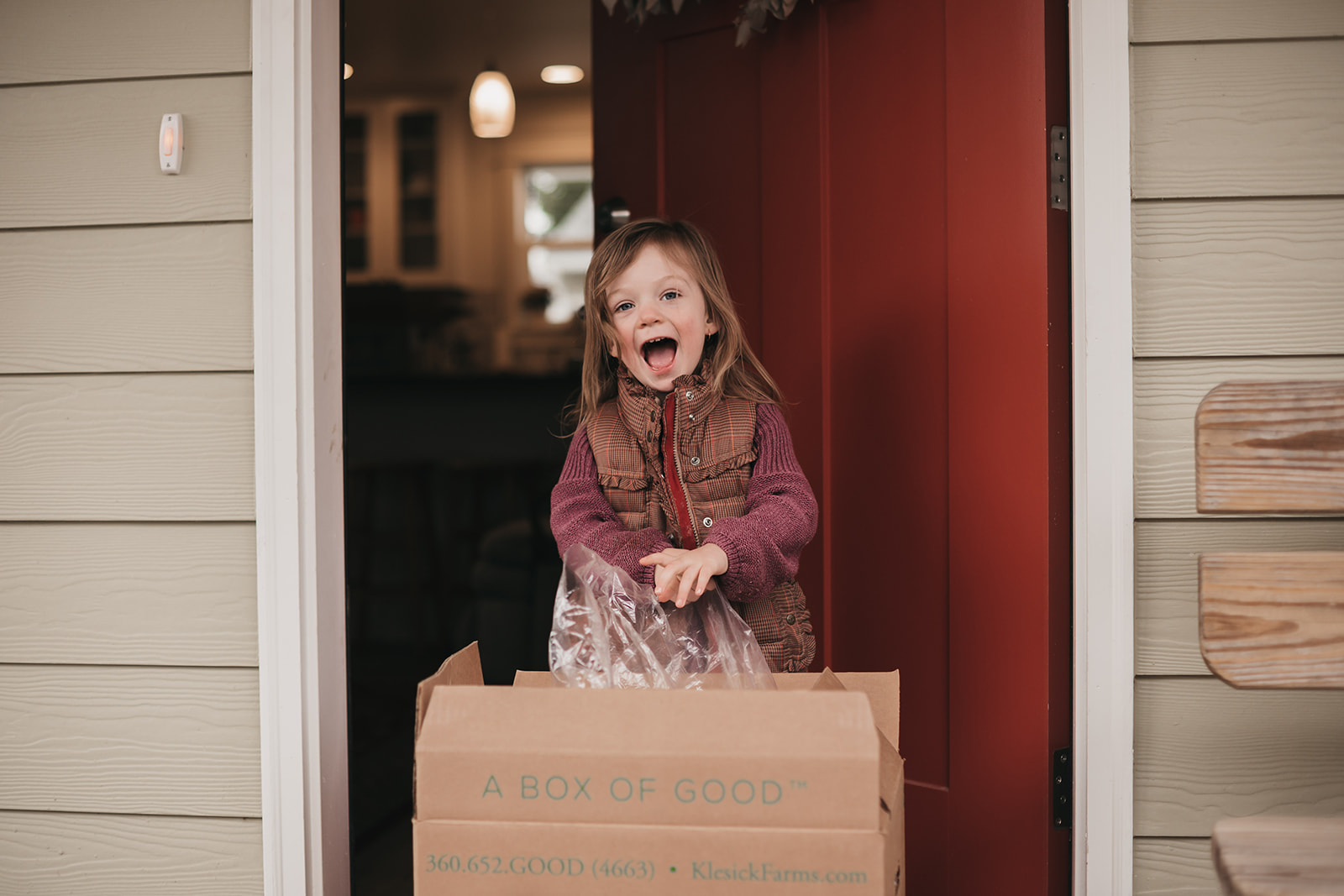
Girl getting home delivery of box of good organic local home delivery of produce in seattle washington

Working with What You’ve Got: Have you found yourself having to alter your meal planning during this stay-at-home season?   We have a few tips we’d like to share that could help simplify healthy eating during this crazy time.  As a matter of fact, we think you might even take a few of these ideas with you into the future.  

Some of our favorite recipes aren’t really recipes; they’re techniques. We love things like soups, stir-fries, roasted vegetables, salads and smoothies!  Once you understand the premise of creating each of these, you can alter the ingredients, use what you have on hand, and still come up with a delicious outcome!   

Soups: With soup, start with a good broth or create one as your base. Decide if you’d like to make a clear soup, a cream soup or a puree.  Clear soups will use the broth as the foundation and then vegetables and seasoning to taste.  Cream soups often use milk, cream or even cream cheese blended with a portion of the cooked vegetables.  Purees are smooth, thickened by blending things like potatoes, cauliflower, rice or beans.  Use salt, pepper and your favorite seasonings to finish to your taste. 

Stir-fries: Stir-fries are so versatile!  We use stir-fried vegetables as a base to go with meat, beans or vegetarian meals.   They’re great in wraps, over rice, with pasta or with salads.  Start with dicing your vegetables small!  We find that everyone eats more veggies that way.  Heat oil in a heavy skillet or wok, add minced garlic, ginger, onion, and chilis (if desired). Add protein, vegetables, salt, pepper and seasoning, and sauté until cooked to your preference. Use taco seasoning for Mexican dishes, Italian seasoning for pasta dishes, Asian sauce or spice to be used over rice.   

Roasted vegetables: Roasted vegetables are a favorite comfort food and so quick and simple!  No recipe required, and virtually every vegetable can be cooked in this way.  Root vegetables are old standbys for roasting, but you can also roast broccoli, cauliflower, zucchini, peppers and onions. Start by cutting vegetables into bite size pieces.  Toss them with a mild non-hydrogenated oil, sprinkle with salt, pepper and seasoning of choice.  We use lots of garlic powder!  Spread them on a baking sheet and give vegetable pieces lots of space.  Roast at 425 degrees until veggies get a bit charred around the edges.  Some vegetables are cooked much sooner than others.  Start with the root vegetables and then add softer vegetables a bit after, or roast like veggies in separate baking sheets, to easily take out when finished. 

I think everyone is familiar with the versatility of salads.  In addition to mixing up your salad fixings, try different homemade dressings as a great way to add variety! 

Smoothies: Smoothies are a super way to get a boost of extra nutrients and have so many possibilities! A kid favorite is always peanut butter-chocolate banana.  We start with a big handful of spinach leaves (shhh!) blended with coconut water, then add frozen bananas, peanut butter, a high-quality chocolate protein powder, and milk.  You can also add collagen, flax oil or whatever supplements that blend well and don’t over-power.  Frozen strawberries, blueberries and bananas are great to have on hand and combine well with leafy green vegetables.  A favorite of mine combines frozen banana, strawberries, avocado, spinach, kale, juice from hand squeezed lemon and oranges, turmeric, and ginger, blended with coconut water.  Give different combinations a try.  

Rest assured; you can use what you’ve got, and it’s going to be good!

Posted on

Consistent, Yet Never the Same

Many years ago, I came across this lecture on the patterns and styles of architecture through the ages. Of course, I can’t for the life of me find it again, not even with the Mighty Google. The main point of the lecture was that the prominent pieces of each generation of architecture, the ones that stood the test of time both physically and emotionally, were both consistent and variable. The columns of stone had consistent spacing, but they also had offsets from each other to create a sense of depth. Mosaics and frescos had intricate designs with distinct lines to create order, but with sweeping beauty in curves and chaotic color. Windows, statues, paintings, and domes had their own balance of organization with artistic freedom. Order and Chaos, balanced. When the pendulum swings too far to the Order side, things become predictable, robotic, mundane, and we lose interest. However, when things swing over into Chaos, things become tumultuous, confusing, lawless. We like a degree of certainty, but not too much. We like an ounce of chaos, but not too much. The things that hold our attention, indeed, those that give us awe and wonder, are ones that are larger than ourselves, outside of our direct control, but still follow an unpredictable pattern. 

It’s likely that, on first glance, we think of things being both Consistent and Variable much like oil and water; they don’t mix. How can something be the same and different? But in fact, the world around us is in a constant state of consistent variability. The waves crash on the beach consistently, day and night, but with varying frequency and intensity. We can’t say whether this wave will be bigger than that wave, but we know the waves are coming. The clouds roll in with some semblance of certainty, but not so much that we can bet the farm on it every day. The wind blows through, and the trees move mostly as expected, generally, but not exactly. We know what wind does, but we can’t know what it will do next. The four seasons come and go with a degree of predictability, but not so much that we can know exactly what any one day will be like. Our galaxy’s stars would be boring if they were laid across the sky as predictable as a city block in New York City, like when you fly to a major city at night and descend amongst a million little stars in a neatly packed grid. How many hours we have wasted invested staring at the flames in a campfire, drawn to the beauty of the current flame, waiting expectantly for what the next flame will do. Knowing the flame will come, but not knowing what form it will take. How similarly we behave around lightning strikes and thunderstorms! Even snowflakes fall consistently, but never the same. We can know that a leaf will fall, but we couldn’t reliably pick where on the ground it will land. When something balances a healthy dose of structure with a hint of uncertainty, we are drawn in.  

Thankfully, our food follows the same patterns of Order and Chaos. We know that too much order in food and too much automation in food production creates “things” that are frighteningly identical in size, color, and shape. When our food becomes too predictable and formulaic, then it’s a good sign that it’s not meant for us. Things like frozen pizzas, cookies, snacks, and pre-packaged vegetables have a heavy dose of “order”, while things at the drive-thru and county fairs lean towards chaos! I love our fresh bread from Rachael because every loaf is just a little different.  

A good rule of thumb to use with the food you eat is to make sure it has both Consistency and Variability. Shout for joy when two peppers are oddly shaped, when squash are different sizes, and bananas are different colors. Be thankful that head of broccoli will take some knife skills, and the carrots aren’t as straight as they could be. That’s how you know your food wasn’t optimized for packaging, nor is it fit for pig food. Right in the middle is food that’s fit for you to eat. 

May we spend more hours gazing at the stars, listening to waves crash on the beach, watching the clouds drift by, following the dance of a fire, and creating and cooking our own food.  

Posted on

Stomachs over Storage

A couple years ago, a friend of a friend (and fellow Box of Good recipient!) was moving her small business to Snohomish, and she contracted me to set up all the technology for her new retail store. Before the computers, printers, Wi-Fi, POS station, credit card readers, and receipt printer worked, we needed to get a new internet router. So I went where everyone else goes, and headed to our local family-owned shop around the corner called Amazon. I picked out the right router that covered the appropriate square footage of her store and purchased it on a Thursday afternoon, around 1pm. I only needed it to arrive at her store by Monday to start setting up shop. But later that afternoon, she texted me to say that the router arrived at the new store! I was flabbergasted. 

While this complex system of distribution works great for consuming more and more cheaper items, it’s not such a great system for food that we actually consume. A router is not bothered by sitting on a shelf for a year, or in a container for 6 months, or a ship for 3 weeks. Nor do cell phone chargers, tires, a broom, a book or a rowing machine! My 94-year-old grandpa just bought himself a rowing machine from Amazon on his cell phone, delivered to his nursing-home “studio” in 3 days, because it’s still not too late to start something new! How long was that rowing machine waiting on a shelf for him? Who knows. 

Unfortunately, we’ve made our food system more like our non-food system, rather than the other way around. We’ve pushed too hard on the “convenience” button and tried to make every food item available all the time in whatever quantity we can dream up. Prioritizing food for storage and transport has come at the cost of the very nutrients we should be consuming. Too often, the same nutrients that our bodies desire also make food expire, but those are replaced with items that enhance their shipping and storage lives. If we were blindfolded and released into a grocery store and told to grab a handful of items, it’s more likely that your shopping cart would be full of items designed for the shelf, not for yourself. The main intention behind the shape, color, texture, presentation, density, price, and ingredients of each product is that it needs to be in a truck, freezer, cooler, warehouse, or storage for an unknown amount of time. It’s made to sustain the temperature changes, shaking, and squishing, rather than sustain our stomachs. 

But fresh local produce and grocery items flip the tradeoffs in our favor, so the nutrients we crave are left in the food, and the costs of a complex storage system are removed. The single-use plastic is eliminated, the gas and electricity are minimal from storing and moving items around between distribution centers. The fresh bread in your Box of Goodis baked by Rachael the morning that you receive it. The raw milk in your delivery comes from Tilly the day before you receive it. The bar of chocolate is made by Kevin the same week you receive it. The kale and carrots are grown by Ray and John, picked a day or two before you get it. The blueberries from Karen are picked a day or two before you eat them. That’s why I can’t eat just one pint! 

A famous person once said, just because it’s possible, doesn’t mean it’s beneficial.  

Posted on

Life of Pie

The Food and Drug Administration publishes the changes to our nutrition laws on their website, and it can be a dull read sometimes. Each year, the FDA makes changes to the National Register, which makes them part of the Law across the Land. I don’t know many people that keep up to date with the FDA regulations, so you’d be forgiven for missing the FDA alterations amongst other things like Twitter changing their name, or the Paris Olympics memes, or any other Very Important News®. Most years, the FDA makes a dozen or so updates to the food regulations, but so far in 2024, there have only been 3. We are 1) reducing sodium use, 2) updating “health” claims on yogurt, but the most riveting one is 3) revoking the standards for frozen cherry pie. What?!? 

In 1967, the FDA made a proposal to regulate the Standards of Identity for frozen cherry pies, meaning that the public was confused about what was and was not a frozen cherry pie. More specifically, the public was not sure whether the sweetener in the cherry goop was artificial or not.  A solid four years later, the proposal was finalized in 1971 and ever since then, we’ve had nothing but perfect frozen cherry pies. In 2020, the American Bakers Association (who else?!) petitioned to revoke the Standards of Identity around frozen cherry pies, asserting that “that non-standardized fruit pies have been sold throughout the country for many years without any evidence of public confusion”. So in March of 2024, the FDA relaxed the rules on frozen cherry pies, saying “the standards are no longer necessary to ensure that these products meet consumer expectations, and revoking the standards will provide greater flexibility and the opportunity for product innovation”. Keep an eye out for some innovative frozen cherry pies coming to a retailer near year! 

As we head into fall, we’re entering peak pie season. The usual pie suspects make this season go ‘round. The classic apple pie, pumpkin pie, pecan pie and chocolate pie are never far from reach. Or you can go the savory route and make sausage pies, delicata squash pies, turkey pies from Thanksgiving leftovers, cheddar pies, chicken pot pies. Quiche is even a pie! And don’t forget custard pies, meringue pies, or sweet potato pies. You name it, you can make a pie out of it! A pie is like the soup of the oven: throw all your extra ingredients in a pie crust, cover it with something, and bake it off! No one will be sure exactly what is in it, but it will taste good! 

If pies are not your thing or you need to be pulled away from the pies, Box of Good will begin offering nutritional classes In October. The class will be once a week for 5 weeks, and it’s a combination of 1 part nutritional education, 1 part sugar detox, and 1 part support group. Laura Conley is a Functional Nutritionist and will be leading the class through education around digestion, healthy fats, the impact of sugar and refined carbs, and how to fight back with whole foods, preferably local and organic when available. To register, look for more info on our website and the space will be limited. We will offer both daytime or evening classes to fit flexible schedules. 

A quick way to summarize the class is a great quote from author Michael Pollan: “Eat food. Not too much. Mostly plants.” 

Posted on

Too Big To Follow

Every once in a while, a phrase makes it into our global lexicon. These phrases are usually tied to an event or time that we all collectively associate. We can often remember exactly where we were and what we were doing. I remember learning a new phrase soon after September 11th, 2001, where all the newspapers and TV shouted “Shock and Awe” on repeat. I’d never heard that before, but suddenly, it was everywhere!  

Shortly before that, we added the “Dot-com Bubble” to reference the fall-out from very speculative tech companies after reality settled in that they may not be as important as they thought. Then we added “Great Recession” and learned all sorts of fun new financial words like derivatives, credit default swaps, and subprime. Without wasting time, we quickly added “Occupy Wall Street” and “Top 1%”. Then we moved on very quickly to “Black Lives Matter” and “Cancel Culture”. Finally, we’ve rounded out the last four years with a plethora of phrases regarding “Social Distancing” and “Flattening the Curve”. 

One interesting thing reading these phrases is that you can often recognize feelings, images, thoughts, or memories surrounding those very phrases, without me providing any further context whatsoever. With just a few words, we can all remember a singular season of life and where we were or who we spoke to. I remember exactly where I was for the first videos of 9/11, as well as when Washington State went into lockdown (if was half-time of my soccer game!).  

My favorite phrase is “Too Big To Fail” because it is accurate enough to cover all sorts of time periods and events. It’s a timeless truth that can apply to the railroads in the 1800s, the oil companies in the 1900s, the car companies after that, then the telephone companies in the 80s, then finally the banks in 2008. Even now, we could still apply it to the tech companies of 2020s, or CrowdStrike in July 2024. We could even apply it to the United States itself across many individual decades. We could also apply it to the Romans, the Dutch, the British, and many other empires in between. The underlying sentiment is that something becomes so critical, so dependent, that even if it fails (and fails those that depend on it), it lives on. Very few other aspects of life get to operate in this spectrum. When my peach tree gets too big, too heavy, too far out from its trunk, and I don’t trim and thin it, the roots give out and it naturally snaps and falls over. As it should, since it can’t support its own weight. Last week, a couple of famous arches in the Utah desert collapsed, and we, so far, have not spent a billion dollars to prop them back up to maintain an unsustainable structure. 

Eventually, some companies become a little too big, a little too important, a little too dependent, and a little too extractive. The tides slowly turn from producing lots of value for the local economy, to gradually sucking all the value in a larger and larger radius. When a company starts taking more value than it produces, people are left wondering where it all went, and is it still worth it to maintain it? The cure for this lose-lose situation is to notice these patterns early, get off the train at the next stop, and decide that these companies are Too Big To Follow. 

In late 2023, Seattle’s local organic chocolatier, Theo’s, was merged into the massive American Licorice Company. To “ensure the future of the company”, they closed their original Seattle manufacturing plant, laid off 60 of the people that got them there, and moved the operations out east. Meanwhile, our friendly account rep that worked with us turned into an automated inbox, our chocolate shipped from the East coast instead of Seattle, and the bars arrived further and further after their production date. They published an eye-opening press release of how they became too big and had to cut ties to their roots. That’s how trees fail too.  

We will always operate “upside-down” and when something gets Too Big to Follow, we’ll go the other direction and look local, look small. Next week, we will begin offering Miodo Chocolate, from our own backyard of Camano Island. Our friend, Kevin Miodonski, has been making single-origin, small-batch, dark chocolate for over 20 years. Our new fresh bread starting this week from Water Tank Bakery follows a similar pattern, from a small local baker using all Northwest ingredients to get bread to your door right after its baked. Stayed tuned for more hyper-local producers of honey, pasta, meat, pizza dough, salad dressing, hummus, even dishware and nutrition classes! We’re gearing up for a full harvest season!  

Posted on

Cream on Top

Greetings and salutations from Tobin and Emily! We’re beyond grateful for the opportunity to serve all our local families with fresh local food, and we couldn’t be happier to be “back in the saddle” at Box of Good. 

Between the two of us, we’ve been raised in a long line of gardeners of veggies, herbs, and flowers, even berries and orchards. With all that food to harvest, it also brought with it a lot of canning, pickling, juicing, jamming, pressing, and preserving. I’ve had many late nights with the kitchen windows steamed up from the pressure pot and water bath, preserving that day’s harvest.

My grandparents moved to Camano Island from Kodiak Island, Alaska in 1977. My grandma, Vivian, was an avid gardener, so much so that when she was done managing her own garden in the morning, she would come over to our house and manage ours too! I would race to get my school done early so that I could go outside and join her.  

When my grandparents passed away 10 years ago, I was fortunate enough to acquire their home and keep it in the family. With that came a box of original pictures of them tilling and forming and shaping the barren grass slopes into neat aisles of raised beds. Then they planted a group of saplings for the start of an orchard. Those trees are now so large that I can barely keep up with trimming them! 

A few years before passing, Vivian planted a frost peach tree in the garden, and that has been my favorite and best-producing tree each year. Like clockwork, the first 3 weeks of August will be overflowing with peaches, and I know I need to be in Canning Gear or else I will lose out on that harvest. There are so many fun things to do with peaches, especially when they’re coming out of your ears.  

One of most satisfying things about the canning process is the “click” you hear when the jars start to cool off from the water bath. The lid pops into place. That’s how you know you got a good seal. However, if you have 10 jars on the counter, you can’t tell which one popped, specifically. However, a successfully sealed jar will cause all the peaches to rise to the top, leaving a few inches of peach syrup at the bottom. I think this is amazing! Naturally, the best bits always rise to the top! 

There are other things that rise this way, as well. Raw milk still has the stuff that conventional milk only dreams of: cream on top! In July, we started partnering with Justin and Katrina Seckel at Camano Creamy to deliver super fresh, local, raw milk. They got into dairy farming because of a similarly long and storied family lineage of dairy farmers paving the way for the next generations. I love seeing all the milk jars come and go with the thick layer of cream, naturally rising to the top. You can make your own butter or ranch dressing or clotted cream with raw milk, because the richest, creamiest part of milk always rises to the top. 

Rising is also the main feature of a yummy loaf of bread. Watching dough rise and rise, over and over, as you knead it into shape. As we prepare to start offering fresh local breads (teaser!), I’m again reminded that natural things rise, organically, without anyone telling it what to do. The best rises to the top. 

Of course, that makes one ponder the reverse: which things in life don’t obey this natural law? Do all the inorganic structures and complex systems and institutions that we humans create follow suit? Does the “cream of the crop” also naturally rise to the top of the systems we’re in control of? Or do we surpress the cream from rising to the top of our own systems in order to squeeze out more and more of a quicker, cheaper solution? Perhaps we’d get better results in our diets, districts, or diplomats if we choose to play in arenas that allow nature to take it’s course more often, where there’s space to grow slowly in their own way, rather than dictate an unnaturally quick pace for a subpar harvest. 

When my grandparents moved to little ole Camano in ’77, they barely knew a soul here. But they found a modest home to move into and good community. My wife and I get to enjoy that home 50 years later. A home that was built by a close family relative of Justin and Katrina Seckel. Good things take time. 

~ Tobin Fekkes

Posted on

Grapefruit and Citrus

This newsletter is going way back to 1979 to a time when I was kid. My children have had a distinct advantage over me when I was growing up. I was a Hamburger Helper and Fruit Loops kid and wouldn’t have known a Fuji from a Granny Smith apple or a Navel from a Valencia Orange. My only experience with fresh produce are fond memories of shelling peas on grandma’s back porch and carrying the 4th of July “seeded” Watermelon to the family picnic. 
Fast forward to 1994, happily married with 3 of our own kiddos. This is when I began a career in retail produce. It wouldn’t be for another 4 years until Joelle and I would launch the Organic Produce Shoppe and then a few more years before we added farming and home delivery.

Those early years are where I gained a lot of experience about the seasonality and quality of produce. I have trimmed tens of thousand lettuce and spinach bunches, handled even more apples and citrus. At my core, I am a good food advocate and love working with quality growers and fresh produce.

I remember it as if it was yesterday, I was interviewing for a manager position after a few years of working in the industry. It was a walk and talk interview. It is not uncommon for me to ask questions when one enters my mind. I am just curious and like to learn. As we were walking through the fruit displays, I asked, “Where did you get grapefruit this time of year?” The manager hiring me said, “California???” This is not the question a potential manager candidate should have asked (smile). 

To be completely honest my only experience was in boutique high quality produce markets. The owner of the company where I started my career never carried grapefruit from California. He was partial to Texas and Florida, which are harvested at a different time. And for sure, those are two really good grapefruit growing regions, but California also grows some outstanding citrus. 

This week we are featuring some of that beautiful grapefruit from California. When I eat grapefruit, I am less likely to use a grapefruit spoon, but opt for cutting it into wedges and eating them like that. 

I did still get that job, because the manager was looking for a person with an eye for quality. Quality is still a driving factor for our small business and customer satisfaction. 
– Thank you for allowing our family to serve yours,

Tristan, Joelle, and the Box of Good crew