
Posted on

FARM DREAMS

Originally Published in The Herald: Sunday, November 23, 2008

Story and photos by Dan Bates, Herald Photographer

THE HEART

Tristan Klesick may not be able to feed 5,000 people with a couple of fish and five loaves of bread, but he does possess strong Christian faith, unusually good food-growing skills and some great ideas for helping people bless other people.

“I know others have the heart to bless people with food,” Tristan says. “And with our farm staff and products, and our delivery vans, we have the means to help them do it.”

Tristan started a program called Neighbor Helping Neighbor about 10 years ago, but it isn’t advertised. He is low key about it and he won’t pressure others to use it. He merely would like to provide a conduit that people can use, by their own choice, to bless others with food.

It’s a not-for-profit function of the farm, something Tristan and his family believe in. They would do it themselves, anyway, but providing a way for others to use them increases the bounty for everyone. So far this year, about 340 family boxes and 100 holiday boxes have been donated.

People can purchase a box of food and have it delivered to someone they know who needs it. Or, what is more often the case, people ask the Klesick Farm to donate it to the food bank. The Klesick Family Farm matches every fourth box that customers donate.

THE SOUL

She is all too young, and alone, holding a baby in a carrier. She avoids drawing attention to herself as she nervously looks over the food at the Snohomish Food Bank.

It’s clear she can’t carry groceries and hold the 2-week-old baby at the same time.

Ed Stocker, 82, kindly invites her to set the baby down next to him. He’ll gladly watch the child.

She is reluctant to separate from that baby, even for a minute. Yet, she finally leaves the child, quickly gathers some food and carries it to her car.

The next time she arrives, she takes the baby right to Stocker and sets the carrier down next to him. Each time she returns, the women volunteering fawn over the baby while she gathers food. Her guard lowered now, the young mother chats happily with the women, and the old man.

The young woman hadn’t been afraid in the beginning, Stocker explained. She was embarrassed.

It’s not easy to seek help. It can be an art to give it.

THE BLESSING

Gail Brenchley of Snohomish donates Klesick boxes because she feeds her five kids produce grown by the Klesicks and sees the difference in how they eat.

“If people are getting fresh vegetables, they’ll eat them,” she said. “Their kids will eat them because they taste better.

“I like to give others the same thing I feed my own family.”

Eva Burns donates the Klesick Farm boxes because, she said, it’s the way she would like to be treated if she were in need.

The delivery is key, she said. Somebody else doing the lifting is what makes it possible for the 82-year-old Everett woman to bless others in this way.

Michele Payton said the Klesick Farm’s pre-order holiday box is a bargain at $30.

“You can donate a second holiday box to some family you know, or to the food bank for $25,” she said. “And you should see it!”

Still, the Camano Island woman cancelled her own Klesick Farm deliveries.

“Because of economics, I e-mailed the Klesick Farm saying I needed to suspend deliveries for a while, until things get better,” Payton said. “Tristan not only called and lowered the cost of my food box, but he counseled me on the economic situation; he’s very knowledgeable.

“It touched me. I was personally surprised by the generosity.”

“It isn’t ‘business as usual,’” Payton said. “It’s not just another good value, food-wise. What other place would call somebody?

“I’m not going to get a call from some CEO at Costco to say, ‘Hey, let me help you out for a while.’ ”

Vicki Grende, whose husband, Don, was on strike at Boeing for eight weeks with the Machinists union, recently e-mailed the Klesick Farm to thank them for charging them half-price throughout the strike and to let them know they would like to pay full price now.

The majority of the donated Klesick Farm boxes go to the Stanwood Camano Food Bank. Ed Stocker will pick up about 60 holiday boxes for the Snohomish Community Food Bank this week.

The food banks are accustomed to stocking fruits and vegetables from the big stores, product that is near the end of its shelf life, yet still good if consumed right away.

The Klesick boxes are different.

“The thing about the Klesick boxes is they’re fresh vegetables,” Stocker said. “They’re not culls. They’re strictly the best — the same food they deliver to their customers is what they send with me.”

“I will go any distance to pick up produce,” Stocker said. “With Tristan, that’s my trip because his kids and I like to talk duck hunting and goose hunting. Those kids, they’re just like my own.”

He thinks Tristan is OK, too. He notes that Tristan began farming as an adult, rather than growing up on a farm like everyone in the Stocker family.

“He has a different slant on agriculture than someone who grew up on the dirt,” Stocker said. “And that’s good!”

Posted on

Preparing for Thanksgiving


Thanksgiving! ~ Ordering a Holiday Box with all of the Fresh Ingredients You’ll Need for Your Special Meal 

Thanksgiving is just around the corner! If you haven’t already, it’s time to start thinking about preparing for the holiday! For a day that’s devoted to cooking, eating, family and thinking about what makes you thankful, a little planning ahead goes a long ways in making that special meal go off without a hitch.

We at Klesick would like to be a part of your Thanksgiving celebration by making your holiday planning easy. Every year in November, we offer an additional special: the Holiday Box ($36). The Holiday box, as its name implies, is full of traditional organic Thanksgiving meal items for your celebration. Keep in mind that you can schedule a Holiday Box to be delivered the week of Thanksgiving, but NEW THIS YEAR: you can order a holiday box for any week in November, as well as the week after Thanksgiving (available Nov. 4 – Dec. 5). You can have this box delivered along with your regular order or in place of your regular order (when you place your order please specify).

Along with the Holiday Box, you can order many of the ingredients you’ll need for your  big meal: hearth-baked dinner rolls, bread cubes for stuffing, cranberries, jams, apple butters, pickles and relishes, as well as all of your favorite fresh vegetable ingredients, like sweet potatoes, green beans, and greens for your favorite sides and salads.

Let us source, pack, and deliver your Thanksgiving good right to your doorstep!

An Opportunity to Give! ~ Donating a Holiday Box to Neighbors in Need

In the spirit of Thanksgiving, Klesick is providing an opportunity for you to donate a Holiday Box to the food bank. The season of giving has started, with schools, churches and businesses kicking off food drives that have become annual holiday traditions. While commonly donated foods are high in salt, sugar or calories, these are poor choices for people with high blood pressure, diabetes and other diet-related health problems. We’d like to ask you or your organization to consider giving a box of organic produce this Thanksgiving.

If your celebration includes helping the less fortunate who live in our community, you may order an additional Holiday Box at a discounted price of $26.00. Like our Neighbor Helping Neighbor program, we will deliver donated boxes to the food bank prior to the Thanksgiving holiday. These will become available to add as a donation throughout the month of November. 

–

Holiday Box Menu

Granny Smith Apples, 2 lbs.

Cranberries, 7.5 oz.

Satsumas, 2 lbs.

Breadcubes for Stuffing, 1 lb.

Celery, 1 bunch

Acorn Squash, 1 ea.

Green Beans, 1 lb.

Garnet Yams, 2 lbs.

Carrots, 2 lbs.

Yellow Potatoes, 3 lbs.

Yellow Onions, 1 lb.

–


Posted on

Farmland, Food, and Livable Communities

By the time you get your box of good this week, I will have left Seattle, arrived in Lexington, Kentucky and spoken at the American Farmland Trust’s national conference, and gotten back to the farm, just in time to move into our new packing facility this weekend. My session at the conference was titled, From the Field: A Farmer’s Perspective on Soil, Nutrition and the Importance of America’s Farmland.

I must have been “sleep deprived” at the moment I accepted their invitation to come and share. Truth be told, I agonized over this decision for quite a while, because I knew that it would be happening during harvest and our move to the new building. This would make my trip to Kentucky more of sprint than a leisurely stroll. Nevertheless, since I am very passionate about the need to “preserve” America’s farmland for future generations, the opportunity of having access to policy makers, conservation organizations and natural resource planners to share about farming, meant I had to say, “Yes!”

I love the title for the conference: Farmland, Food and Livable Communities. It says it all: no farmland, no food, no communities. Cities and farms have always been associated together. Neither is able to survive without the other, because we have to eat to live and city folk, they have to eat as well.

Ah…but therein lies the rub. With refrigeration, diesel and airplanes, the farms can be moved further from the cities, which means the cities will eventually lose their connection to the farms and where their food comes from. As the farms move further and further away, so does the quality of the food. We accepted farms 100 miles away, then 200 miles away, then in the next state, country and before you know it, Chinese apples are on the shelf. I am not excited about that progression, and I am certainly not excited about losing any more farmland to development.

That is why I went to Kentucky—to invest in the folks who make their living trying to preserve farmland and other natural resource lands. I wanted to encourage them to press on, plow ahead, and not grow weary in well doing. Their work is important, it is important now and for generations to come.

Thank you for sending me to Kentucky. Because of your support of our farm and our box of good, I had a platform from which to speak!


tristan-sign

Posted on

Know Your Produce: Collard Greens

Collard greens are part of the cruciferous vegetable family, which also includes kale, broccoli, Brussels sprouts, cabbage, rutabaga and turnips. These nutrition powerhouses pack in lots of nutrients for a little amount of calories. If you are trying to eat healthier, cruciferous vegetables like collard greens should be at the very top of your grocery list. Collard greens are a great source of Vitamins A and K, as well as folate, manganese, and calcium.

Store: Loosely wrap greens in slightly damp paper towels, then place in a plastic bag and refrigerate for up to 4 days. Wash just before using.

Prep: Hold each leaf by the stem. With the other hand, zip the leafy part off the stem. Discard the stems. (Chard stems may be cooked.) Cut the leaves into strips. Swirl the greens in a salad spinner filled with water. Lift out the basket; discard the water. Repeat until no dirt remains.

Use: Sauté tip: Heat oil in a large skillet. Add as many greens to the skillet as will fit, season with salt and pepper, and cook, tossing frequently. As the greens wilt, add more greens to the skillet. Cook until tender.

Note: dark leafy greens pair very will with savory items such as garlic, onions, and bacon (traditionally, they were paired with ham hocks or pig jowels), and balance out well when served with a dollop of coconut oil or a cultured whole milk dairy, such as sour cream or crème fraîche (or even butter) – saturated fat helps the body assimilate the fat-soluble vitamins, calcium, and minerals contained in the greens.


For more extensive information on Collard Greens, check out this article on Mercola.com

Posted on

Pumpkins for Pateros

I love my Klesick Family Farm community. What a resource it is! I am not a writer by trade and feel far more comfortable one-on-one or one-on-250, than I do at the computer. Once a week, I get a “nudge” from Jim reminding me that he needs me to write a newsletter for the following week. One would think that after 17 years of writing newsletters I wouldn’t need those reminders. Thankfully, I usually have something I am “ruminating” on! This week, I surprised Jim with a newsletter before he even asked!

Last week, I wrote about our community initiatives and I was struggling with a paragraph that wasn’t working for the newsletter. So I posted it on FB and was blessed to have a few professionals tighten it up. It still didn’t quite fit the topic for last week, but it does this week! The new improved paragraph in question is below. Drum roll please!!!!!

“We grow and deliver only healthy food – grown and nourished with compost, cover crops and minerals to help produce the healthiest food possible. We all have to eat, so why not eat something that does more than tantalize your taste buds and expand your waist line? Why not eat something that actually feeds and nourishes your body?”

That says it all. That is what Klesick Family Farm is all about. From farm to table, you can trust us to only deliver what will nourish your families and do it in a way that is sustainable. So, a hearty “Thank you” to my FB editors!

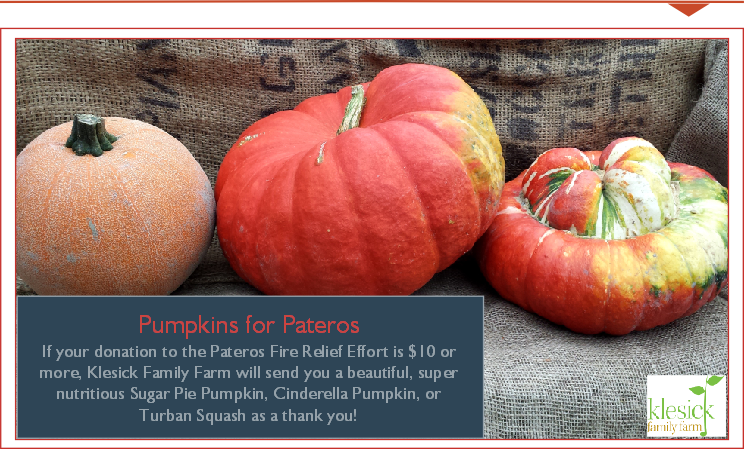
As a result of all that compost, cover crops and minerals, I have a lot of oversized sugar pie and Cinderella pumpkins and turbin squashes this year. I really do try and grow them to be a little smaller, but those two crops loved all the “groceries” we fed them this summer! And they just won’t fit in our boxes of good.

But I have an idea to make good use of these over-achieving pumpkins and turbins – I am calling it “Pumpkins for Pateros!” Here is how it works: For every Pateros fire relief donation of $10 or more that we receive between now and the end of November, Klesick Family Farm will send you a beautiful, super nutritious sugar pie pumpkin, Cinderella pumpkin or turbin squash as a thank you!

What do you think? I get to move some over-achieving squash and together we can help our neighbors in Eastern Washington rebuild? Sounds like a win-win! To make a donation, please visit our website and select the Giving category on our Products page or give our office a call!


tristan-sign


Posted on

Community

At Klesick Family Farm, we are defined by our community because we are a local family farm, a local family business and a local family. We are also defined by our commitment to quality, customer service and our service to our community. Where we live is more defined by geography, but for us, customer service, quality and how we invest our lives are choices we get to make every day.

It is the same with our donation programs or, if you will, our “box of good” initiatives. We have three ongoing initiatives in which we ask you to partner with us: Food Banks, Water Wells and Healing through Nutrition. We believe these also define us, and we would want them to define us. Because we are committed to good food, we are also committed to helping our neighbors in need get t his good food. Your partnership with us expands the message and access to good food and its impact locally and internationally.

Food Banks: We are currently delivering high quality fruits and vegetables to nine different food banks in our community. For every $26 food bank box you donate, Klesick matches it by 25%. Year-to-date, together we have donated 562 boxes of good. Many of you donate boxes on a regular basis and this makes a huge difference. However, we believe that even more good is possible. So, if helping the less fortunate in need is a passion for you, you can autopilot your impact by choosing to purchase a food bank box for delivery in Anacortes, Edmonds, Everett, Lake Stevens, Marysville, Monroe, Oak Harbor and Stanwood.

Water Wells: Crossway International is our international initiative with orphanages and a water well drilling focus in Africa. Dean Chollars is a dear friend of ours and has donated his life to improving the lives of some of the poorest in the world. Your support of our farm business helps us help the poorest with fresh water.

Healing through Nutrition: This is an opportunity where you can contribute money toward customers fighting cancer or heart disease. Your funds allow us to offer these customers a discount on their orders, making healthy food more easily accessable to them in their fight. As a family and a farm we believe that good food is a big part of the solution and cure for these type diseases.

Lastly, we also try and support communities in the throes of a natural disaster. Currently, we are supporting an effort to help the Pateros/Brewster communities rebuild after the summer fires.

My family and business motto, when it comes to helping is: Always pray, decide whether to give money, time or both, and then do it.

tristan-sign

Posted on

Wish You had been Here

It was a normal work day here in the office at KFF, as we were getting ready for the next day’s deliveries, when a visitor knocked at our door. When she introduced herself as Marlene Smith, we knew immediately who she was. Marlene is from Pateros, WA, one of the communities in eastern Washington so affected by the devastating forest fires, and is married to Phil Smith, who pastors the Pateros Community Church. That’s the church KFF is partnering with to bring needed funds to the people of Pateros as they rebuild after this recent disaster. Marlene was visiting with her mother who lives here in Warm Beach less than a mile from our office! What a small world. Marlene came by to express her deep appreciation to all of you who are contributing to our Methow Valley Fire Relief Fund.

What stories Marlene had to tell. The Smiths had lost their own home in the fire, but the church, which was right next door, was saved. A young volunteer fighter arrived on the scene and thanks to her efforts and those of three other volunteer fire fighters, they were able to save the church, which sustained some minor damage but still stands. One of those fire fighters happened to be our “own” Bruce Henne, from Earth Conscious Organics (ECO) in Brewster, WA—the  people who grow your apples, pluots and cherries. Gratefully, ECO’s orchards were spared in the fire, even though the fire came to the very edge of their apple orchards. We also heard how one of the people in Pateros purchased the old grocery store in town and turned it over to the people coordinating fire relief efforts, so there would be a place for people to come and get help.

As we talked, I told Marlene about a phone call we had from a person who receives deliveries from us. When she heard that we were organizing fire relief efforts, she just had to call. She grew up in Pateros and went to Pateros High School. She was so thankful that funds were being sent to help the people of this community recover from the fire. She too adds her thanks to all of you who are helping.

Connections. That’s what amazes me. The very people we are trying to help way over in Pateros have family just down the road from our office! Bruce Henne, whom we have known for years and talk to every week, was directly involved in fighting the fires there. One of the people we deliver to every week grew up in Pateros. We’re not just sending money to who knows whom and to who knows where. We can put faces to the people we are helping. We’re connected. They’re real people with real needs.

I wish you could have been here to talk with Marlene yourselves. You would have seen the gratitude and appreciation she has for your generosity. You also would have felt the connection. The Smiths have lived in Pateros for nine years now and have come to love and care for the people there. They know the community and its needs first hand. We can be assured that the money being sent there is being put to good use.

Thanks to all of you who are contributing. Any of you can still do so by either going online (select “Giving” on our products page) or by contacting our office to either make a one-time contribution or make a recurring one. Together we can make a difference.

Mike Lama

KFF Customer Care

Posted on

The Kick

This time of year is the best! I love fall. Fall is when farmers, well at least fresh market farmers, are in that part of the race where you start your “kick” to finish the race well. By now most of us have been harvesting all summer and are tired. The summer harvesting is what pays the bills (e.g., weeding, fertilizer, seed, and labor), but now we are heading toward fall.

Every farmer I know has a bead on what the fall will look like in July. We can tell if the crops need water, weeding or some feeding, and based on these observations, reasonable expectations can be drawn. Nevertheless, getting the crops out of the field and into your boxes has a lot of variables in play. For the most part, however, farmers know how the fall is shaping up in July!

After getting through my son’s August wedding, I am turning my attention to the winter squash and potato crops. All summer I have been eyeing those delicatas, carnival, acorn, turbin, two kinds of sugar pie pumpkins and few cindarellas. I love growing squash. We plant it by the handful and harvest it by the truckload. All squash have an amazing yield and a diversity of flavors and cooking methods: baked, pureed, roasted, steamed, soups and pies. Hmm! Hmm! A few more weeks and we will be picking the first squash of the season.

Potatoes are a close second. This year we have four varieties: one yellow, two reds and a purple. Every year I am always surprised by the amount of potatoes under the “hills.” I know I planted them, but it just seems like a miracle every year. The kiddos and I head out and pull up a couple plants and there they are—big beautiful potatoes! The ritual just brings a smile to my face every time we do it. And now that I have a grandson, the tradition gets to continue!

Lastly, we are “harvesting” a new packing and processing facility in the City of Stanwood. It has been in the works for over a year, but it looks like we will be moving to the new facility in October.

Between the wedding and the building, plus all the farming, the final leg of this year’s race (aka, farm season) will surely require a little R&R. I just might need the whole winter to recover. Oops…got caught day dreaming! Back to work—there is still a lot to do before then!

Posted on

Know Your Produce: Dragon's Tongue Beans

Dagon Tongue beans are an open pollinated heirloom variety originally cultivated in the 18th Century in the Netherlands. The bean has a warm cream color with vivid violet variegations throughout its stringless pod. Its shape is broad and the bean measures to an average of six inches in length. The pods are crisp and succulent and bear four to six plump bone white seeds with pink to purple stripes that turn tan with age. The fresh seeds are firm, slightly starchy, nutty and sweet. The entire bean can be eaten raw or cooked. When cooked, the bean loses its variegated colors.

Store: wrap in plastic; refrigerate. Use beans within one week for optimum flavor and texture.

Prep: Wash in cool water. Remove the tips of the bean with a paring knife.

Use: Best raw, Dragon Tongue beans are also excellent steamed, but the color fades during cooking. Perfect for pickling with spices, adds its naturally good flavor to bean salads and stir-fries. Serve simply as a delicious side dish. Its unique color makes this bean an attractive edible garnish and an interesting conversation piece when served to curious guests.

Posted on

Freezing the Summer

The Klesick family has been in full freezing mode for the last few weeks and will probably continue here for the next few as well. Years ago, canners (those people who canned fruits and vegetables) would put up lots of jars for the winter food supply.  People canned meats, veggies, fruit and sauces when the items were plentiful and in season. The canners, for the most part, are a very small component of food buyers today. I know that a few of you still exist, so you can relate when I say that I can barely find a freestone peach to can anymore. Pickles have bucked that trend, however, and are still made every year, but most other canning items have fallen on “hard times.”

Ironically, the practice of canning has declined with our prosperity, stable electricity to run refrigerators and freezers, and a plethora of fruits and vegetables widely available all the time. Except for opening a can of black beans, I hardly even remember using a can opener—and we don’t even own an electric one—but when I was growing up it was the main kitchen gadget. I Still remember watching that can go round and round!

Today the Klesick family freezes and freezes and freezes. We freeze lots of berries, mangos, nectarines, peaches and grapes. The freezer has replaced the shelves of cans! It is not a perfect system – when the power goes out we NEVER open the freezers, and if it looks like it is going to be an extended outage we will fire up the generators.

The Klesick’s cannot be the only family in the off-season that enjoys a splash of summer on pancakes, or in hot cereal, or as a frozen treat. Joelle and I enjoy a green smoothie every morning and those frozen berries with fresh greens transport your taste buds right back to those “chin dripping” juicy peaches and nectarines of summer.

So, from now till the end of August, Klesick Family Farm is running a “Freezing the Summer” special! Check out the offerings in your email inbox, on Facebook and our website, and order a case or two of local summer goodness for your next delivery and start looking forward to winter

Posted on

Know Your Produce: New Potatoes

New potatoes are freshly harvested young, or small, potatoes. They have paper-thin skins and lots of moisture inside, and they tend to be sweeter than older potatoes (in much the same way that freshly picked corn is so much sweeter than cobs that have been sitting around for a few days). New potatoes are pure perfection in potato salads or simply boiled with a bit of butter and a few chopped herbs. Skins that are starting to flake away from the potato are fine – that’s the price of such youth and delicacy! New potatoes are freshly harvested and a bit of dirt just shows that they really are new potatoes and not just small potatoes.

Store: Because they have such thin skins and high moisture levels, new potatoes don’t keep as well as more mature potatoes. Keep them in a paper bag or loosely wrapped plastic in the fridge and use new potatoes within a few days of buying.

Don’t fall prey to the temptation to wash new potatoes before storing them. That bit of dirt clinging to their skins will actually help keep them fresh and any water on the outside will hasten bruising and softening.

Posted on

Disasters

UPDATE: 8/5/2014

Klesick Family Farm will be working with Pastor Phil Smith of Pateros Community Church in Pateros, Washington to engage in rebuilding our Eastern Washington neighbors’ lives. This local church is currently involved in distributing resources to people who have been adversely affected by these fires, and will be involved in the long-term process of rebuilding their community. If you would like to partner with us, you can add a $1, $5, or $10 donation to your deliveries or make a one-time donation, here.

7/30/2014

This has been a devastating disaster season for Washington State. The Oso mudslide earlier and now the Carlton Complex fire, which now has the dubious distinction of being Washington’s largest forest fire. As most of us know, due to the various media outlets, a good portion of the city of Pateros has burned, leaving another community with its world turned upside down.

I just spent an hour with our longtime friend and grower, Bruce, from Earth Conscious Organics (ECO) Farms in Brewster. Bruce is a volunteer firefighter and has been working around the clock trying to save people’s homes in and out of the city of Pateros. I was grateful to know that the ECO family of farms were spared from the fire, just skirting the Pink Lady block of apples. In fact, it appears that none of the farmers we work with in Eastern Washington have lost any of their farms. Thankfully, the loss of life with this disaster pales in comparison with the Oso mudslide; however, the magnitude of the disaster area is unreal and these farmers’ communities have been hit hard.

We have received a few phone calls asking if Klesick Family Farm will be doing a similar outreach to the one we did with the Oso/Darrington communities. The answer is, we are currently looking into how we can help. And based on our long-term relationships in some of the fire damaged communities, I am confident that we will be able to partner with a local nonprofit organization or church to help those communities rebuild their lives.

As with the Oso disaster relief outreach, we will want to be giving into these communities for a longer period. Currently, there are lots of dollars and supplies flowing into these communities, but we would like our efforts to extend beyond this initial blitz and be a “reminder that people still care in the months that follow.”

So, if you would like to partner with us as we engage in rebuilding our Eastern Washington neighbors’ lives, you can add a $1, $5, or $10 donation to your deliveries or make a one-time donation. We will diligently seek to locate an “on the ground” local nonprofit through our network of growers to get your donations to the most pressing need.

On a personal note, I want to thank you for trusting us with your family’s healthy food choice and also working with us to help others in need. You have shown yourselves to be a generous and giving family. And it leaves me humbled to work alongside each of you. May each of you be blessed as you have blessed others.


tristan-sign


Note: you can donate to the Methow Valley Fire Relief Effort on our website.  

Posted on

Grilled Green Beans and Peaches

Serves 4

Ingredients

2 peaches, cut into ½ inch wedges

1 lb. green beans, trimmed

2 tablespoons olive oil

Kosher salt and freshly ground pepper, to taste

2 tablespoons slivered almonds

1 tablespoon sherry vinegar

Directions

Toss peaches and trimmed green beans with the olive oil; season with kosher salt and freshly ground black pepper.

Cook in a grill pan or in a skillet over high heat, tossing often, until beans are crisp-tender and peaches are lightly charred, 8–10 minutes.

Toss with toasted slivered almonds and Sherry vinegar. Serve and enjoy!

Recipe adapted from Bon Appétit

Posted on

Stonefruit 101

“Stonefruit” refers to members of the genus Prunus, which includes peaches, nectarines, plums, pluots, cherries, and apricots. The season for summer stonefruit is short-lived, and delicious! With the fruit coming and going so quickly, we don’t want you to miss out by having to toss spoiled or improperly ripened fruit. We’d like to share some info on proper storage in order for you to make the most of these short-season gems.

Care – Store unwashed fruit at room temperature until ripe (usually only 1-2 days), then place in sealed container in the fridge.

Ripeness – Gently press around stem and when flesh gives slightly to pressure fruit is ripe. Stonefruit ripens from the inside to the outside, so if fruit is soft all over it is more likely overripe.

Tips for Preventing Spoilage – Stonefruit’s biggest enemy while ripening is moisture coupled with lack of airflow. Set ripening stonefruit on a cloth or paper-covered countertop or in a place where it gets plenty of airflow. Try setting them stem side down to ripen. This lessens the chance of then rolling and bruising. Once your stonefruit is ripe, it deteriorates very quickly. Within a day of being fully ripe, if left out of refrigeration, you can have overripe/spoiled fruit and some very attracted fruit flies. Check daily and place in refrigerator as soon as you notice the stem area has begun to soften. Take special care when handling your stonefruit – never squeeze to check for ripeness! Even a small bruise will be cause enough to turn into a rot/bruised spot on your fruit as it is still ripening. Check for ripeness by gently pressing around the stem area. It should yield to light pressure.

Use – Once fruit is ripe, and you’ve placed in the refrigerator, plan to use within a day or two (this gives you a total keeping time of about 4-5 days). Stonefruit is refreshing as a healthy breakfast paired with yogurt or hot/cold cereal, as a topping to a green salad, and as an ingredient in fruit salads. For grilling, or for topping green salads: use slightly less ripe fruit, it will hold up better without breaking apart/juicing. Stonefruit also bakes up fabulously into crisps, pies, and sauces!

Posted on

Farming

A few more days and we will be heading to August and then September and then October. This farm season seems a lot longer than years past. Maybe it’s just because the weather this year has felt more out of sorts with it getting hot in May, raining in June, and then blistering in July. I guess it has felt more like August and my farming clock is still adjusting.

Most crops have responded well to the heat, living off some of the earlier rains and our irrigation. The raspberries keep kicking out fruit, the strawberries are coming along, greenhouse cucumbers, peppers and tomatoes are thriving and the green and yellow zucchini are over achievers.

Our late season crops, like potatoes and winter squash, look fabulous, which makes this farmer pretty happy. Now only if the sugar snap peas could have joined that list. Our pea harvest is normally double what it was this year, but with the hot weather the peas set a bunch of fruit and then quit!

The short harvest on the peas, while sad, will give us a little breathing room to catch up on some needed weeding and a little R&R. Hopefully, we can get our family into the canoes and out on the Stillaguamish River, which we find very relaxing, especially if you pay attention to the tides!

And just as that R&R comes to an end, it will be all hands on deck as we begin harvesting green beans! Ironically, we were well into picking beans by this time last year, but our first planting this year never got going during that cold spell in June, so technically, we are picking our second planting with the third well on its way.

Grandma always said, “Don’t put all your eggs in one basket,” and we know that all too well, but that saying’s cousin, “Don’t count your chickens till they hatch,” is the kicker. For us, diversification of our crops helps this farmer to sleep a little deeper as the harvesting and farm season marches on!

I consider it a privilege to grow, source and deliver the freshest and healthiest fruits and vegetables for your family. Your purchases mean a lot to our local network of farmers and their families. Thank you!


tristan-sign

Posted on

Farm Update

This is the part of the season where farmers are planting, weeding, and harvesting as well as planning for the next season. Last week, the harvest rotation was cucumbers, snow peas, snap peas, raspberries and zucchini. This week, we have the same harvesting schedule, but less of some and more of others. Raspberries will taper off, with peas, cucumbers and zucchinis kicking in to high gear. We will also be harvesting red leaf lettuce and kohlrabi and a few bunches of chives and sunflowers. Once the harvesting is finished, we have weeding, and lots of it.

Now we are adding irrigation. Irrigation—some farmers lovingly refer to it as “irritation” J. No water, no crops, no food—funny how that works. Fortunately, our soil has a good water-holding capacity, so we get by with a lot less “irritation” than most folks.

Wedding

Our second son, Aaron, has found the love of his life and asked her to be his wife. We are delighted to add Emily to our family and host their wedding in late August on the farm.

The wedding date has precipitated a change in our annual farm festival, which has traditionally been the third weekend in August. As parents and hosts of our son’s wedding, we have decided to change the festival to a series of educational farm walks and events.

So, in lieu of our annual farm festival, we are hosting two farm tours, a fun run (tentative), our squash fest and a garlic planting day. We are excited to share our love of farming and our farm with each of you through these fun, interactive and informative farm days. Each of the listed events are free to our customers, except the Harvest 5k Fun Run. If your school group, church group, book club, etc. would like to come see the farm on a different day, give the office a call and we would love to schedule a farm tour.

Schedule of farm events:

Friday, August 1st, 7pm and 8pm, 1 hour farm tour with wagon ride through the farm.

Thursday August 28th, 7pm and 8pm, 1 hour farm tour with wagon ride through the farm.

September 27th Harvest 5k Fun Run, supporting the Port Susan Food and Farming Center.

September 27th (same day as the Harvest 5k Fun Run) noon to 5pm. Come and help farmer Tristan harvest winter squash and potatoes.

October 12th Garlic Planting, 9am to noon. It will be a clove-popping, garlic-planting party.

See you this summer,


tristan-sign

Posted on

Farm Update Wednesday

Every week for the last few months, I have been vlogging (video blogging) on Wednesdays about something on the farm.  It has taken me a few years to warm up to the idea of vlogging. I have been writing a weekly blog since 1998, but vlogging that took some coaxing. But eventually Marty, our social media and menu planner, was able to talk me into it. And she is quite faithful to send me reminders, but this week I beat her to the punch and sent one in before she even asked!


I have covered berries, apples, pruning, potatoes, chives, sunflowers, winter squash, and greenhouses. It has been a lot of fun to chronicle what is happening at that moment and what is going through my mind at that same moment. If you could hear the bloopers! I usually take three or four videos before I get an acceptable 45 – 60 second “winner”. I always seem to start with, “Hey, Klesick Family Farm customers, Tristan Klesick here……”  Last week, we talked about raspberries. This week’s topic will be decided on Wednesday morning, where I will find something that catches my eye and get to vlogging.


My hope is to communicate how we grow your food and the importance of growing good food.  It is about a way of farming that nourishes you physically, emotionally and spiritually. Our message is one of hope through good farming and good food, hope through good customer service and hope through being a part of a community that cares about the environment now and in the future.


So when Wednesday rolls around check out our Facebook and Twitter pages and see what is on my mind and what is growing on the farm!


See you Wednesday,


tristan-sign