Posted on

Farming

I know it is December, but farming is never far from my mind. And right now, I am thankful to not be farming, as it is flat out miserable outside. Of course, the frozen tundra that is usually home to chards, kales, cabbages, beets, carrots, etcetera, has limited any harvest opportunities for the moment. If we get a lengthy reprieve from the freezing weather, most of the greens will make a comeback and start re-growing, but for now we will manage the harvested potatoes and winter squash and work inside the packing shed.

In the near future, Maleah, my 10 year old daughter, will publish her first newsletter and will be sharing about her farming venture. As her daddy, it is sure fun to see the excitement in her eyes as she pours through the seed catalogs. I probably have the same excitement in my eyes.

Ribbon Cutting

Last week, Mayor Leonard Kelley from Stanwood, Ken Klein, our Snohomish County Councilmember, and Linda Neunzig, the Snohomish County Agricultural Coordinator, were on hand with several other members of the local business community for the ribbon cutting ceremony of our new packing facility. This was my first ribbon cutting and it was fun to be a part of such a festive event.

Moving to Stanwood has been a goal of ours for several years. Surprisingly, it took about two years to make this move happen—two years of negotiating, planning, permitting and building is a long time. All of the planning and what not, did help us build a really nice facility, but as a farmer this was definitely a long “crop” to get harvested.

Now that we are here, we can better serve you, our customers, and our other farming neighbors as a more efficient food hub. Food hubs are all the rage now, but we have been operating as food hub for 17 years, we just never called ourselves such. But in its truest sense, we are a food hub. We grow food, we source food and we deliver it, and we only do organic and GMO-free.

Moving to Stanwood will help us going forward to comply with what I believe will be a whole new host of food safety regulations. These new regulations will make it harder to farm, but having our packing facility located within the city of Stanwood, will definitely make complying a lot easier for the future.

If you would like to come and see our new facility, call the office and set up a time to visit or just stop by.

Looking forward to 2015 and really seeing our new “food hub” hum!


tristan-sign

Posted on

Passing the Baton

John, Gordon, and Hugh come by every week and pick up some of our food bank donations. They are a part of a team that, for Klesick Family Farm (KFF), begins with you. Yes, you. Through your partnership with KFF, we are able to bless hundreds of families throughout our delivery areas. We are currently serving eight different food banks in Island, Skagit and Snohomish Counties weekly through our Neighbor Helping Neighbor initiative. With your help, so far this year we have been able to donate upwards of 650 boxes of organically grown produce and would love to see that number grow to 1,000 boxes of good for the year.

John, Gordon and Hugh are the middle legs of a relay race, where good food ends up in their vans on the way to the Stanwood Camano Food Bank or His Pantry food bank at Camano Chapel. Once there, the baton makes its way to many more volunteers who sort, merchandise and finally help our neighbors in need. But it all begins with the donation of a $26 box of good. For just $26 a month you can purchase a Neighbor Helping Neighbor food bank box and begin an act of compassion—one that will send a message of hope (and good food) all the way through the channel of volunteers on its way to a family in need.

Around Thanksgiving and the holidays, in particular, the sting of hunger hurts a little more. So for more than a decade KFF has sponsored a $26 donation Holiday Box. This is the same Holiday Box that we offer to our customers for their Thanksgiving meal, but we discount the donation Holiday Box in order to make it easier for customers to bless others in  our community.

Klesick Family Farm is committed to serving our neighbors in need. We are thankful to partner with you and John and Gordon and Hugh and the hundreds of other volunteers to offer a good food solution and an act of compassion to help others.

Would you consider joining us this Thanksgiving by starting another relay race and investing $26 to help our neighbors in need? We have made it super easy, just order online or contact our office and we will do the rest.

Thank you in advance for your continued partnership.


tristan-sign

Posted on

Farmland, Food, and Livable Communities

By the time you get your box of good this week, I will have left Seattle, arrived in Lexington, Kentucky and spoken at the American Farmland Trust’s national conference, and gotten back to the farm, just in time to move into our new packing facility this weekend. My session at the conference was titled, From the Field: A Farmer’s Perspective on Soil, Nutrition and the Importance of America’s Farmland.

I must have been “sleep deprived” at the moment I accepted their invitation to come and share. Truth be told, I agonized over this decision for quite a while, because I knew that it would be happening during harvest and our move to the new building. This would make my trip to Kentucky more of sprint than a leisurely stroll. Nevertheless, since I am very passionate about the need to “preserve” America’s farmland for future generations, the opportunity of having access to policy makers, conservation organizations and natural resource planners to share about farming, meant I had to say, “Yes!”

I love the title for the conference: Farmland, Food and Livable Communities. It says it all: no farmland, no food, no communities. Cities and farms have always been associated together. Neither is able to survive without the other, because we have to eat to live and city folk, they have to eat as well.

Ah…but therein lies the rub. With refrigeration, diesel and airplanes, the farms can be moved further from the cities, which means the cities will eventually lose their connection to the farms and where their food comes from. As the farms move further and further away, so does the quality of the food. We accepted farms 100 miles away, then 200 miles away, then in the next state, country and before you know it, Chinese apples are on the shelf. I am not excited about that progression, and I am certainly not excited about losing any more farmland to development.

That is why I went to Kentucky—to invest in the folks who make their living trying to preserve farmland and other natural resource lands. I wanted to encourage them to press on, plow ahead, and not grow weary in well doing. Their work is important, it is important now and for generations to come.

Thank you for sending me to Kentucky. Because of your support of our farm and our box of good, I had a platform from which to speak!


tristan-sign

Posted on

Farm Update

This is the part of the season where farmers are planting, weeding, and harvesting as well as planning for the next season. Last week, the harvest rotation was cucumbers, snow peas, snap peas, raspberries and zucchini. This week, we have the same harvesting schedule, but less of some and more of others. Raspberries will taper off, with peas, cucumbers and zucchinis kicking in to high gear. We will also be harvesting red leaf lettuce and kohlrabi and a few bunches of chives and sunflowers. Once the harvesting is finished, we have weeding, and lots of it.

Now we are adding irrigation. Irrigation—some farmers lovingly refer to it as “irritation” J. No water, no crops, no food—funny how that works. Fortunately, our soil has a good water-holding capacity, so we get by with a lot less “irritation” than most folks.

Wedding

Our second son, Aaron, has found the love of his life and asked her to be his wife. We are delighted to add Emily to our family and host their wedding in late August on the farm.

The wedding date has precipitated a change in our annual farm festival, which has traditionally been the third weekend in August. As parents and hosts of our son’s wedding, we have decided to change the festival to a series of educational farm walks and events.

So, in lieu of our annual farm festival, we are hosting two farm tours, a fun run (tentative), our squash fest and a garlic planting day. We are excited to share our love of farming and our farm with each of you through these fun, interactive and informative farm days. Each of the listed events are free to our customers, except the Harvest 5k Fun Run. If your school group, church group, book club, etc. would like to come see the farm on a different day, give the office a call and we would love to schedule a farm tour.

Schedule of farm events:

Friday, August 1st, 7pm and 8pm, 1 hour farm tour with wagon ride through the farm.

Thursday August 28th, 7pm and 8pm, 1 hour farm tour with wagon ride through the farm.

September 27th Harvest 5k Fun Run, supporting the Port Susan Food and Farming Center.

September 27th (same day as the Harvest 5k Fun Run) noon to 5pm. Come and help farmer Tristan harvest winter squash and potatoes.

October 12th Garlic Planting, 9am to noon. It will be a clove-popping, garlic-planting party.

See you this summer,


tristan-sign

Posted on

What Are You Wearing?

laundry soap_cedar & lemongrass

Handmade La Conner Laundry Soaps

Now that you’re on the road to better health by eliminating toxins that go into your body, what about the toxins you’re putting on your body?

Laundry detergents usually contain chemicals that are dangerous to the health and irritating to the skin. A residue of these chemicals remains on clothing after it is washed that then transfers to your skin. Clear evidence of this can be found in scented products, because chemical fragrances would be useless if they were simply washed out. Chemical fragrances are especially bad and are known for aggravating asthma. Laundry product manufacturers sometimes add formaldehyde to their formulas. Formaldehyde is carcinogenic, a skin irritant, and a respiratory poison.

We’ve recently come across a natural laundry soap crafted locally by Handmade La Conner that we are really excited to share with you. These ultra-concentrated laundry soaps are handmade in small batches, absolutely never using fillers, parabens, phosphates, chlorine, artificial colors or fragrances, making them ideal for those who have sensitive skin. They are safe for both septic systems and high-efficiency washing machines.

We are making this laundry soap available to you in these refreshing options: cedar & lemongrass, lavender, sweet orange, spicy citrus, as well as unscented (fragrance comes from pure organic essential oils). Each 16-ounce jar of this powdered soap will wash up to 64 loads of laundry in a high-efficiency washing machine. Order some today and take your detoxing efforts to the next level.

And while you’re at it, don’t forget to check out the natural, skin-loving, earth-friendly soaps and lotions handcrafted by EcoSations available on our website.


Septic Cents™

Septic Cents™ is a liquid enzyme product that stimulates broad ranges of desirable microbe populations commonly found in septic tanks to ensure optimum performance from your septic system.

Benefits of Septic Cents™:

  • Reduces and liquefies contents of your septic tank and drainfield.
  • Reduces build-up of solid organic waste and allows it to flow freely through the leach bed.
  • Improves percolation and absorp-tion many times over, even in clay.
  • Helps eliminate messy back-ups.
  • Cleans and maintains drainfields, septic tanks, cesspools, pipes, and grease traps.

Visit the products page of our website for more information.

septic_cents_sample

Posted on

Memorial Day

We honor the memory of those in our armed forces who have laid down their lives to preserve our freedom. To these men and women we are forever indebted.


This is a hard week for most in the Oso and Darrington communities.  The amazing outpouring of local, regional, and national prayers and financial resources was incredible and showed the generosity of the American people.  But the Oso and Darrington communities also gave future generations a gift as well.

Because of the tenacity of the Oso and Darrington communities, FEMA has changed in its approach to local volunteers and how they are integrated into search and recovery teams.

On day two or three of the disaster, family and friends were “lobbying” (I am being PC) hard to get in there to find their loved ones and to try and rescue as many as possible. These families, of course, had a very vested interest in finding their loved ones and friends, but FEMA policy “had” been to allow only “professionals” to do the searching. But the local knowledge of the area and local fortitude of these communities forced FEMA’s hand and a decision had to be made. Were FEMA and the local leadership going to try and keep out the “locals” or integrate them?

Honestly, there was no option but to integrate because, short of military intervention, those locals were going to help. And because of their tenacity, FEMA now has a blueprint to integrate other local community members into search and rescue teams where appropriate.

While this disaster is still very raw for many of us, it has left a “path” for closure and healing for the untold number of natural disasters to come—all because one community and one government agency saw a way to work together and get more accomplished than either could do alone.

Oso Strong,


tristan-sign

Posted on

Bees and Butterflies

There has been a lot of news surrounding the honey bees and butterflies in the agricultural world. Large multi-national companies are spending/investing big dollars into research to figure out why these two insects, primarily honey bees, are dying in droves.

Honey bees are best known for their honey, but their pollination services are the most sought after commodity. It only makes sense that honey bees and Colony Collapse Disorder (CCD) are making headlines and garnering the lion’s share of research dollars.

Honestly—no, bluntly—honey bees and butterflies are really “canaries in the coal mine.” They are bell weather indicators to the health of our agricultural systems. If the health of honey bees is an indication of the health of our food supply, we are in trouble, big trouble.

I would make the stretch to say that conventional or chemical agriculture and most non-organic world farms are detrimental to the ability of honey bees to survive. American farmers have plenty of toxic options to kill pest, weeds and anything else they don’t want competing with their crops, and, unfortunately, there are no selective insecticides. Farmers just kill the good and the bad and wreak havoc on the balance of nature. And really, there are no bad or good insects, they each provide an important ecological function, just some insects are more desirable or beneficial in our minds.

I would contend that we are not going to solve the plight of the honey bee, butterfly or the thousands of unnamed insects until we embrace the problem. The honey bee die-off is the symptom, much like heart disease is a symptom. The solution mostly lies in changing how we farm, not changing the honey bee.

Large chemical companies are lining up to “help” solve, in my opinion, the very problem they have created with the production of their chemical products. It is, at best, an expensive public relations campaign or possibly some form of mitigation. I have little faith that the research will yield actual solutions because that would require these companies to go out of business, which is not an option for them.

Just maybe, if the American public wants to save the honey bee, it might inadvertently save itself because the only thing that is going to save the honey bee is a change in how we farm. One thing is for sure, improving the health of the American people has not proven itself to be a big enough driver to elicit the change, but maybe the honey bee will have enough sting to make it happen!

The other way to save the honey bee is to continue to do what you are doing now—supporting local farms that value all life and raise food that doesn’t support the chemical companies.


tristan-sign

Posted on

Plenty of moisture around here!

Every crop needs a few necessities to get off to a good start. Soil: it holds the nutrients like Phosphorus, Manganese, Magnesium, Nitrogen, Boron, Calcium, etc. Soil critters: microbes, fungi, earth worms, beetles, spiders, bees and other creeping, sliming and crawling critter that digest decaying matter or breakdown minerals so the plant can utilize the nutrients to grow. Sunshine: everything loves a few heat units. Water: check that off the list, until August!

In our micro climate, we can really assist the crops we grow by amending our soils with nutrients in the form of compost or mined minerals, like calcium, through soil sampling and application rates. We can also inoculate our fields with good bacteria and fungi that help the plants thrive. We can do as little harm as possible to earthworms, beetles and spiders by not spraying our fields with herbicides, pesticides, fungicides and bactericides. We can also help the critters help the plants by not overtilling or overcultivating our fields.

When it comes to soil and soil critters, we can treat them alright and have a measure of control. But when it comes to sunshine and water, we barely have an “oar in the water” to guide that boat! The greenhouses can help, but sunshine is still needed to generate some heat. We don’t use propane or lights in our greenhouses. Propane and lights can mimic natural sunshine, but they come with their own environmental impacts and expenses. Have you ever tried to heat a 1000 sq. ft. space to 70 degrees with 1/16th of an inch of plastic between winter and the crops? That is a sure fire way to “burn” some dollars up. For us, we use them as season extensions to try and capture a little more warmth as spring comes on or fall leaves us.

But water, that is completely outside my control. Yes, we can irrigate a little in the summer, but for the most part we work with what falls from heaven and is conserved in our soil. Our soils have great moisture holding capacity (a.k.a., clay!). They are slow to dry out, which is a great attribute in August, but fairly detrimental NOW! Ideally, I would have some sandy soil for the spring crops and some of “heavier” (clay) soils for the summer/late summer crops when a lack of water is an issue. But alas, I have heavier soils, which makes springs like this one very challenging.

But the good news is that we have perennial crops, like tree fruit, berries and a few greenhouse crops, to offset a wet spring, but we will need a warm summer to catch up. It is going to be a good year for our vegetables.

Farming for the future,

tristan-sign


Posted on

Living a Giving Life

I have been thinking about the act of giving. Giving is an opportunity to participate in making some thing, some place or some one’s circumstances better than could be accomplished by itself. Giving requires sacrifice, a lot or a little, but you have to be willing to deny yourself something in order to give.

This past week, the world celebrated Easter—a holiday to remember the resurrection of Jesus. Nothing has more radically impacted the world than His birth, ministry, death and resurrection. He is the ultimate example of giving.

We believe in giving. And we believe the act of giving, whether money, talents or time, is freeing. It reminds us that we are not the most important entity in this world. It changes our focus. It intensifies our senses and awakens us to the needs of others and other things. Giving also allows us to give more, and it is contagious and infectious. Being generous is a surefire way to live a happy life.

This is why, when an opportunity to give arises that we can participate in, we are all in, in whatever capacity we can participate. But we have had to learn where to draw our giving boundaries over the years. Here is what we have learned about giving:

1. We have planned giving and then we dig deeper for emergency giving.

2. We always pray for whatever the pressing need is.

3. Then we assess how we can help. Is it with time, knowledge, communication, money or all of the above?

4. Sometimes we are unable to participate because of location or skills needed.

5. If we cannot help physically at the location, that is okay. Help comes in many different shapes, sizes and methods, and all of it is needed.

6. Refer to #3 and decide what you can do and then do it with all your heart!

Lastly, we are grateful and thankful for your partnership as we reach out to the Oso and Darrington communities. As a group we are able to collectively do more than as an individual, but community can only happen when two or more agree to walk together.

Thank you for walking alongside us to help Oso and Darrington land on their feet again.

Tristan

Posted on

Oso Mudslide Relief Efforts

My family is from the Oso community. My cousins have been among the many volunteers on the ground doing an amazing work. Being “locals,” their understanding of the area has been absolutely critical to the relief efforts. Their knowledge of the location and usability of back roads, the location of heavy equipment and where to find local resources, like gravel, is invaluable. I have cheered them on and checked in every day. I have listened to the stories and hardships—it is heart-wrenching.


The news is doing a good job of not over-sensationalizing this event because it really is as bad, and might be even worse, than reported. I have worked on many disaster sites and led a few teams, but I have never seen devastation like this before. The loss of life and the magnitude of the slide and its location have created a very challenging rescue and recovery operation.


I am heartened by the efforts of the Oso, Arlington and Darrington communities and the work of Snohomish County, the State and the Federal response teams. We are at the point where large sums of money are being donated and used to stabilize the situation and lots of government agencies and large non-profits are in full support mode and using their expertise to help these communities. Although this outpouring of giving and help is incredible, from my past experience during and after disaster responses, it usually wanes fairly quickly, but the physical, emotional and financial impact will continue for those rebuilding their lives. It is a part of human nature to rally our efforts at a time like this, but these efforts are hard to sustain long-term.


So here is what I am proposing:


The Klesick Family Farm would like to engage in the disaster relief for the long haul. I have budgeted $1,000/month to help put families back on the ground. We will be working with local community churches that are nimble and able to quickly get resources to the impacted families.


Like us, many of you have already donated –thank you. However, I would ask you to consider partnering with us for the long haul and setting up a recurring tax-deductible donation on your account. Imagine if half of our customers added an extra $1 per delivery—we could raise $3,500 per month to extend hope to our neighbors in Oso and Darrington.


How to Help the Oso & Darrington Communities


  • Give through Klesick Family Farm: Give your charitable contribution through Klesick Family Farm and we will get it into the hands of the locals. You can either make a one-time donation or add the donation as a recurring item to your regular produce delivery. Recurring donations will be scheduled to terminate at the end of June or sooner if you’d prefer. 100% of donations will go local community churches and other non-profit organizations to directly help families who have been most impacted. Donations are tax-deductible. Donors will receive a tax statement at the end of the year. Please visit our website to donate. 
  • Red Cross of Snohomish County: If you wish to help victims of the Oso mudslide, cash donations are preferred. The American Red Cross is no longer collecting items. Go to the Red Cross of Snohomish County at www.redcross.org/snoco to donate. People can also text “RedCross” to 90999 to make a $10 donation.
  • Darrington Community Center: The Darrington Community Center welcomes any donations brought into the center, which is located at 570 Sauk Ave. 360-436-1217.
  • Check with your local bank, as many have set up accounts to donate toward the relief effort.


Thank you for your generous outpouring.


tristan-sign

Posted on

Providence

I often quote to myself (and to others) that simple prayer by Francis of Assisi, “Lord, grant me the strength to accept the things I cannot change, the courage to change the things I can, and the wisdom to know the difference.”

planting_lettuce6


As the farm season starts to unfold, there are bound to be things that I have planned to do, but just won’t get to. It might be weather related, it could be a timing issue, or it could be just a lack of time. But one thing is for sure, I will get to a lot of things on my list and a few things that weren’t. And at the end of the day, at the end of the farming season, I will have gotten something planted, weeded and harvested.

This week, we are planning on doing something that wasn’t on my farming list. In January, I ordered 4 flats of lettuce to transplant into our greenhouse. Our greenhouse isn’t very big and I was planning on only planting lettuce in half and spinach in the other half. I planted the spinach by seed and then went to get the lettuce transplants—all 512 of them.

When I arrived to get the flats, we walked over to get them and I started to grab the 4 I ordered and the nurseryman asked, “Is that all, you ordered 40?” My response was “gulp.” 40 flats x 128/flat = 5,120 plants. I have never planted 5,120 lettuce plants in my life at one time. So much is really out of our control when it comes to farming, and this week I picked up the remaining 36 flats of lettuce to transplant.

This will be a big undertaking, because the weather has not been the greatest for preparing a seed bed. Well, when an opportunity presents itself, like an extra 4,608 lettuce plants to plant, I stop, pause and evaluate the opportunity and then I pray, “This wasn’t my idea, but Lord if you want to do that, I am game!” Then I start looking for an opportunity to plant 5,120 more heads of lettuce in the first week of spring.

This is a bold move and definitely qualifies as borderline stupid, which is why I normally don’t plant lettuce in March! But sometimes on occasions like this, you discover a new way of doing something and other times you affirm why you don’t do something. Time will tell. For now, I am going with Providence and growing a lot of lettuce at the Klesick farm!

Your local lettuce farmer,


tristan-sign

Posted on

In Remembrance

I often quote to myself and to others that simple prayer by Francis of Assisi,

God, grant me the strength to accept the things I cannot change,

the courage to change the things I can,

and the wisdom to know the difference.

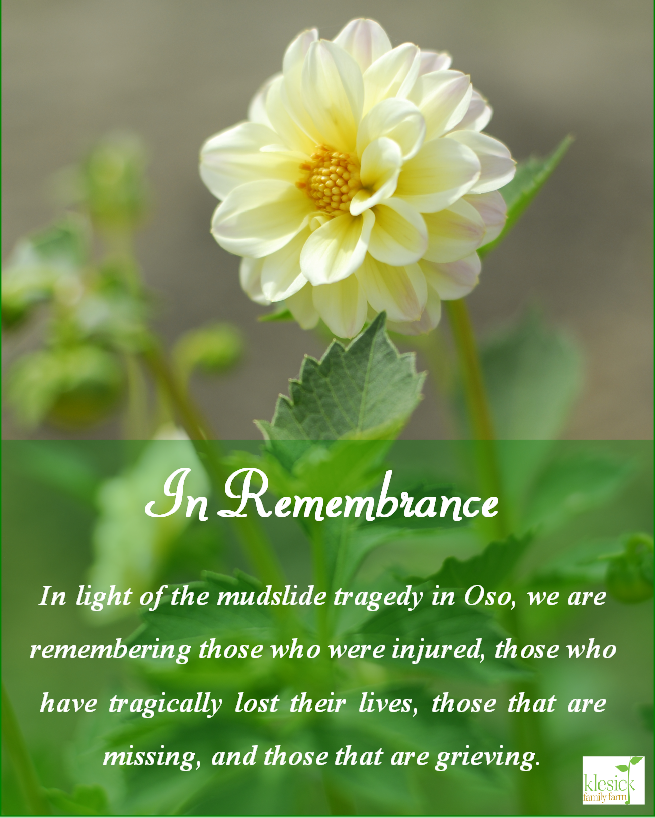
In light of the recent mudslide tragedy in Oso, we are remembering those who were injured, those who have tragically lost their lives, those that are missing, and those that are grieving.


tristan-sign

Posted on

Wild, Farmed, and GM

salmon-safe-logo 250x297In a far away land, there lived a fisherman who fished and fished and fished. The salmon he caught were sold at the marketplace. He was an early rising and hard working fisherman who had learned the habits of the fish. He understood their cycles and seasons, like when they would return to spawn. He respected the gift of the fish and so only fished in such a way as to not hurt the future of the fish or its ability to continue to feed not only people, but all living things within the watershed (bears, eagles, earthworms, grasses, trees).

As the years marched on, the fisherman noticed that the fish he was catching were a little smaller and less plentiful as they once were. He still sold his fish at the marketplace, but now he had competition from a farmer selling “farmed” fish. The farmer was raising salmon in a pen. The cost of raising the fish was cheaper and the marketplace got a bargain.

Eventually, word spread that the farmer’s fish didn’t have the richness, color, or the revered Omega 3s found in the wild salmon populations. The farmer soon discovered, however, that if he took the food of the wild salmon, like sardines and herring, and made it into fishmeal and fish oil to feed his farmed salmon, they tasted better. Unfortunately, there was a lot of bycatch (incidental or unwanted fish and other marine species) in the process and, as to be expected, a lot less fish for the wild salmon to eat.

The marketplace was growing weary and leery of farmed salmon, and for good reason. The farmer realized that the customers were becoming educated and were voicing their opinion about the overharvesting of sardines and all the bycatch. To make matters worse, word was getting out that his farmed fish were “getting out.”

After some thought, the farmer contacted another farmer and started to buy genetically modified (GM) soybeans to supplement the fish meal and fish oil, to help his farmed salmon grow bigger sooner. He reasoned that if his fish grew quickly, not only would they be ready for market sooner on less feed, but they would spend less time in the pen, meaning less chance for escapement. All of this would mean more profit.

Later, when a scientist discovered that a growth hormone could be injected into the salmon egg, causing the fish to grow twice as fast and twice as big, the farmer embraced the scientist. The marketplace, however, embraced neither, but instead let the farmer know that they would not eat his farmed, GM-fed, or GM-altered fish.

Thankfully, the fisherman was still fishing and bringing his nutrient-rich, Omega 3 laden wild salmon to  the marketplace, where he was greeted by excited customers who valued the fish and the fisherman for helping them live better and eat better.

Always organic, always GMO free.

tristan-sign

Posted on

A Box and a Quest

We rolled out our new Recipe Box last week and are pleased to see that it is meeting a need for many of our customers. For some time, I have been ruminating on a new box for our customers to try and this is it. A few years ago, we introduced the Essentials Boxes, then came the Northwest Box, then the Harvest Box, and last year the Juicer Boxes. All of these boxes originated because of customers like you communicating with us about what best met your needs.

The Recipe Box is built around its own recipe and contains all the ingredients available to make the recipe. The box is unique in that it may have pasta or beans or salsa or olive oil, in addition to the fruit and vegetable portions necessary for making the meal. It will also be portioned to serve 4 people. I am very excited for this new box and I hope you will enjoy it as well.

food-rulesOur Annual “K” Quest

It is that time of the year again! Time for the “K” Quest! Once again, we give our customers the chance to win a prize by embarking upon our virtual quest. Each day of the quest, we will hide the Klesick (our seedling logo) on a new page within our website. When you find it, click on the logo, enter your name and e-mail address, submit, and you will be entered into the prize drawing (one entry per day per customer). Two lucky “K” questers will receive a copy of Michael Pollan’s latest book, Food Rules!

Follow Klesick Family Farm on Facebook daily to receive clues on where to find the hidden “k”. The quest will take place February 3-11, 2014. The prize drawing will be February 11th and the winners will be notified immediately thereafter. Happy Questing!

signature