Posted on

Pollinators

It takes a community to raise anything, accomplish anything. Earlier this week I was walking by this beautiful rhododendron and was compelled to stop. I walk by this plant every day, multiple times on my way to the front door. But this morning, at 5:30, the plant was all a buzz, literally buzzing with the humble bumble bee—what a wonderful symphony! All these beautiful insects were freely about their work, in and out of one flower and then off to the next one, hundreds of them sharing the flowers with each other. It is beautiful.

We have lots of these workers everywhere. Our farm is a safe haven for them and for many more less common critters, all equally important, filling their space on our farm and in our community.

The rhododendron is beautiful and fragrant, but it really doesn’t have any economic value for the farm, unless you consider the pollinators. When the pollinators enter into the equation, that rhododendron becomes indispensable!

With all the trouble honey bees are having with the myriad of chemicals farmers are using to grow their crops, I am thankful for the other pollinators. My guess is that the humble bumbles are also impacted, but because they are not colonized like honey bees we do not hear about their losses. But if given space to forage where the farm is “clean” and free of chemicals, the bumble bees, and a host of other insects, thrive.

And as a side note, the farmer gets the apples, pears, plums, and berries pollinated and you get the “fruit” of their work and mine!

Next time you see a humble bumble at work, whisper a “thank you” for all the work they happily do for us!

Farmer Tristan


Recipe for this week’s box menu: Grilled Carrots with Lemon and Dill

Serves 2-4

Ingredients:

1 bunch carrots, scrubbed and patted dry

2 teaspoons avocado oil or other high-heat oil

1/2 teaspoon salt, divided

1 tablespoon dill, minced

1 tablespoon fresh lemon juice

1/8 teaspoon freshly ground black pepper

Instructions:

1. Trim tops and any fibrous ends from the carrots and cut crosswise into pieces approximately 3 inches long. Cut any thick ends in half lengthwise, so all pieces are about 1/2- to 3/4-inch thick. (If you are using an outdoor grill, see note below.) In a bowl, toss with the oil and 1/4 teaspoon salt.

2. Preheat grill pan or grill over medium-high heat. Place carrots cut-side down on the grill and cover. (Use a big pot lid or a metal sheet pan as a grill pan lid.) Grill for 4-5 minutes, until the carrots develop sear marks and are beginning to soften. Flip, cover, and grill for another 4-5 minutes. Carrots will be softened with a bit of crunch in the middle.

3. Transfer the carrots to a bowl. Mix in remaining 1/4 teaspoon salt, dill, lemon juice and pepper. Serve warm or at room temperature.

Recipe Notes:

If you’re using an outdoor grill, you may want to grill the carrots whole, so they don’t fall through the grates. After grilling, let them sit until cool enough to handle, cut them into pieces and proceed with the recipe.

Try using other acid and herb or spice combinations. A few ideas: lime juice & cilantro, balsamic vinegar & parsley, and orange juice & cumin.

Recipe from thekitchn.com


Know Your Produce: Green Onions

Also called scallions, green onions have a mild, sweet flavor; raw or cooked, they can be used in a variety of dishes. Unlike other onions, scallions are very perishable. Refrigerate them in a sealed plastic bag, and use within three days. Before cooking, cut away any wilted parts from the tops, trim the roots from the bulb, and wash thoroughly. Try them as a topping on pizza or cut up and added to soup during the last 5 minutes of cooking.

Nutritional facts: Besides being higher than other onions in folate and potassium, green onions provide a significant amount of beta-carotene (in the green tops).
Posted on

Local Solutions

When I have an opportunity to use my talents and resources, I jump on it! At Klesick Farms we are in the good food business – we grow, source and deliver good food to our local neighbors in Island, Skagit, Snohomish and King Counties. And each of these counties have hunger issues and together we are a part of the solution.

Our part of the solution has been to deliver local food to the food banks through our Neighbor Helping Neighbor (NHN) program. Year-to- date, through your partnership, Klesick Farms has sent over 384 of our $28 boxes of good food to local food banks.

I am now adding a new partner to our NHN giving program – The Everett Recovery Café. While technically not a food bank, they are also serving a group of our local neighbors. The Everett Recovery Café “is a community of healing, purpose, and hope. This safe haven from the streets provides an ongoing base of support for men and women who have suffered trauma, homelessness, addiction and/or mental health challenges. As these men and women contribute to the café community and develop relationships with peers and staff, they establish stability in housing, mental and physical health, relationships, education and employment.”

If you would like to help us extend a helping hand to the Everett Recovery Café or to the 8 other food banks (Everett, Oak Harbor, Anacortes, Edmonds, Lake Stevens, Marysville, Monroe, Arlington) you can schedule regular donation and we will do the rest. Your regular $28 partnership accomplishes a lot:

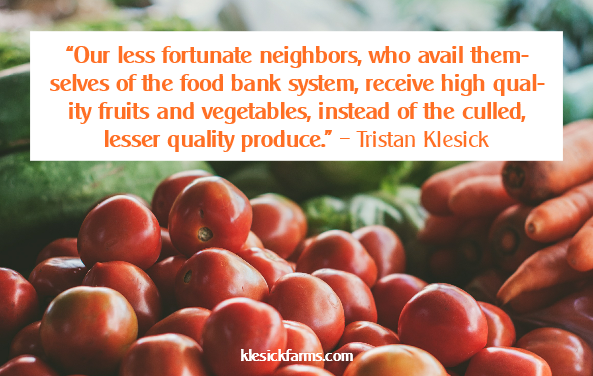
  1. Our less fortunate neighbors, who avail themselves of the food bank system, receive high quality fruits and vegetables, instead of the culled, lesser quality produce.
  2. The farmers we work with get to grow and sell more from their farms to help feed local families. This is a big deal. Our NHN food bank boxes have an average of 10 different items in them. For an example, year-to-date, with your purchases, we have sent over 10 extra cases of apples, 16 extra cases of lettuce, etc. Those are real numbers to a farmer and real food to local family!
  3. Klesick Farms matches every 4th box that is donated by you.
  4. We send a year end tax statement for you to deduct your donation.
  5. But most important, your gift of one of our NHN boxes is a gift of compassion and care to local folks who are our neighbors in need.

Our NHN program is one reason why we use the tag line a box of good!

Farmer Tristan

Learn more about the Everett Recovery Café here.

Know Your Produce: Baby Bok Choy

Bok Choy, a member of the cabbage family, has been cultivated by the Chinese for over 5,000 years. Besides China, it is also grown in California and Canada.

Bok choy is high in nutrition, containing several minerals, including potassium, calcium, phosphorus, and magnesium, and vitamins A, C, K, and a wide spectrum of B-complex vitamins.

Do not wash bok choy until you are ready to use it. Unwashed, it will keep in the refrigerator for up to six days.

Besides being used in stir fries, bok choy can also be added to soups for a delicate flavor, pickled for a refreshing appetizer, grilled or sautéed as a delicious accompaniment.


Recipe: Cornbread Panzanella Salad

Ingredients:

8 oz. cornbread, cut into cubes (about 2 cups)

1/2 cup halved cherry tomatoes

1/2 cup cubed fontina cheese (can substitute gouda)

1/2 cup cubed cucumber

1/4 cup chopped fresh basil leaves

1/3 cup extra-virgin olive oil

1 lemon, zested and juiced

1/2 teaspoon kosher salt

1/2 teaspoon freshly ground black pepper

Directions:

  • Combine all the ingredients in a large bowl.
  • Toss gently to combine.
  • Place in a serving bowl and serve.

Recipe from foodnetwork.com courtesy of Giada De Laurentiis

Posted on

A Time To Plant

I was talking to a group of second graders the other day about farming. I found that they ask some amazingly insightful questions; an insight, I think, that comes from their simplicity. A few were already well on their way to a life of healthy eating.

But as we talked back and forth, I wanted to impress upon them that eating good food starts with the soil and ends with a choice. Choosing an apple or carrot (the most popular vegetable) will help them grow up smart, healthier and strong. I explained to them that healthy plants don’t get sick, and the healthier we are, the less sick we get. It was a delightful 30 minutes with young ones eager to learn.

I too have a choice. I choose to farm without chemicals and work with nature to raise food in a watershed, in a local community, on a family run farm.

Thank you for the choice you also are making. You have chosen to support a farm that raises food without chemicals, in your watershed, in your local community, run by a family on a farm. That choice will make all the difference in the world for your health, your family’s health and your community’s health.

That is why planting the first crops of spring are so special for me, because I get to raise food for local folks – who get it!

Last week we took advantage of the nice weather and got a goodly amount of healthy lettuce and peas planted! It feels so good to get some crops in the ground.

Hang on, the local season starts with planting and ends with good food on your plate!

Tristan

Posted on

It is so Simple

At Klesick Farms we say, “Healthy eating made simple.” We also say, “Eat Better, Feel Better.” Sadly, most Americans are eating out of a plastic bag, a can or a box (ouch!). A lot of the food budget goes to packaged food, fast food or packaged fast food, and as a result our national health is getting worse.

Ironically, the antidote is to not eat “their” food. What is “their” food? The stuff in the middle of the grocery store—high carb, high sugar and low fat. Just try walking through the grocery store and try to buy a snack without sugar in it!

When a family makes an intentional choice to not eat packaged food, nutritional benefits go up. They go up because the family will be eating something to replace those carbohydrate-heavy foods with vegetables, fruits, nuts, seeds and proteins. (The proteins can be vegetarian or meat-based—based upon your choice.)

Close your eyes and just imagine the calm around all the schoolyards of our communities if PROCESSED SUGAR was not on the menu for breakfast, lunch, dinner and a bedtime snack. Shoot, just imagine the calm around the house!

Last week, I actually brought in an old fashioned sugar bowl filled with sugar for a talk I was giving. I also brought in the makings for an old fashioned lunch – a peanut butter and jelly sandwich and a low fat single serving chocolate milk. Do you know how much sugar is in this good old fashioned lunch? Remembering that 4 grams = 1 teaspoon, and assuming the body processes carbohydrates into glucose (sugar), here’s what I found:  2 slices of wheat bread = 28 grams; 2 tablespoons peanut butter = 15 grams; 2 tablespoons strawberry jam = 20 grams; 8 oz. low fat chocolate milk = 24 grams; total carbs (sugar) = 87 grams divided by 4 grams (1 teaspoon) = 21.75 teaspoons of SUGAR!

We would be better off putting the sugar bowl back on the table and adding our own sugar to our plain, unsweetened food.

There is no way that we could pour that much sugar on our cereals, sandwiches or in our coffee!

I think the sugar bowl in America has moved from the table to our waistline!

The good news is that the waistline can “trend” the other direction if we eat more vegetables, fruits and non-packaged foods. In fact, if we committed to eating the recommended 6-9 teaspoons of sugar a day (yes, a day!), we would see dramatic health changes in ourselves and other Americans!

But eating healthy is a spiritual decision. It takes will power and determination to eat differently. As far as I can tell, eating more vegetables, fruits and non-packaged foods looks like a good strategy to be healthier. If we are healthier, we are more than likely happier!


Providing good food for you and your family,

Tristan

Posted on

Peas and Pears

As I spend more and more time in the field, I love that the farm is coming alive. Spring is like a magnet – it draws me from a deep restful slumber to a “Yes, I am ready for spring” experience. These daily spring walks invigorate my soul. I know what is about to happen. It has been the cycle of my life for the last 18 years, yet it is always fresh, always new, and always CRAZY!

If we are going to maintain or increase our health, what we eat will be important. And, let’s face it, we are going to eat. Why not eat the good stuff? I am a huge proponent of, “If we eat better, we will feel better.”

As spring marches forward, so does the bounty of the local harvest! Every day, as I wander through my fields, taking mental notes, noticing the garlic, fruit buds, dandelion blossoms, honey bees and other insects, the signs are clear. Soon I will be orchestrating a beautiful symphony of local, organic, and nutrient-rich food.

Bon Appétit

tristan-sign

Tristan Klesick

Posted on

Our Food System Is Broken

We care more about our air and water quality than we do the food we eat. Last time I checked, we need to breathe, drink and eat. My cynical side says, “This means the coal lobby isn’t as strong as the sugar lobby.”

The EPA is lowering the boom on coal, but the FDA and the USDA are doing the old “wink-wink” when it comes to our food. The American food supply has been coopted by the sugar and processed food industries, with the blessing of the FDA and the USDA. But what has been the result of this high carb, high sugar, low fat experiment? An unhealthy American population!

The only way we are going to change our personal health is by not buying corporate America’s food! Only by removing the profit from Coca Cola, Pepsi, Starbucks, General Mills, etc. will the health of America change. When we intentionally stop eating their processed “food” they will respond. Of course, first they will advertise more to promote “the benefits” of their products. Then they will lobby Congress to protect them from the consumer, but finally they will produce healthier and more nutritious processed foods to earn your business back. They will do this not because they love you or care about your health, but because their pocket book is hurting! It’s simple. NO SALES, NO PROFIT.

If we are going to effectively change our food system and take it back, we are going to have to do it one bite at a time, by saying “yes” to more organic fruits and vegetables, and better quality dairy, meat, and wild fish.

The easiest way to win this war on our health (waistline) is to not eat their processed sugar laden products! If we consciously choose to not eat their food, we will win this battle. It only takes a 5% shift in their sales and they will respond.

And do you know what else? If you cut back on processed foods (a.k.a., sugar foods), you will avoid eating GMOs.

And do you know what else? You will lose weight just by not eating processed foods.

And do you know what else? You will feel better (after a few days as your body detoxifies) because you are eating better.

WOW, am I ever fired up! If we cut out sugar, we change the food system for everyone, and we will feel better and healthier!

Give it a try this week. Intentionally cut out sugar. Your body will thank you.

Cheers to your health,

Tristan

Posted on

It is Getting Closer!

We are slowly working our way towards the starting line. We just planted some sugar snap peas that will be transplanted mid-March, we are finishing up on the last minute maintenance that needs to be done on our equipment, we are checking seed supplies, and we will be “pulling” soil samples in the next few weeks.

The soil sampling is important. It helps us monitor nutrients in our soil and know what organic nutrients we need to order for our crops. We also take leaf samples throughout the growing season to check how well the plants are absorbing the nutrients from the soil. Based on the soil and leaf tests, I will foliar feed my crops to give them some extra nutrition.

You might be saying to yourself that is a lot of “fussing” over nutrients. So what’s all the “fuss” over soil and plant health really about? It is about you! Growing food for you is a privilege, and I want the food I grow for you to help you live a vibrant and healthy life. And food grown without synthetic herbicides, pesticides, and fungicides is better for you, the farmer, and the environment. But food grown with nutrition at its foundation is the prize! And that is what I grow for you – nutrient rich food. Bon Appétit!

But I have another prize for the next two weeks!

We are running a Share the Good Food campaign for the next two weeks.* We have teamed up with Theo Chocolate to offer a month’s worth of their 70% organic dark chocolate for every one of your friends who signs up for a box of good food. And as a thank you for referring your friend, I will send you a month of Theo dark chocolate with each of your deliveries, too. A month of free chocolate for you and your friends—now that is worth sharing!

*If a friend you refer signs up for delivery between 2/28-3/13, you will both receive a bar of chocolate with each of your deliveries that fall within the next four-week period, starting with when your friend signs up for delivery. The more friends you refer, the more chocolate you receive!

tristan-sign

Tristan

Posted on

We're headed to a home & garden show near you!

Come show your support for the community and share your passion for healthy homegrown food with your fellow Green-Thumbs. We’ll be there too, so be sure to find us and say “Hi!” We’ll be hosting a raffle each day to give away organic produce at the show (including for current customers) – you won’t want to miss it! Here’s the details so you can put it on your calendar.

image

Everett Home and Garden Show

March 11, 12 & 13

xfinity arena at Everett Broadway & Hewitt Everett, WA 98201

Show Hours: Fri: Noon – 7 PM Sat:10 AM – 6 PM Sun: 10 AM – 5 PM (Click image for tickets and more info.)

image

Skagit Island Home and Garden Show

March 18, 19 & 20

Skagit County Fairgrounds, 1410 Virginia Street, Mount Vernon, WA

Show hours: Fri, 11AM-6PM Sat,10AM – 6PM Sun, 11AM- 4PM (Click image for tickets and more info.)

image

Port Susan Home and Garden Show

March 19

Camano Center – Camano Island WA

Show Hours: 10 AM – 4 PM

FREE ADMISSION (click image for more info)

Posted on

Houston, We have a Problem

That is a classic line from the Apollo 13 movie, starring a very young Tom Hanks and Kevin Bacon. I hear that line playfully bantered around a lot when there are minor nuisances or inconveniences. But in the movie, “Houston we have a problem” was referring to a calm and calculated response to a very serious situation.

As a parent, I feel like Washington, D.C., isn’t getting it.  Our nation’s health is spiraling out of control. America has a serious health crisis that is going to impact every area of our nation: health care, military, political, family, the environment and education. Since the 1970s, when Jane Fonda was encouraging us to “exercise,” to the “Biggest Loser” today, what has changed?

We have been encouraged to exercise, eat low fat, and eat lots of grains and carbs, regardless of where those calories are coming from. And what has been the direct result of following the recommendations to exercise, eat low fat and a grain-based diet? More childhood obesity, more cancer, more heart disease, more diabetes, more health issues.

Yes, Washington, we do have a problem! And your pandering to the food, farm and biotech lobbies is at the heart of it.

I believe the underlying issue is sugar! It is in practically everything. There are over 600,000 grocery items in our stores and 80% of them have sugar added to them. Sugar is in our cereals, our coffee, our sodas, our breads, and our ice cream. If a food is processed, some company is trying to add sugar to it.

I contend our nation would be a lot healthier (and skinnier) if we swore off sugar or at least 90% of it.

But here is where good health meets dark health. The grocery manufacturers of America like to sell groceries, and since 80% of their products have sugar they lobby to protect themselves and their constituents.

To complicate the matter, the sugar beet and corn farmers also have a stake in the fight because they grow the sugar for the grocery manufacturers. If Congress makes any meaningful change in legislation that would curb the use of sugar or call it out as a health issue, they will get an earful from these farmers. To complicate the issue even more, the farmer’s primary supplier to help them grow all that sugar is none other than Monsanto and other biotech companies who have shoved genetically modified technology down our throats.

And so it goes. Our senators and congress people have to stand up against the grocery manufacturers and the farm and biotech lobbies if they are going to make any meaningful food policy changes. Ironically, these lobbies also happen to be the same ones that spend millions of dollars to make sure that GMO labeling never gets a foothold.

This situation hasn’t changed for decades, and it doesn’t matter whether the Clintons, Bushes, or Obamas are in office or the Bushes or Clintons are in back in office. They didn’t improve our food when they had an opportunity and I sincerely doubt they will this time around either.

The only thing that is going to make a difference is not supporting that food system. That food system doesn’t care about your family’s health, they care about profits, and no sales equals no profit! The less we eat of their food the healthier our family will be.

Thanks for supporting a different food system. Let your friends know where you get your real food!

Real food grown here!

tristan-sign

Farmer Tristan

Posted on

I Really Like Farming!

I can hardly contain my excitement! Every year I get a little winter’s rest and then the first crocuses show up and I am chomping at the bit to get out there and get going. As a matter of fact, I already planted my two green houses to spinach and radishes. I am planning on another early and warmer spring.

Do you know what my favorite crop is to grow? The one I am harvesting! If my plantings make it to harvest (most do), that is always my favorite crop at the moment. Picking it at the height of nutrition and flavor, packing it, and getting to you—that is exciting! And the nice thing about growing vegetables and fruit is there is almost always something to harvest.

I was just out in my fields, checking in on some overwintering curly parsley and chives, and you know what I found? Beets! Those beets were too small to harvest last fall, so we left them in the ground and now they are ready. The tops aren’t in the best shape, but the beets are solid and tasty. I wish I had planted more! Which is another nice thing about farming—I get to try it again next year! So, I will plant beets a little earlier (mid-August) and I will plant more of them, then I will have more beets to sell in the spring.

Now I might be the only farmer writing this newsletter, but a whole lot of you are chomping at the bit to grow some vegetables, too. Which is why Klesick Farms is now carrying vegetable seeds from High Mowing Organic Seeds. This is where I buy most of my seeds. I recognize that if we are going to have healthy food for generations to come, we are going to need genetic diversity in our seeds.

There are two ways to support organic seed production:

1. You can buy vegetables from growers who use organically grown seeds (if you are reading this letter you can check

that off!).

2. Or you can plant them yourself and still buy some of your vegetables from me.

If you are a gardener and would like to support organic seed production, you can buy them through our website or you can go to: highmowingorganicseeds.com/klesick and order them directly. Either way, shipping is free.

Also, we have arranged with Michael, at Rents Due Ranch, to have organically grown tomato, peppers, basil, and strawberry plants available this spring, so stay tuned for updates in early March for their availability.

Bring on spring!

tristan-sign

Tristan