
Author: Tristan Klesick
Cows on the Klesick Family Farm – April '14
Cows are happiest when they are knee deep in the green grass. Here’s a video update of the Klesick Family Farm cows in April, 2014.
Harvesting Lettuce & Spinach
When it comes to greenhouses, I am a newcomer. For years, I have eschewed the technology, but after a spring like this, “I am a believer!” We have taken a beating from the weather this spring and our planting windows have shrunk considerably. I know I have a relatively short memory (comes with age), but I am a little dismayed by the lack of farmable weather for April—March was a better month.
But if you saw my “Wednesday Farm update Video” last week on Facebook, you can tell that I have turned 180 degrees on my opinion about greenhouses. If it wasn’t for my two greenhouses, I wouldn’t have gotten peas planted and then transplanted out to the fields. Granted, I mudded them in, but they are growing and when the weather breaks they will take off and get growing in a hurry.
For the first time, I planted an early spring crop of lettuce and spinach in one of the greenhouses and, experimentally speaking, I might make it a habit. The spinach is not as profitable to grow in the greenhouse as the lettuce, but it does grow a few weeks quicker and can be direct seeded. Lettuce, however, needs a little warmer nights to start from seed, but as transplants they are good to go. Next year, I will probably grow lettuce exclusively in both houses. Mostly, lettuce is a little simpler to harvest and handle than spinach. And during most springs, “simpler to harvest and handle” is appreciated by this farmer.
In our valley, the farmers are traditionally dairy farmers or they raise crops like spinach, cabbage, chard and beets for seeds. The dairy farmers need to start cutting their fields soon, before the grass is overripe, and then they need to get the corn planted. The seed crop farmers (farmers who raise crops for their seeds and not the vegetable) need long growing seasons and April is a critical month for them. But this hasn’t been a normal “wet” spring and some of my large farming neighbors are going to be financially impacted if warmer dry weather doesn’t come pretty darn quick.
Ironically, the weather is one reason I like to farm. I like the challenge of working with what comes my way and the different management styles each season, crop and weather require. The weather is also why I grow different crops, because from year to year, I won’t know which crop will “pay the bills.” It can be spinach and other leafy vegetables or potatoes or tree fruit or beef cows or any combination thereof.
But then the weather can be almost perfect like last year, when almost everything we planted did well. And in those rare seasons, when all the crops do well, it had a lot to do with the weather!
Living a Giving Life
I have been thinking about the act of giving. Giving is an opportunity to participate in making some thing, some place or some one’s circumstances better than could be accomplished by itself. Giving requires sacrifice, a lot or a little, but you have to be willing to deny yourself something in order to give.
This past week, the world celebrated Easter—a holiday to remember the resurrection of Jesus. Nothing has more radically impacted the world than His birth, ministry, death and resurrection. He is the ultimate example of giving.
We believe in giving. And we believe the act of giving, whether money, talents or time, is freeing. It reminds us that we are not the most important entity in this world. It changes our focus. It intensifies our senses and awakens us to the needs of others and other things. Giving also allows us to give more, and it is contagious and infectious. Being generous is a surefire way to live a happy life.
This is why, when an opportunity to give arises that we can participate in, we are all in, in whatever capacity we can participate. But we have had to learn where to draw our giving boundaries over the years. Here is what we have learned about giving:
1. We have planned giving and then we dig deeper for emergency giving.
2. We always pray for whatever the pressing need is.
3. Then we assess how we can help. Is it with time, knowledge, communication, money or all of the above?
4. Sometimes we are unable to participate because of location or skills needed.
5. If we cannot help physically at the location, that is okay. Help comes in many different shapes, sizes and methods, and all of it is needed.
6. Refer to #3 and decide what you can do and then do it with all your heart!
Lastly, we are grateful and thankful for your partnership as we reach out to the Oso and Darrington communities. As a group we are able to collectively do more than as an individual, but community can only happen when two or more agree to walk together.
Thank you for walking alongside us to help Oso and Darrington land on their feet again.
Tristan
Spring
This week, it looks like we are going to have a decent stretch of good weather and every farmer is going to be hard at it working the ground. As much I try every year to get ahead of or prepare for the farm season, I never feel that I am quite ready for it to begin. We have been plugging along doing many non-weather-related projects, but these can be miserable chores when it is raining sideways or hovering around freezing. But we do get many of them done; albeit, all layered up and looking like the Michelin man trying to stay warm.
Although Urgency and Procrastination are distant cousins, they both can be task masters. I try to strike a balance between the two of them, between what has to happen and what can wait. Nevertheless, there is nothing like a few good days in spring to put a bounce in your step and a burst of “get ‘er done” coursing through your veins!
Much to the disdain of Cousin Procrastination, we have made some pretty significant changes this winter. We have realigned our farm fields to make them more efficient to farm, upgraded fencing for our grass-fed cattle and invested in farm equipment to help us with harvest and post-harvest handling.
I find it ironic how Cousin Procrastination lives with me, but I am not quite sure when Cousin Urgency is going to pay me a visit. Although I do expect a visit every time this year, I am just not sure when it will be. However, the thought of Cousin Urgency coming does tend to accelerate the pace of activity and the need to get ready for the visit.
Well, Cousin Urgency has arrived and the Klesick family is going to be busier than a “one-armed wallpaper hanger.” We still have fencing to button up before the cows arrive. We have 3,000 pea plants to get in the ground and trellised, plus another 10,000 peas to direct seed. There is a ton of potatoes waiting to be planted, so I need to get that ground ready, fertilized and composted, and IT ALL HAS TO BE DONE YESTERDAY! At least this is what Cousin Urgency is saying. In reality, it can be accomplished over a few weeks and everything will be just fine. Striking that balance is the hard part, and as sure as “the cream rises to the top” the most pressing tasks make it to the top of the list.
Thanks for checking in. Your good food team will be hard at it growing, sourcing and delivering organic and GMO-free fruit, vegetables and grocery items for you this week and every week.

Oso Mudslide Relief Efforts
My family is from the Oso community. My cousins have been among the many volunteers on the ground doing an amazing work. Being “locals,” their understanding of the area has been absolutely critical to the relief efforts. Their knowledge of the location and usability of back roads, the location of heavy equipment and where to find local resources, like gravel, is invaluable. I have cheered them on and checked in every day. I have listened to the stories and hardships—it is heart-wrenching.
The news is doing a good job of not over-sensationalizing this event because it really is as bad, and might be even worse, than reported. I have worked on many disaster sites and led a few teams, but I have never seen devastation like this before. The loss of life and the magnitude of the slide and its location have created a very challenging rescue and recovery operation.
I am heartened by the efforts of the Oso, Arlington and Darrington communities and the work of Snohomish County, the State and the Federal response teams. We are at the point where large sums of money are being donated and used to stabilize the situation and lots of government agencies and large non-profits are in full support mode and using their expertise to help these communities. Although this outpouring of giving and help is incredible, from my past experience during and after disaster responses, it usually wanes fairly quickly, but the physical, emotional and financial impact will continue for those rebuilding their lives. It is a part of human nature to rally our efforts at a time like this, but these efforts are hard to sustain long-term.
So here is what I am proposing:
The Klesick Family Farm would like to engage in the disaster relief for the long haul. I have budgeted $1,000/month to help put families back on the ground. We will be working with local community churches that are nimble and able to quickly get resources to the impacted families.
Like us, many of you have already donated –thank you. However, I would ask you to consider partnering with us for the long haul and setting up a recurring tax-deductible donation on your account. Imagine if half of our customers added an extra $1 per delivery—we could raise $3,500 per month to extend hope to our neighbors in Oso and Darrington.
How to Help the Oso & Darrington Communities
- Give through Klesick Family Farm: Give your charitable contribution through Klesick Family Farm and we will get it into the hands of the locals. You can either make a one-time donation or add the donation as a recurring item to your regular produce delivery. Recurring donations will be scheduled to terminate at the end of June or sooner if you’d prefer. 100% of donations will go local community churches and other non-profit organizations to directly help families who have been most impacted. Donations are tax-deductible. Donors will receive a tax statement at the end of the year. Please visit our website to donate.
- Red Cross of Snohomish County: If you wish to help victims of the Oso mudslide, cash donations are preferred. The American Red Cross is no longer collecting items. Go to the Red Cross of Snohomish County at www.redcross.org/snoco to donate. People can also text “RedCross” to 90999 to make a $10 donation.
- Darrington Community Center: The Darrington Community Center welcomes any donations brought into the center, which is located at 570 Sauk Ave. 360-436-1217.
- Check with your local bank, as many have set up accounts to donate toward the relief effort.
Thank you for your generous outpouring.
Providence
I often quote to myself (and to others) that simple prayer by Francis of Assisi, “Lord, grant me the strength to accept the things I cannot change, the courage to change the things I can, and the wisdom to know the difference.”

As the farm season starts to unfold, there are bound to be things that I have planned to do, but just won’t get to. It might be weather related, it could be a timing issue, or it could be just a lack of time. But one thing is for sure, I will get to a lot of things on my list and a few things that weren’t. And at the end of the day, at the end of the farming season, I will have gotten something planted, weeded and harvested.
This week, we are planning on doing something that wasn’t on my farming list. In January, I ordered 4 flats of lettuce to transplant into our greenhouse. Our greenhouse isn’t very big and I was planning on only planting lettuce in half and spinach in the other half. I planted the spinach by seed and then went to get the lettuce transplants—all 512 of them.
When I arrived to get the flats, we walked over to get them and I started to grab the 4 I ordered and the nurseryman asked, “Is that all, you ordered 40?” My response was “gulp.” 40 flats x 128/flat = 5,120 plants. I have never planted 5,120 lettuce plants in my life at one time. So much is really out of our control when it comes to farming, and this week I picked up the remaining 36 flats of lettuce to transplant.
This will be a big undertaking, because the weather has not been the greatest for preparing a seed bed. Well, when an opportunity presents itself, like an extra 4,608 lettuce plants to plant, I stop, pause and evaluate the opportunity and then I pray, “This wasn’t my idea, but Lord if you want to do that, I am game!” Then I start looking for an opportunity to plant 5,120 more heads of lettuce in the first week of spring.
This is a bold move and definitely qualifies as borderline stupid, which is why I normally don’t plant lettuce in March! But sometimes on occasions like this, you discover a new way of doing something and other times you affirm why you don’t do something. Time will tell. For now, I am going with Providence and growing a lot of lettuce at the Klesick farm!
Your local lettuce farmer,
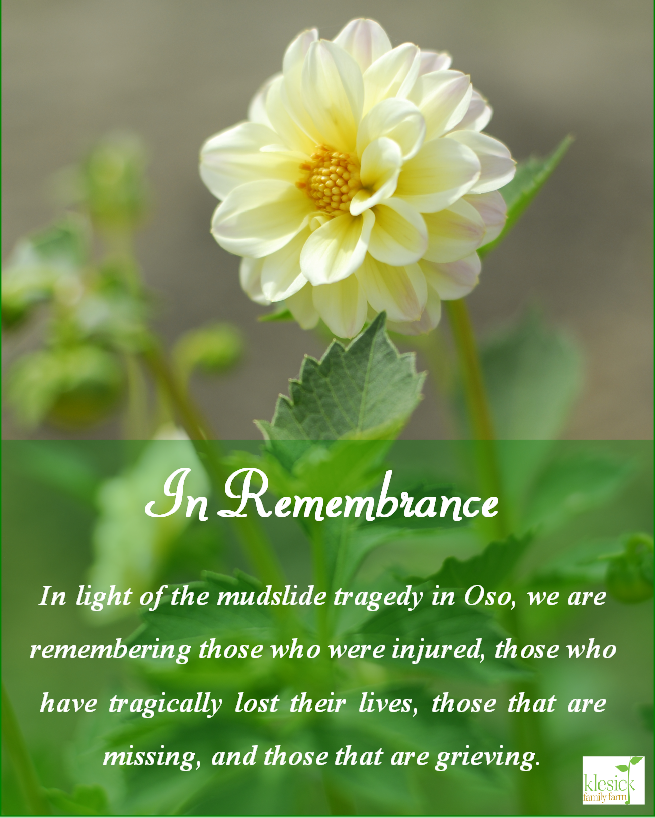
In Remembrance
I often quote to myself and to others that simple prayer by Francis of Assisi,
God, grant me the strength to accept the things I cannot change,
the courage to change the things I can,
and the wisdom to know the difference.
In light of the recent mudslide tragedy in Oso, we are remembering those who were injured, those who have tragically lost their lives, those that are missing, and those that are grieving.
Chives, Crocuses, Daffodils and Tulips
The time has come. All winter long I wander around doing this and doing that almost aimlessly, but not quite. During the winter, our family tends to rest and recuperate from the previous farm season. (We even went to Disneyland for the first time in 23 years, which was not restful, but it was fun.) But I must be a farmer at heart, because it is this time every year that the winter fog becomes a little less dense and my senses awaken to spring. I think there is a little farmer in all of us during this time of year!
I get excited when I see grass growing. I don’t love to mow, but I love to notice the nuances in the shades of green or the thickness of the blades. I am also drawn to buds on the fruit trees. I notice the leaf buds and fruit buds, I pay attention to how much they are swelling and I wonder if a hard frost will set them back this year, again. I begin to think about the pollinators. Will it rain during the time the flowers are open, will the bees want to get out and work so there will be fruit in the fall?
I notice how much water the mud puddles are holding and how much they have dried or not dried out. I pay attention to the impression left by the tractor tires—how deep, how defined or not at all. I listen to the birds, the frogs, the coyotes—each species unique, but still calling this their home too. I also notice that the swans are still here, but I know that when they move on from this winter home, that it will be time to plant strawberries, peas and spinach.
Now I am looking for pockets of weather, openings in the curtain of heaven, to begin my annual dance with this farm. In many ways it has already begun because our farm is a living eco system with many types of crops growing. We have been pruning fruit trees and seeding greenhouses, we have been in the shop repairing and building equipment to help us this season, our seeds have been ordered, soil samples taken and fertilizer blends have been created to feed each of our crops.
So it is, as our daylight increases, so does our energy, focus and purpose. Our partnership continues with this patch of earth we call home, to grow fruits and vegetables that are so flavorfully packed with sunshine and nutrients that they will cause your taste buds and mine to dance—food that will feed your family and mine!
Always organic, always GMO-free.
Wild, Farmed, and GM
 In a far away land, there lived a fisherman who fished and fished and fished. The salmon he caught were sold at the marketplace. He was an early rising and hard working fisherman who had learned the habits of the fish. He understood their cycles and seasons, like when they would return to spawn. He respected the gift of the fish and so only fished in such a way as to not hurt the future of the fish or its ability to continue to feed not only people, but all living things within the watershed (bears, eagles, earthworms, grasses, trees).
As the years marched on, the fisherman noticed that the fish he was catching were a little smaller and less plentiful as they once were. He still sold his fish at the marketplace, but now he had competition from a farmer selling “farmed” fish. The farmer was raising salmon in a pen. The cost of raising the fish was cheaper and the marketplace got a bargain.
Eventually, word spread that the farmer’s fish didn’t have the richness, color, or the revered Omega 3s found in the wild salmon populations. The farmer soon discovered, however, that if he took the food of the wild salmon, like sardines and herring, and made it into fishmeal and fish oil to feed his farmed salmon, they tasted better. Unfortunately, there was a lot of bycatch (incidental or unwanted fish and other marine species) in the process and, as to be expected, a lot less fish for the wild salmon to eat.
The marketplace was growing weary and leery of farmed salmon, and for good reason. The farmer realized that the customers were becoming educated and were voicing their opinion about the overharvesting of sardines and all the bycatch. To make matters worse, word was getting out that his farmed fish were “getting out.”
After some thought, the farmer contacted another farmer and started to buy genetically modified (GM) soybeans to supplement the fish meal and fish oil, to help his farmed salmon grow bigger sooner. He reasoned that if his fish grew quickly, not only would they be ready for market sooner on less feed, but they would spend less time in the pen, meaning less chance for escapement. All of this would mean more profit.
Later, when a scientist discovered that a growth hormone could be injected into the salmon egg, causing the fish to grow twice as fast and twice as big, the farmer embraced the scientist. The marketplace, however, embraced neither, but instead let the farmer know that they would not eat his farmed, GM-fed, or GM-altered fish.
Thankfully, the fisherman was still fishing and bringing his nutrient-rich, Omega 3 laden wild salmon to the marketplace, where he was greeted by excited customers who valued the fish and the fisherman for helping them live better and eat better.
Always organic, always GMO free.
Salmon Safe Certification 2014
We’ve renewed our Salmon-Safe Certification!

This means that Klesick is:
- Maintaining a buffer of trees and vegetation along the stream banks
- Controlling erosion by cover cropping bare soil
- Improving the passage for migrating fish
- Applying natural methods to control weeds and farm pests
- Using efficient and non-wasteful irrigation practices
- Protecting wetlands, woodlands, and other natural areas
- Promoting on-farm plant and wildlife diversity
Learn more about Salmon-Safe on Stewardship Partner’s website.
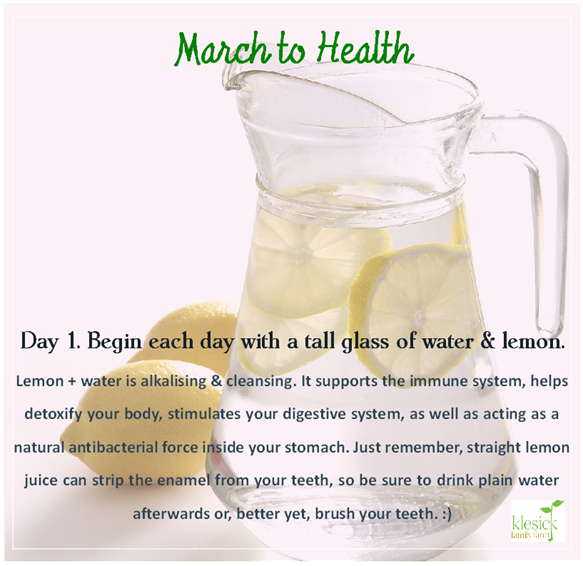
March to Health – Food, Health & Exercise Tips

Always Organic ~ Always GMO Free
 What’s the rub when it comes to GMO free and organic? Understanding where the organic and GMO free movements connect and do not connect can create some friction or rub some people the wrong way. I would like to tackle the organic, GMO free definitions. This opinion is my own, shaped by 20 years in the good food movement (my oh my, where did the time go?) and countless conversations, workshops and books I have read. I have been blessed to know and interact with some of the most incredible farmers, food activists, and conservationists during this time.
The organic movement was founded in direct response to the abuse of the soil and continual decline of the nutritional value of food. In the early days, the farmers or visionaries behind this movement recognized that there is a big difference farming with nature versus trying to conquer nature. These die-hards respected the soil and recognized that a functioning farm should resemble a healthy eco system. From this foundation, the organic food movement has developed a list of what can be called “best management practices.” These practices govern what can be applied to the soil and when it can be applied, and it is governed by third party certifying agencies and the USDA.
It is important to know that organic does not mean “no sprays,” no pesticides, or no herbicides because there are naturally derived pesticides (like bt) or herbicides (like vinegar) that can be used. Organic does mean that no synthetically derived sprays, pesticides, herbicides, or fertilizers can be used. Organic farming is a system of farming and it requires different management principles than non-organic farming, but organic farmers still have an arsenal of sprays, pesticides, herbicides and fertilizers at their disposal. The difference is from what source they are derived—natural or synthetic. They are also GMO free by definition, since GMOs are prohibited by National Organic Program (NOP) standards.
The GMO free community is an important movement that is gaining lots of traction. We are seeing labeling initiatives springing up all over the place. But is GMO free better for you? Yes and no. It is true that a GMO free label means that these food products have been processed with beans, corn, or canola that have not used genetically modified organisms in the seed stock. But if the label doesn’t also say USDA Organic, it means that that product is grown non-organically using synthetically derived pesticides, herbicides and fertilizers. So while the seed itself is not laced with pesticides or herbicides, the plants are more than likely sprayed with them. This is an important distinction, which means that GMO free products fall into the same category as non-organic fruits and vegetables.
Your best bet is to eat organically grown fruits, vegetables, grains and organic processed foods to avoid food that is farmed with synthetically derived pesticides, herbicides, and fertilizers. Organic is better for you and better for the soil.
Which is why Klesicks is always organic and always GMO free!
Time to Prune
 Last year, we “top worked” some Comice pear trees in our orchard—36 to be precise. We saved 12 of these trees to pollinate the Buerre Bosc pears. I planted the orchard five years ago, but the Comice pears have not performed well and seemed unhappy in our microclimate. The Bosc pears, however, took to the microclimate like a duck takes to water. So this winter, I cut some scion wood from the Bosc pears and am going to “top work” the last 12 Comice pear trees. Last year, we grafted the Comice pears over to Conference pears and four Asian pear varieties. The picture in this article is Stephen cutting off the “nurse” limb we left to stabilize the tree from the aggressive pruning.
Definitions:
Top working is a term that refers to grafting a new variety onto an existing tree. In a sense, you are working on establishing a new “top” for the tree. It can save a few years in establishing a new variety and lots of dollars. “Top working” makes sense if you are happy with orchard layout, irrigation tree spacing, and if the new variety is compatible with the existing root stock.
Nurse limbs are designed to allow the tree to funnel energy to the new shoots that have been grafted onto the top of the “stump.” It works well because the “nurse” limbs are lower and the tree begins to put energy into building a new top. In the following spring we come back through and select the best of the grafts and cut off the “nurse” limbs.
Grafting is the process where one variety is grafted into or onto another tree. As mentioned earlier, it can really speed up the process of getting back into fruit production by 2-3 years. It is a relatively straitforward process, but you need to be ready to do it when the weather is right, towards the end of April. You also have to gather the scion wood in the dead of winter and store it at near freezing to keep it dormant.
Scion wood is the wood that is grafted onto the existing tree. We typically use a 4-6 inch piece of wood with 3-4 good buds (buds become the future branches). Amazingly, as the main tree adopts the grafts, they will grow 2-4 feet over the summer. And now we are selecting the best “grafts” from last year to grow the new tree.
If all things go as planned, we should see a small crop next year of Conference pears and a larger crop of Buerre Bosc pears in two years from the “top worked” trees this year.
My Head is Swimming!
 I have been at three farm conferences in three weeks and the amount of information is overwhelming. Literally, I feel like I have been drinking out of fire hose.
The first was the Eco Farm Conference in Monterey, CA. That was a tough place to visit :). This is the conference where the hardcore organic food movement gathers annually. Lots of great classes on food systems, local agriculture and environmental initiatives. At this conference I was able to connect with other growers, buyers and foodies. Lots of optimism and hope for the future of organic food. And I wholeheartedly concur that the good food movement is alive and well.
The following week I found myself in Coeur d’Alene, ID at another meeting. This one was a part of a the local farm bank that I work with. At this meeting I found myself sitting among farmers who farm thousands of acres. This agriculture group refers to themselves as Agribusiness or production Ag. Even though I don’t farm that kind of acreage, I had been invited to the table to get in there and talk about healthy food and healthy farming practices and also listen to the wisdom these farmers have to offer. Also, this group is dealing with Succession Planning, so a good amount of time was spent on the importance of “planning to pass” the farm onto the next generation of farmers. The big take away for me at this conference was to ensure that as I plan for the future, I update our wills!
But, sadly, I have to admit that coming from CA to ID, the two conferences were more like the weather in more ways than one. You could say that one group drinks Bud and grows the Hops for it and the other is more likely to grow the bud and smoke it. I will let you decide which group does which (just for the record, I do neither). Tragically, both groups view each other as enemies. I think there is a lot of common good that can be shared between both groups if we could be less democrat and republican, liberal and conservative, or quite frankly, just plain civil.
But the last conference in Spokane was about growing nutrient-rich food! Now this is a breath of fresh air! The growers here are giddy with the results they get farming with nature and not against it. It is about using soil and foliar biology to build nutrition in the plants that feed YOU! Now this is right up my alley—large growers, small growers, organic or mostly organic growers, all focused on not only replacing chemical inputs with organic inputs, but farming with a whole different set of principles that put the soil first, not profits.
This is why I farm biologically, why I farm the soil, because the soil is everything. Benjamin Franklin said it best, “A nation that destroys its soils, destroys itself.” This famer and the farmers we work with to feed you every week are a part of the solution, farming living soil and producing living food.
Hurry up spring, as I can hardly wait to start farming!
A Box and a Quest
We rolled out our new Recipe Box last week and are pleased to see that it is meeting a need for many of our customers. For some time, I have been ruminating on a new box for our customers to try and this is it. A few years ago, we introduced the Essentials Boxes, then came the Northwest Box, then the Harvest Box, and last year the Juicer Boxes. All of these boxes originated because of customers like you communicating with us about what best met your needs.
The Recipe Box is built around its own recipe and contains all the ingredients available to make the recipe. The box is unique in that it may have pasta or beans or salsa or olive oil, in addition to the fruit and vegetable portions necessary for making the meal. It will also be portioned to serve 4 people. I am very excited for this new box and I hope you will enjoy it as well.
 Our Annual “K” Quest
It is that time of the year again! Time for the “K” Quest! Once again, we give our customers the chance to win a prize by embarking upon our virtual quest. Each day of the quest, we will hide the Klesick (our seedling logo) on a new page within our website. When you find it, click on the logo, enter your name and e-mail address, submit, and you will be entered into the prize drawing (one entry per day per customer). Two lucky “K” questers will receive a copy of Michael Pollan’s latest book, Food Rules!
Follow Klesick Family Farm on Facebook daily to receive clues on where to find the hidden “k”. The quest will take place February 3-11, 2014. The prize drawing will be February 11th and the winners will be notified immediately thereafter. Happy Questing!

Crocuses!
 As Chungo, our friendly black lab, and Myliss, our friendly cat, were soaking in the sun from our front porch this beautiful winter day, one couldn’t help but feel a little touch of spring in the air, but I am not easily fooled. As I walked up the steps to the ever-inviting tail wagging of Chungo, calling out to me for a scratch around the ears, I was treated to the first flush of crocuses! On our farm, they are the first telltale sign of what is to come. I love to see them as they start to peek through the flower bed mulches that have been keeping them warm and nourished since October. Those first shoots are so green, with that dark vibrant green that is overflowing with life. It is invigorating to my soul and serves as a reminder that spring is just around the corner.
And with the encouragement of the first crocuses, comes a little extra energy bump and reminder to pick it up a little. We still have fences to mend, gates to build, trees to prune, raspberries to tie off and transplant, and scion wood to collect for this year’s grafting. We are still busily deciding where to plant what, when and how much. We are going to try some early greens in one of our greenhouses and some baby ginger in another one. It is amazing how a little sunshine can provide the burst of energy to get those winter projects buttoned up! Stay tuned.
The Recipe Box
This week, we are rolling out the new Recipe Box. I have been ruminating on a new box for our customers to try and now we have it. A few years ago, we rolled out the Essentials Boxes and then we introduced the Northwest Box, which features only locally grown items. Next, we introduced the Harvest Box and last year we introduced the Juicer Boxes. But all of these boxes originated because of customers like yourselves communicating with us about what worked and didn’t work for your needs.
In that same spirit, the Recipe Box has come to life and is now available. This box will be built around its own recipe and will contain all the ingredients available to make the recipe. The box will be unique in that it may have pasta or beans or salsa or olive oil, in addition to the fruit and vegetable portions necessary for making the meal, and it will be portioned to serve 4 people. I am ultra excited for this new box and I hope you will enjoy it as well.
Cheers to your Health!