
Posted on Leave a comment

What Your Produce Dollar Really Supports

Girl getting home delivery of box of good organic local home delivery of produce in seattle washington

Why choose local when it comes to the increasing options for produce delivery? 

The marketing has been loud from some national mega companies, encouraging consumers to purchase produce that is ugly or imperfect in order to address our country’s food waste epidemic. However, the source of our country’s food waste stems from our broken food system and overproduction. We already have a system set up to use blemished products. It goes to our food banks and is used for frozen goods, canned goods, pet foods, and every type of processed food you can imagine. Unfortunately, the feel-good messaging from the venture capital-backed ugly produce movement will leave in its wake many local farms and small businesses. 

We’d like to encourage you to consider the long-term cost benefit of choosing to support local farms/businesses, the environmental impact, and benevolent impact it has in our own communities. Consider the Box of Good. 

Because of our passion to keep local farmland viable, the platform we’ve been given in our business, community involvement, and countless volunteer hours, over the years we have been able to play a pivotal role in impacting future generations, through farmland preservation initiatives, right in our own Stillaguamish and Snohomish Valleys. (Ask us about this if you’d like to know more!) 

The number of for-profit family farms is shrinking at an alarming rate! We need local farms. In the PNW consumer production farming in the winter is nearly impossible, however, the home delivery business model makes it possible for us to farm in the spring, summer, and fall and then source in the winter. This model keeps local farmland in production, which helps maintain future food security. 

In addition to farming in this community, we are honored to partner with our customers to help meet the needs of those experiencing financial hardship. Before we started donating to our local food bank, 23 years ago, they told us that they only had canned goods for their customers, and a few, barely edible, produce items. Our imperfect produce goes to the food bank twice a week, and we also have customers who donate delivery boxes. We do give some trimmings to local animal farmers and we also compost in order to provide additional soil nutrients for next year’s crops! NOTHING goes to waste! And, last year alone, we were able to donate over $32,000 worth of high-quality organic produce to 12 local food banks, with the help of our customers! 

Included in the Box of Good is our weekly newsletter including information about our own farm, farming and land use issues, PNW agriculture, understanding our government food policies, nutrition, the how and why of healthy eating, inspiration for healthy living, recipes and tips for preparing your produce.  We love sharing our passion for farming and health! 

Our produce is always certified organic because that’s what we believe in!  When ordering from Klesick’s you can be assured that your produce will be fresh, carefully selected, and handled with care, both in our packing facility and in our own delivery vans, while on route to your home. Orders can be simply placed online, or our helpful office staff is available to work with you to create the perfect box for your family.  We are always happy to address any concerns or answer any questions! 

At Box of Good we offer high quality/nutrient dense home-delivered organic produce at competitive pricing!  We are a local farm and a local business with a heart for the people and the community we live in. We are honored when you choose us to supply you with not just a box of produce, but with a Box of Good! 
Posted on Leave a comment

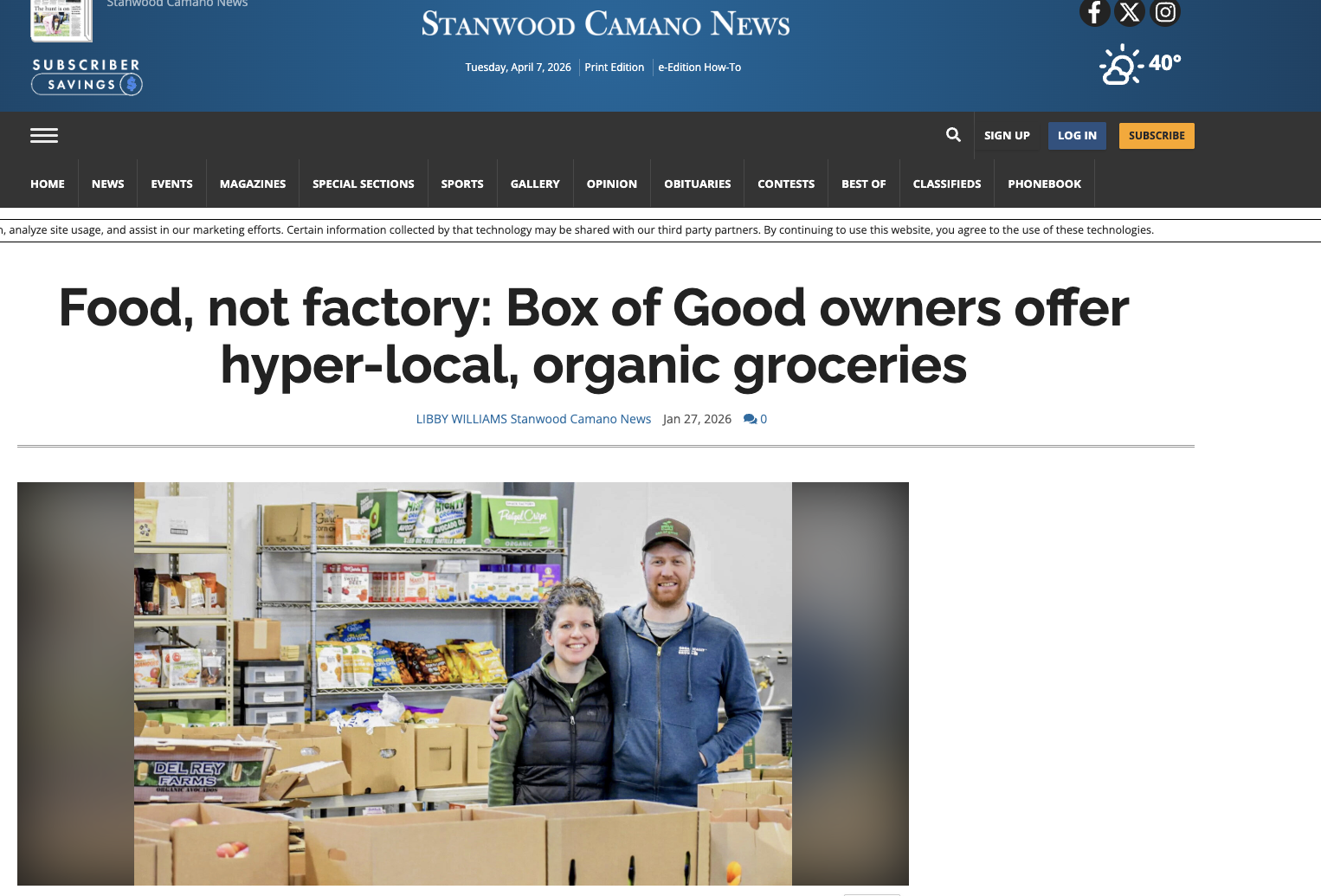
Food, not factory: Box of Good owners offer hyper-local, organic groceries

Tobin Fekkes is in no short supply of “soap box” moments when it comes to talking about locally sourced food and supporting farmers.

Fekkes said he doesn’t remember when the passion began, but it’s driven him to become the owner of Box of Good Foods along with his wife, Emily Fekkes.

Box of Good is a local, organic food and grocery delivery service based in Stanwood.

Tobin Fekkes got involved back in 2016, when the company was called Klesick Farms.

This past week, the couple finalized the process to become the sole owners of the business.

They said their goal is to combat a problem they’re seeing: food at the grocery stores isn’t really food anymore.

“The food that gets into the grocery store is designed for the transportation and not for your body,” Tobin Fekkes said. “And, to get food to last as long as it needs to in a freezer or a truck or on a pallet or on a warehouse shelf, you have to turn food into factory food.”

He gave the example of tomatoes that are picked green and “ripen” throughout the transportation process, so people may eat a red tomato, but it tastes green.

The couple’s solution is simple: simplify the process.

“(We’re) sourcing hyper-local stuff … and you can cut your distribution from weeks or months or years, in some cases, down to days or hours,” Tobin Fekkes said.

“We pick up carrots from Mount Vernon on a Wednesday, they were picked Wednesday morning, go in a box on Thursday, and they’re at your house on Friday morning.”

Boxes are customizable depending on a customer’s need, down to the ripeness of the bananas, so the Fekkeses can time them out for the week.

A small team of delivery drivers brings the food to homes within an hour’s radius of Stanwood.

Tobin Fekkes said a sign of quality in Box of Good’s products is their ability to go bad.

“If your stuff doesn’t go moldy, then it’s not really that organic. Organic mold is actually a good sign because your food is real food,” he said.

He said the company differs from community-supported agriculture, or CSA, because, unlike a CSA that can only provide produce during the growing season, they’re able to source produce year-round.

Emily Fekkes said this is due in part to how many new farmers and providers the company has gained throughout the years.

“It’s grown a lot, we have bread, and we have raw milk from Camano Island Creamery, and we have eggs and cheese from Samish Bay and fresh pasta from Whidbey Island,” she said.

“The idea is that it can be your whole grocery, and it’s organic and local.”

During the growing season, Box of Good works with about 40 to 50 providers, which decreases to about 25 in the winter months.

The Fekkeses said they believe in supporting local farmers, something they don’t feel happens enough through big box grocery stores.

“If we want to keep being able to have fresh food available, we have to be directly investing in it,” Emily Fekkes said.

Besides direct payment, Box of Good also provides opportunities for suppliers to reduce their environmental impact.

“Our barbecue guy, he does TV dinners, tallow, barbecue sauce, and he had everything in plastic containers with a film lid … and his barbecue sauce, the first ingredient was high fructose corn syrup,” Tobin Fekkes said.

He said he worked with the owner of Pure Smoke NW BBQ to switch to non-plastic containers, which cost less, and change the ingredients to healthier options.

The couple has also worked with dairy farmers to use glass containers that customers return to be refilled.

Tobin Fekkes said they make these efforts because it shouldn’t be on the consumer to fix the environmental shortcomings of companies.

“It’s always the consumer’s job to fix the problem of more, or it’s your job to pick a paper bag instead of a plastic bag, or it’s your job to pay eight cents for a plastic bag,” he said.

“What if we fix that problem?”

To learn more or shop, visit boxofgood.com.

Libby Williams can be reached at [email protected] or 360-732-1727

Posted on

Would You Order Red Dye #5?

What if when we shopped for food or went to a restaurant, we ordered exactly the items that we ate. I mean exactly. You would be asking for things like red dye 5, or thiamin mononitrate. Can you imagine saying those words out loud and not only saying them, asking for someone to bring it to you to eat?  I don’t know about you, but I don’t have a clue what is really in those products.

Why is it that as a society, we care about what we read or watch and are careful to regulate what our kids ingest visually and auditorily, we are careful about the rating of movies and shows they watch, or the words that our friends say around them, guarding their ears and eyes. But seemingly we don’t put as much thought and care about what goes in and literally becomes part of their bodies or our bodies, what we absorb as part of our cells, the literal make-up of who we are?

You ARE what you eat, but if you don’t know what you’re eating, how do you know what you are? How it’s functioning (or not functioning)? You should be the expert with your own body, but you’re letting other people control who you become, on a cellular, fully integrated level. In the book, The Kitchen Counter Cooking School, when addressing the additives in various cooking projects, the author says, “If it doesn’t exist in nature, how does my body know what to do with it?” And that’s a valid question. If we started feeding our pets a bunch of synthetic, man-made products and they started acting lethargic or irritable, or off, we would do everything we could to figure out what was wrong with them. People would find out what they were being fed and would be horrified that they were being put through that. But for ourselves, for our human bodies, we say it’s okay. We compromise on our own beings, for convenience or to keep our tastebuds happy or to keep up with what society keeps pushing into us.

We need to help people to stop believing the lie that cooking is hard, that you’re incompetent and that cooking isn’t a worthwhile way to spend your time. What is more worth your time than your health? The small amount of time spent cooking and preparing nourishing food now, could very likely reduce the time taking medications, sitting in doctors’ offices, and laying in a hospital bed later. And once again, The Princess Bride is right about one more thing, “If you haven’t got your health, you haven’t got anything.”

-Emily

Posted on

Lessimalism

I was flying from Connecticut to Seattle the other day, coming home from a funeral. We left the east coast at 6pm, so we got to experience the most incredibly vibrant orange and pink sunset as we took off, then very soon darkness settled over us and I got a glimpse of the entire country over the next six hours, but only as a vast darkness, occasionally dotted with pinpricks of light. I wondered who those people were in those clusters of tiny lights. And I wondered where we were, what us was just below.

Why am I enthralled by little dots of light? Stars, lit up towns, city skyscrapers at night, lights on a tree or house at Christmas time. I know that light pollution is a significant problem and there’s lots that can and should be done to fix it, but somehow, I still love these little, tiny specks of light. Is it because in the vast abyss light is so rare that it becomes something precious? Is it so astonishing what a massive impact a tiny light can have in seemingly endless darkness? Maybe because it shows what a difference one tiny thing can make? I wonder if it has something to do with the idea of scarcity. Like when you’re given a box of specialty chocolates, you savor each one, wanting them to last. When you go to the effort to make a special pastry, you don’t just wolf them all down in one sitting, you make it a special breakfast where you can take your time. Last year in the nutrition class that Laura Conley taught, she talked about chewing your food. How important it is for your body’s digestion for you to take time, chew each bite, really taste it and think about what you are eating. The idea was not to practice scarcity, but by chewing and paying attention to what you are eating, it improves digestion, improves enjoyment, and reduces over consumption because you are aware when you are full. I think that in many senses, practicing scarcity is quite a valuable skill, for our food, resources, and time.

I’ve been thinking a lot lately about minimalism, which is probably something my mother never thought I would say, if you take my 4th grade desk into account. I tend to be a little sentimental and for quite a while that manifested as keeping pretty much every scrap of paper and item I had found or made. However, it’s encouraging to know that we all grow and sometimes leave certain tendencies behind us, and in that vein, I’ve been thinking about, and (minimally) enacting minimalism in parts of my life. I’m not on the ‘mattress on a bare floor’ side of minimalism, but there’s a lot to be said for a little. I read about someone that has taken a minimalist approach to her life and, as a result, her entire life is less stressful. She has less items to dust, less devices to keep track of and update, her floors are easier to sweep and vacuum as there are more wide-open spaces. She appreciates the items that she has, not having to care for so much stuff. And I really think that all makes a lot of sense.

Tobin and I love to travel and over the last couple of years we’ve made a goal to only take carry-on items when going on a trip, no matter the length of the trip. If you manage to travel through Great Britain for three weeks in October with only a small carry-on suitcase and a backpack, you come home feeling like you can just get rid of most of your belongings. You’ve lived perfectly delightfully without them, haven’t you? Practicing minimal tendencies literally relieves the load. It frees up effort, energy, and time. And isn’t that the one commodity that most of us always want more of? 

 Now, I am still sentimental, and I still keep things, but on the whole, I am approaching minimalism incrementally. Perhaps we’ll call my approach ‘less-imalisim’. So, maybe the lights are beautiful because they are tiny, or we instinctively know that light is warmth and we crave that, but I think that some of why they are fascinating and beautiful, is because they are scarce. We cherish them in a way we don’t the lights in our home or the incredible light of the sun. So, maybe that worn out trope is true, but I’d like to propose a modification: maybe ‘less gives more’.

-Emily

Posted on

A Feeling You Can’t Translate: Gezellig

Tobin and I have been thinking a lot about community lately. About what community really is and means. Sometimes it seems that word can be thrown around, just to make you believe that whatever they are doing is good, because they believe in ‘community’. But we’ve been thinking about, and also seeing, what community is. For us, it has shown itself as support, friends reaching out for coffee or a conversation, or just checking in; knowing that there are people you could call to come help you move a piano, and they would show up; people who want to know you and who want to be a part of your life; people who go out of their way to be part of your journey, and people who support one another, in every sense; people who want to do good things, together.

We are delighted that you are a part of this community, a community that supports one another. Your intentionality to support and encourage local producers has a deep impact on their lives and I would guess that their hard work, dedication, and integrity to pursue their work has a significant impact on yours. That is the community that we have a privilege to be a part of and we are so appreciative to participate in it.

We had the opportunity last fall to travel to the Netherlands and spend some time with Tobin’s family. We stayed with his cousin and had a wonderful few days sharing life with them. We talked a lot about family and travel and they shared stories and memories with us. This cousin speaks Dutch as her first language and flawless English as her second. However, there is one word that she can never say in English, not because she can’t pronounce it, but because there isn’t an English word for it, it just doesn’t exist. This word is ‘gezellig’ (huh-zell-ikh). It means cozy, pleasant, sociable, or a warm feeling of conviviality. When she was sharing about a particularly sweet memory or a wonderful holiday they had, she would say ‘It was really…’ she would pause, breathe in, smile, then say, ‘gezellig’. This word conveyed the memory of a feeling. It wasn’t just a word that could be simply translated to English, gezellig is an experience.

I think that what we have been experiencing in our lives, but in this year in particular, is gezellig, we just never had a word for it. It’s far beyond community; it’s a feeling and an experience that permeates our hearts and minds and something that changes us. Something that makes us pause, smile, and remember. Our community is more than just that, it’s gezellig.

We are grateful to be entering this new year bringing with us the gezellig of last year and watching for more moments of it in the coming days. We hope that you experience many moments of gezellig this year and thank you for being an integral part of a vibrant, supportive, incredible community.

Sincerely, Emily