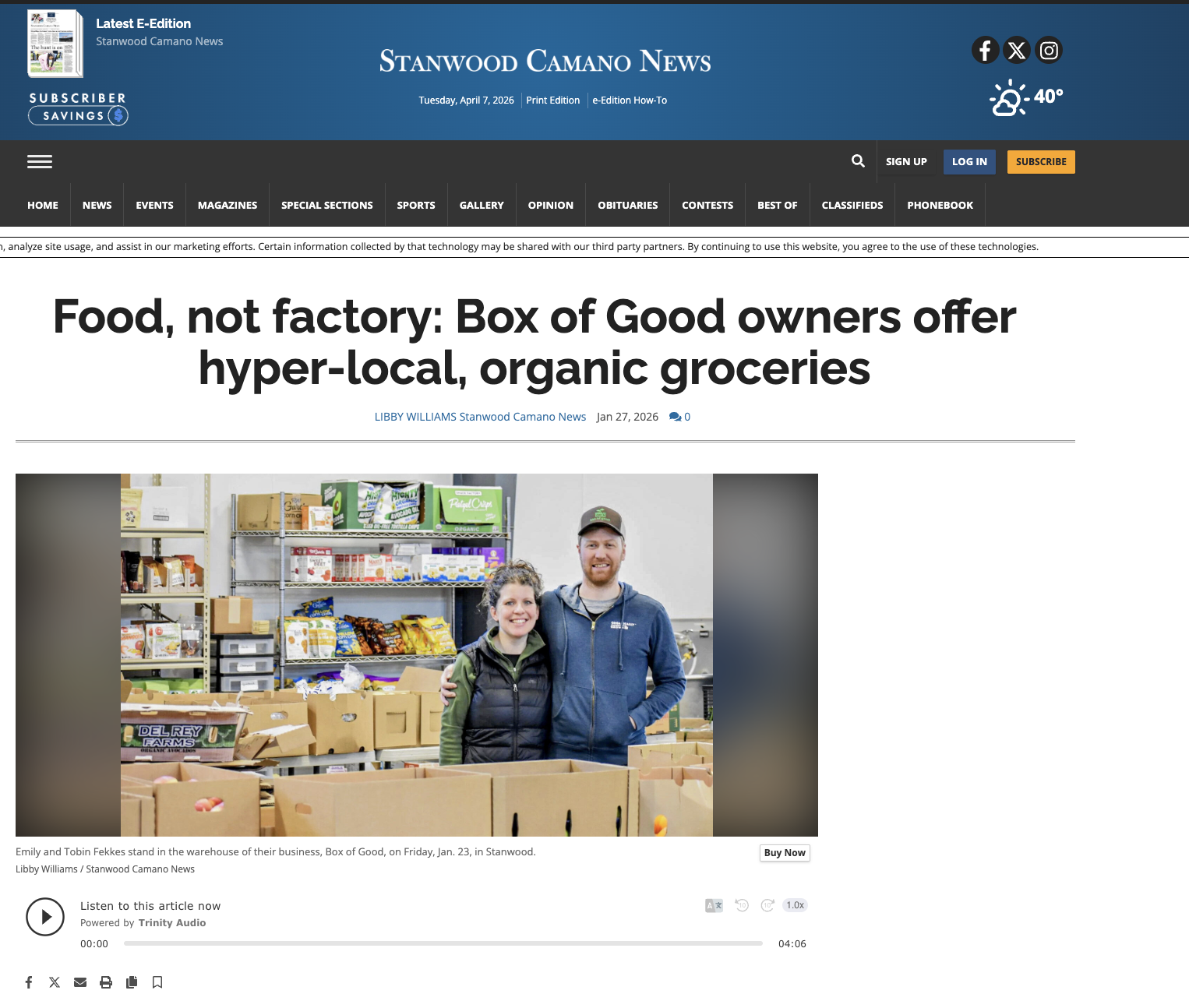
Tobin Fekkes is in no short supply of “soap box” moments when it comes to talking about locally sourced food and supporting farmers.
Fekkes said he doesn’t remember when the passion began, but it’s driven him to become the owner of Box of Good Foods along with his wife, Emily Fekkes.
Box of Good is a local, organic food and grocery delivery service based in Stanwood.
Tobin Fekkes got involved back in 2016, when the company was called Klesick Farms.
This past week, the couple finalized the process to become the sole owners of the business.
They said their goal is to combat a problem they’re seeing: food at the grocery stores isn’t really food anymore.
“The food that gets into the grocery store is designed for the transportation and not for your body,” Tobin Fekkes said. “And, to get food to last as long as it needs to in a freezer or a truck or on a pallet or on a warehouse shelf, you have to turn food into factory food.”
He gave the example of tomatoes that are picked green and “ripen” throughout the transportation process, so people may eat a red tomato, but it tastes green.
The couple’s solution is simple: simplify the process.
“(We’re) sourcing hyper-local stuff … and you can cut your distribution from weeks or months or years, in some cases, down to days or hours,” Tobin Fekkes said.
“We pick up carrots from Mount Vernon on a Wednesday, they were picked Wednesday morning, go in a box on Thursday, and they’re at your house on Friday morning.”
Boxes are customizable depending on a customer’s need, down to the ripeness of the bananas, so the Fekkeses can time them out for the week.
A small team of delivery drivers brings the food to homes within an hour’s radius of Stanwood.
Tobin Fekkes said a sign of quality in Box of Good’s products is their ability to go bad.
“If your stuff doesn’t go moldy, then it’s not really that organic. Organic mold is actually a good sign because your food is real food,” he said.
He said the company differs from community-supported agriculture, or CSA, because, unlike a CSA that can only provide produce during the growing season, they’re able to source produce year-round.
Emily Fekkes said this is due in part to how many new farmers and providers the company has gained throughout the years.
“It’s grown a lot, we have bread, and we have raw milk from Camano Island Creamery, and we have eggs and cheese from Samish Bay and fresh pasta from Whidbey Island,” she said.
“The idea is that it can be your whole grocery, and it’s organic and local.”
During the growing season, Box of Good works with about 40 to 50 providers, which decreases to about 25 in the winter months.
The Fekkeses said they believe in supporting local farmers, something they don’t feel happens enough through big box grocery stores.
“If we want to keep being able to have fresh food available, we have to be directly investing in it,” Emily Fekkes said.
Besides direct payment, Box of Good also provides opportunities for suppliers to reduce their environmental impact.
“Our barbecue guy, he does TV dinners, tallow, barbecue sauce, and he had everything in plastic containers with a film lid … and his barbecue sauce, the first ingredient was high fructose corn syrup,” Tobin Fekkes said.
He said he worked with the owner of Pure Smoke NW BBQ to switch to non-plastic containers, which cost less, and change the ingredients to healthier options.
The couple has also worked with dairy farmers to use glass containers that customers return to be refilled.
Tobin Fekkes said they make these efforts because it shouldn’t be on the consumer to fix the environmental shortcomings of companies.
“It’s always the consumer’s job to fix the problem of more, or it’s your job to pick a paper bag instead of a plastic bag, or it’s your job to pay eight cents for a plastic bag,” he said.
“What if we fix that problem?”
To learn more or shop, visit boxofgood.com.
Libby Williams can be reached at [email protected] or 360-732-1727