Posted on

A Little Tense

In August of 2003, Joelle and I purchased our current farm in all its glory. Never mind the buildings (where the original barn was lying flat in a heap of timber), or the funky carport attached to the front of a once beautiful farmhouse, or the machine shop/equipment storage barn that was, well, still “standing” for now! 

We had been shopping for a farm for 5 years. We looked at everything from Montesano, to Goldendale, to Rockport, to Darrington, to Tonasket. The worst part was that we knew we wanted to farm; we just didn’t know what kind of farm we wanted to be. 

When you don’t know what kind of farm you want to be, just about any farm will work. Thankfully for us, we stumbled across this previously described gem and got to work restoring “her” to her former glory. What really sold us on this place was not the house, but the equipment shed and the soil.  

About the time we discovered this farm, we had finally settled on growing veggies, and we were now looking for farms with good soil. If you are going to buy a farm and raise vegetables of commercial significance you will need rich deep alluvial soils. That means you are going to be living, or at least farming, in the flood plains. That is where we ended up. About as close as you can get to the mouth of the Stillaguamish river, and a whopping 14 feet above sea level. And every one of those 14 feet matters down here.  

Allow me to close this loop. In October 2003, this valley got blindsided by a rainstorm that just came sheeting off the hills and flooded everything. We were new and hadn’t really been properly introduced to the Stillaguamish River, but during that flood we knew who the boss was going forward. From 2003 to 2011 we experienced several significant floods, and not much since then. 

I know that one day, and possibly this year, the Stillaguamish will remind us who “owns” the valley bottoms. I am thankful, though, that the Stillaguamish River shares this beautiful soil with us farmers rather freely. 

In 2003, it had also been a few years since there had been a meaningful reminder of flooding in the valley, and that October flood caught many farmers off guard. By the time they knew it was going to flood, it was too late. Millions of dollars of corn and potatoes went unharvested in our valley. Literally, months of planning and hard work was left to rot.  

Which is why, 16 years later when the weather switched in early September to a colder and wetter pattern, every farmer was pushing their equipment and working around the clock to make sure that the Stillaguamish wouldn’t lay claim to any unharvested crops. For the most part the valley is ready in case it floods. Down here it is not if, but when it will flood. At least the crops are out!  

-Tristan
Posted on

What Happened!

Things were growing right along. The summer was a tad colder than desired, but all in all there was enough sunshine and good weather, with a few timely showers, to keep most veggies and fruit crops content. Everything was pretty happy, except for the tomatoes.  

I mean, they were happy enough, but not really happy. Ok, let’s be real, this just wasn’t a tomato year. Yes, we produced some amazing tomatoes, and a decent quantity, but this wasn’t the year to grow all your tomatoes outside, which is exactly what chose to do. 

Hindsight is always 20/20. For the previous 2 growing seasons, the summers were hot and dry, and when you add a little irrigation to hot and dry, you get TOMATOES. When it comes to climate change, we believe that the climate is changing, and the NW is going to be one of the winners, especially when it comes to growing tomatoes on the western side of this state. 

Our decision to grow all of our tomatoes outside was the right one, in light of the warming trend, but this last season was more normal in its presentation, and maybe we should have planted the greenhouses too. If you are thinking, “why not just plant the greenhouses every year?” The short answer is, growing tomatoes outside is more enjoyable for me. But next year, I will probably grow inside and outside. 

We have this new patch of cucumbers that is coming into production right now and, if this was last year, those cukes would be producing like crazy. However, this early start to fall has them a little confused. It is also a tad cold for them, and with the shortening day length, those beautiful plants are probably going to be calling it quits here pretty soon. John and I are talking about covering them with a blanket called Reemay. It will protect the plants from a light frost and extend their season.  

Tree Fruit 

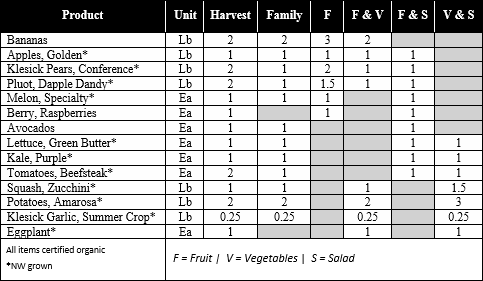
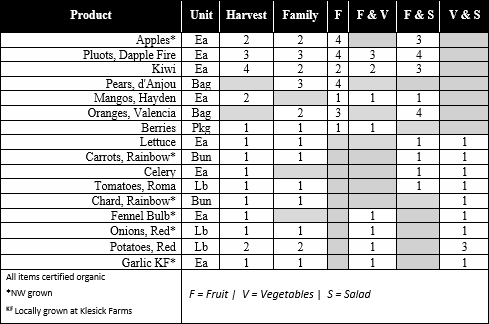
We have been featuring our Conference pears in the boxes lately. I love pears. I could eat a pear every day, especially a firm pear. I like them firm and juicy, and these Conference pears are perfect right now. Our Conference pears are a harvested over a two-week window, and then they’re gone. Thankfully, the Bosc and Comice pears are close on their heels. We should have Klesick pears for the next few weeks, then a gap, and then Bosc and a few Comice pears in early October.  

Lest I forget, look for the first winter squash in a few weeks. I am thinking I will lead with the Delicata, then Carnival, pie pumpkins, and Acorn for Thanksgiving. Look for Delicata to arrive in two weeks.  

The farm recap respectively submitted! 

-Tristan

Posted on

Jade and Marketmore

We grow two types of cucumbers here at the farm. We grow an old and trusted standby called Marketmore, and a newer up and comer called Sliver Slicer. We interchangeably mix and or match them as they come out of the field and find their way into your boxes of good.

Cucumbers are sneaky little plants. One day you think you have harvested all the ones that are ready to go, and the next day you come back and there is another 200 lbs. How did that happen?!!?!!!?!!

The farm season is especially challenging for the Klesick team. You may have noticed that the aforementioned cucumbers have been a staple for the last several weeks, as have the green beans. It is really hard for smaller farms like us to get the harvest quantities right. The quality is easy, but trying to figure out how many pounds of cucumbers are going to come off a week in advance is pretty tough!

With lettuce it is easier, just count them. Lettuce harvest does get tricky because they can ripen at different times and can also look ready when they are not.

But I think green beans are the trickiest of all. This year we switched back to another old and trusted standby in the green bean world, called Jade. I think they are a little happier planted in Mid-Summer, but the early May plantings did just fine. When you talk about Jade in the midst of farmers who have grown it for 30 or 40 years, their eyes light up and their voices get noticeably quieter. There is a reverence when it comes to Jade that is hard earned, and deservedly so. They are absolutely beautiful and tasty green beans.

Even within vegetable classes, some varieties are happier planted earlier, and some later. When it comes to Jade, it seems to work well as an all-season winner! I actually try to plan for a “gap” on cucumbers and green beans, but this year the harvest rolled from one planting to another to another and the harvest kept coming. Now I am not complaining, but we try to have variety in the box of good menus and not put an item in every week.

This year, the green beans and cucumbers have been prolific, and I must say… so, so, so fresh and delicious! We are literally picking one day and delivering the next day. For us, it is so rewarding that we can pick it, deliver it, and you can be eating cucumbers or green beans within a day.

That is best kind of fast food!

-Tristan

Posted on

Back To School

Many of you are getting your kids ready for back to school and thinking about school clothes, supplies, and LUNCHES!  I’d like to take a few minutes to share some ideas that have made our school lunches healthy, simple, and environmentally friendly!  

First of all, I like to use reusable storage containers.  We go the whole year without throwing out a single “sandwich bag.”  Ziploc makes a divided container that is spill proof and pretty durable.  Ours have lasted the whole year long.  If you’d rather steer clear of plastic, there are similar divided containers made of stainless steel.  We purchase cloth lunch bags that fit our containers perfectly, then add a freezer pack to keep things cold.  When using the divided containers, sometimes the items fit better with the addition of a large size silicone muffin cup.  This adds another “section” to the container.  

One thing I like about the containers is that it helps me think through what to send in their lunches.  One section we put in veggies, one section fruit, one section holds the protein, and the smallest section might have a healthy cracker, chip, or small homemade treat.

Most importantly, make sure you have a good supply of healthy foods that your kids will eat!  When ordering your weekly produce, remember that you can order “add-on” items to guarantee that you will have the special items that your kids like most.  For vegetables, I always have cucumbers, carrots, and peppers on hand, because I know my kids will eat these.  If available, my kids also enjoy raw sugar snap peas, green beans, and some even love shredded cabbage or raw cauliflower. 

Choosing fruit is easy! They all like cut apples and oranges!  Melons, grapes, kiwi, nectarines, pears, and berries all make a great addition to school or work lunches.  

For protein, sometimes we’ll send a half sandwich with organic cheese and veggies on homemade sourdough bread.  But there are so many other choices besides sandwiches.  We might send yogurt with chopped fruit and homemade granola, or a nut/seed/dried fruit mix, or a whole grain, honey-sweetened, zucchini or carrot muffin. One of my kids loves it when I send nut butter in one of the compartments along with chopped carrots, celery, and apples for dipping.  Some of my kids enjoy creating their own salad wraps, and I send the ingredients in the separate compartments.  Don’t forget you can send things like a quinoa salad or even dinner leftovers in a reusable soup thermos.  

We stay away from pre-packaged individual serving products.  With the divided containers there’s just no need, and the environmental impact with these items is just too high! 

We’re happy to bring you quality lunch supplies for your kids!  Take a few minutes to think through how we can best help you meet your nutrition goals for your kids this year, while simplifying the process!  

-Joelle

Posted on

Farms and Fish

When I was a kid, the strawberry bus would come by every June down to South Everett. The bus would pick up middle schoolers and high schoolers and haul them off to Marysville or Mount Vernon. As the season went on, the same bus would pick up mostly the same the kids and haul them to Mount Vernon, and they would harvest cucumbers.

Of course, machinery and/or a crew of professional seasonal migrant pickers eventually replaced kids at those jobs. I don’t remember those buses coming much after 1980 or so. Whatever caused the shift, the shift was here to stay. Many of those crops (cucumbers, berries, sweet corn) are not a major part of the acreage being farmed today.

Agriculture is not much different than other businesses. We have to deal with market changes, labor shortages, rising inputs, mechanical and technology issues. We are really not so different when it comes to the business climate. There are three areas where Agriculture diverges from many other businesses, and that is the issue of habitat, critical areas, and natural resources.

Unlike a store front, our business model is dependent upon having land to farm, and the best farmland in Snohomish County was in Marysville. The next best soils, although “heavier,” were in the valley bottoms from Monroe to Snohomish, and Arlington to Stanwood. The only farmland left in Marysville is what is north of town, and it is getting wetter by the year as the hillsides fill with houses, the water sheds down the mass of asphalt, and zero lot line houses stack up like cords of wood.

Why did we lose all that prime farmland in Marysville? We lost it because we don’t care about the long-term future of feeding people. Essentially because, Marysville was flat, didn’t flood, and relatively close to Boeing. 

Today, Snohomish County still has lots of farmland, but it is in the valley bottoms where flooding makes building houses harder (not impossible). There is another pressure facing Agriculture today, besides poorly planned communities that shed their water to next parcel below them and eventually into the valleys. The pressure today comes from the Natural Resources/Restoration community. This is a well-funded group, mostly by taxpayers, who work to restore the valleys to their pre-European functions for wildlife or, more specifically, Chinook salmon.

I am all in favor of clean water and healthy functioning watersheds. I have spent 21 years of my working career farming with nature. I have tallied many a month of 40 hours or more volunteering on salmon and farming boards – working on solutions for farms and fish. It is frustrating that almost every person working on the salmon issue is paid by a Salmon Grant to be at those meetings, and all those meetings are during the day. How many working people have time to participate in government???

So why do I continue to stay at the table and be engaged? Because I believe that we can have both a vibrant farming community, and healthy ecosystems. As a local community, we are going to have to decide that Farming and habitat/Chinook Salmon can coexist. The natural resource community may not be paving over the valleys like the Development community was encouraged to do in Marysville, but the outcome will be the same without a shift in public policy. No farmland, no farmers and, quite possibly, no Chinook either.  

Posted on

Hinges

I came across a quote from W. Clement Stone. He is attributed to have said, “Little hinges swing big doors.” Let that sink in for a moment. “Little hinges swing big doors.” What size hinge is necessary to swing the doors in our lives that are blocking progress? One needs the appropriate size hinge, the appropriate number of hinges, and the appropriate placement of hinges to swing any door. Small hinges can swing large doors. 

I am no hinge expert, but this is what I do know. Hinges facilitate the movement of the door. A door, by definition, must be able to open, or it would be a wall. Ironically enough, a door is also a wall, but a wall is not a door.

Alright Tristan where are you going? Thanks for asking. When we moved to our farm and farmhouse there were two front doors kitty corner to each other on the same porch (still somewhat of a head scratcher to me???). One of those doors was a door with a window, much akin to a back-porch door. The other door was this really ornate, cool, solid wood door on the adjoining wall. Both had doorknobs and both looked like doors, duh! They were both doors.

The really cool old door didn’t work, and the half-glass back-porch door did work. What couldn’t be discerned from the outside is that at some point in this farmhouse’s 127-year history, someone took off the hinges of that old door, nailed it to the wall, and then paneled over it on the inside. True story 🙂

Sometimes, when it comes to making life changes, we try the wrong door. It might even be the coolest door, or even what appears to be the correct front door, but if that door has no hinges, it is not going to open. When you locate the door with hinges, you have a chance to pass through it, and it will open rather effortlessly. This can either be a good thing or not, but for the most part, if you can open a door, it is at a minimum meant to be opened. If not, it would be locked, or in the case of our old farmhouse, nailed shut and paneled over on the inside.

When it comes to eating healthy, we complicate it. Eating healthy is not complicated, we are! The door to eating healthy is relatively well-oiled and placed in the open where you would expect a door to be. The door to fresh fruits and vegetables, the one door that moves the needle on health and longevity like none other, isn’t nailed shut, hidden, or hard to find. But sadly, for some reason, most Americans rarely open it up and walk through it.

Of course, your family opens the door to health every time a Box of Good arrives, ensuring fresh organically grown fruits and veggies are available for you and your family to eat healthy. Thank you for that. 

As a side note, we swapped out that back-porch door with the really cool ornate wood door, then filled the open space with a window. 

Enjoy,  

-Tristan

Posted on

Summer

I’m hoping for more summer, but last week had that Fall feel to it. When I came downstairs, the heater had turned on. I thought to myself: hmm, that is strange. To the thermostat’s credit, it was chilly. Of course, a few cold mornings in early August don’t predict the future, but before we know it, it will be September. And you know what that means, SOCCER season.  

I coach my son’s team, and I already have those boys practicing. I am a coach that believes in practicing with the ball all the time, and we practice at game speed for most of the practice. But I digress. Fall will be here soon enough, but for now there is still lots of work to be done on the farm. 

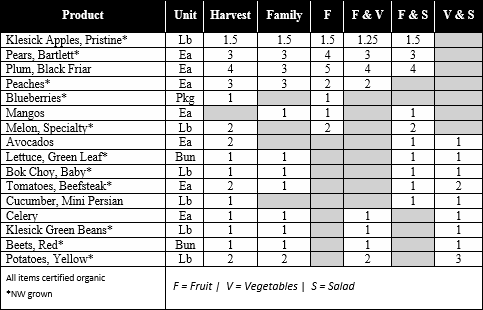
If I had to sum up the farm season, it was mostly wins. Things were a little slower growing and quality has been really good. Our early apples have that sweet, tart flavor that is reminiscent of another era. The Pristine is a little later this year, even with the drier weather, but it is fun to have an early apple. The trees we grafted from Honeycrisp to Liberty apples have been growing really well, and in 2021 we will have a healthy crop of Liberties. I absolutely love this apple, but our next apple will be the Gravenstein, followed by the Chehalis.  

Soon there will be Conference and Stark Crimson pears, followed by the Bosc pears. Pears are my favorite crop. I could eat a pear every day. You might be wondering how I chose my varieties. I grow what I like to eat, and I grow what grows well on our farm. Some of this is trial and error. You do your research and plant the crop, and then you try to farm them. Sometimes an experiment will take 3-5 years before you can accurately judge whether or not the crop or tree is a good fit for your microclimate or farming style. We have grafted all of our Comice pear trees to Conference Pears, and that was a good decision. The Conference pear tree is much happier on our farm and tastes really good. Pears are still a month away though.  

Switching back to veggies. Cucumbers are coming on, tomatoes are coming on, green beans have been strong with our third planting a few weeks away. This week we are harvesting beets. Beets are one of my favorites. Our French relatives serve, boiled, peeled, and cubed beets with grated carrots and green beans as the first course. I love that dish; I could eat it a few times a week with a little olive oil and balsamic vinegar. Try it this week, you can put all of it on a bed of lettuce or spinach, too. YUM! 

Thank you for eating your fruit and veggies, it is the easiest way to obtain optimal health. 

Cheers,

-Tristan

Posted on

Why Local?

Commerce has always been the heartbeat of every economy. Let’s face it, if a community has no way, or severely limited ways, to create products or get them to a market, that community is going to be smaller, and possibly not even exist. 

The idea of local means something different to different people. For some it might mean buying Chinese products from a local shopkeeper, or a large one like Walmart???? For others it might be buying only locally made items from nonlocal materials. Others might think that local means buying only items from local producers who use local items, but even the producer might use a plastic or hemp or some other material from somewhere else to package the item. Are we counting the energy from dams or natural gas or big oil in the production of our local items? 

The idea of local is a difficult thing to pin down. Where do we draw the line? American only? Washington only? America and Mexico only? What about customer service, quality, and local jobs? Are those as equally important or more than where the item is produced? Is the size of the company important? Is there anything inherently better about Costco because it is a local company or Trader Joes because it is not? 

One of the most local things is food, but even that is complicated. Local food is almost always raised by local farmers using Diesel to power their tractors and get their products to market. What about the seed and fertilizers? They mostly come from other places too.  

Klesick farms is a local company and a local farm, but we also work with other local farmers and producers from Skagit or Washington, other states, and even countries. We pride ourselves on being as local as locally possible, and also having a high standard for quality and customer service. Quality, not only in the actual produce we deliver, but the internal quality of the organically grown produce we deliver. That internal quality is the real prize, the fact that it’s beautiful is a plus. 

What we are after is the quality that feeds your body, that fuels your body, mind, and soul to be as healthy as you can possibly be for as long as possible. What we eat is important, and I like to think that where it comes from has a little to do with it as well. For the last 21 years, Klesick’s has never deviated from that mission, message, or passion. Your health is important, and growing or sourcing foods that are healthy, vibrant, and nourishing is embedded deep in our DNA.  

Your health matters to this local farm and company! 

-Tristan

Posted on

Inchelium Garlic

This week we are featuring Klesick Farms Inchelium garlic. We have settled into this variety to grow. It is a classic soft-neck garlic as opposed to a hard-neck garlic. The latter produces a seed pod, called a garlic scape, that is edible. Ironically, those seed heads will eventually turn into bulbils, which is essentially a very tiny garlic clove. When you plant those bulbils, you get one clove the next year and then if you plant that one clove from that one bulbil you will get a head of garlic.

Most farmers do not plant bulbils, but instead plant cloves directly and bypass a year of growth. When we planted hard-neck garlic in the past, we would save those bulbils. Then in the fall, just like regular garlic, we would plant them and harvest garlic greens in the spring, similar to green onions. Through trial, error, and frustration, we discovered that harvesting garlic greens in March is really difficult due to the elements, and our clay soils. 

We have learned to wait till the weather moderates and the soil warms before we attempt to harvest or plow on our farm. Because of this, we no longer grow garlic greens, mostly due to a time of year issue. However, garlic grown for bulbs does just fine, and the Inchelium is a beautiful heirloom variety that was discovered in Colville Washington.

Ironically, garlic, like most plants, takes on the personality of the soil and the farmer. This year’s garlic was a bumper crop! The combination of planting in hills, mulching with straw, and spacing it about 6” apart in each row and between the rows with two rows per hill seemed to work. Of course, that is what worked this year with this year’s weather pattern and this 9-month experiment will become the planting protocol going forward.

Garlic is one of those truly slow foods, especially compared to radishes, which take about 25 days to mature. Garlic is a superhero, and while it might take 9 months to grow and a few months to dry/cure, it can also last for months, unlike it’s quick growing compadre the Radish! 

CAUTION. We are sending you “uncured” garlic in your box this week, which means we just harvested it and it will not last for more than a few weeks on your counter. EAT IT THIS WEEK. You can use it just like regular garlic, press it, dice it, stir fry or roast it, but just make sure you use it this week. 

The rest of the garlic will be curing and available later in August and into the winter. If you haven’t noticed I am big fan of garlic and am all in on INCHELIUM! 

Enjoy,

-Tristan

Posted on

Wildlife and Farming

Peter Rabbit and his siblings have taken up residence this year! The rabbits are cute and fun to watch scurry around. And they definitely feel at home! You can practically walk right up to them. The other day I found one sunning themselves in the greenhouse under the cucumbers. The nerve!  

I haven’t seen too much vegetable damage from the rabbits. But I have been scratching my head lately, wondering why the drip irrigation is leaking in unusual places. I even replaced a section the other day that was all scratched up. Hmmm!  

I mentioned this story to John, my #1 farmhand and it was like a light bulb went off above our heads. He just replaced two complete sections of drip tape which was all scratched up! But they weren’t all scratched up, they were chewed up, apparently those lazy critters are helping themselves to a drink every now and then FROM THE DRIP TAPE! 

Part of the problem is that our farm dog has gotten along in years and while his desire to chase rabbits still exists, the motivation to chase rabbits has long since left?. Of course, having a good rab bit chasing dog has its advantages (like less rabbits wandering willy-nilly here and there). But, since that option isn’t present, we will have to go to Plan B. I am going to put a plywood rabbit door that us humans can step over or move and then I am going to put a water dish outside the greenhouse. 

Obviously, our “farm ecosystem” is a little out of balance, which is why we have a lot of rabbits. Eventually, the coyote/owl/falcon/hawk/eagle populations will respond to the new increased food/rabbit supply and create balance again. It will take time, which means I will need to manage the operation a little differently and possibly get another rabbit-chasing farm dog.

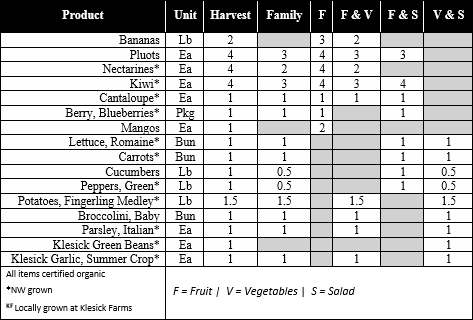
This week’s menu has 13 locally grown fruits and vegetables. It has been a very late start to the local season, but we’re harvesting now! We are even seeing a few tomatoes ripening, both the Early Girls and the Sungold Cherry tomatoes. And we are going to have a bumper crop of cucumbers, green beans and beets. The potatoes have really loved the cool spring and this dry stretch. Of course, everything has really loved this dry stretch of warm weather, even this farmer

  What is fun about market/truck farming is that the landscape is always changing. Every week we are planting something, then we add weeding to the planting, and then eventually you add harvesting to the planting, and weeding–which is where we are right now–and it is busy! Around September planting slows down your focus on harvesting and weeding. In October, you stop weeding altogether and keep harvesting, and then in November you take a long nap and wait till Spring to start the cycle all over again! 

But right now, it is local produce time and us local farmers are getting it out of our fields and delivered to your door

Your farmer in health,

-Tristan

Posted on

Generations

The Stillaguamish River Valley has been the home of the Klesick Family for 70 years. I haven’t really given it that much thought till the last week on the 4th of July. My grandparents moved to Oso in the early 1950’s, like many folks from that generation, they were WW2 veterans and settled in Puget Sound. And a good many of the 11 Aunts and Uncles ended up working for Boeing. My grandpa worked in the lumber yard in Darrington and Grandma worked for Boeing. 

Our family has been spending summers for the better part of 70 years visiting and playing and creating memories. As time marches forward and I am now a grandparent, the transitions seem faster. Almost, all of the great aunts and uncles have left this planet and the next guard has taken their place. Many of them sitting in the exact same spot their parents would have perched to take in all the festivities and catch up on all the happenings. 

And just as my parents have moved up a tier, so have Joelle and I. The new grandparent tier with my cousins are nearing a half century and a few us older, not by much though! And our collective children range from ages 7 to 28, and there are upwards of 23 of them from just the Oso side of the family.  

And now the older children are having children and they are continuing the family tradition of coming to Oso and connecting upwards with the “older guard”. Four generations laughing, playing, visiting and strengthening connections.

This past weekend, it really struck me. I was one of those little kiddos, splashing in the Stillaguamish River with my brother, sister and cousins 45 years ago and almost at the identical spot. I used to build dams in the side channel and splash my mom just like my grandkids were now doing to their mom. 

I remember my dad fording the river with me in tow and how I used to do the same with my children, and how the “worrying” side of the family would all caution us to be safe – some things haven’t changed.   Continued…

And this weekend I saw my son, with a tight grasp on two of the young ones fording that river at almost the identical spot I would have crossed with him and the same spot that I would have crossed with my dad. 

And although I can’t say for sure, I imagine that my grandpa probably forded that river with my dad in the early 1950’s at the same spot. As a matter of fact, if I close my eyes, I can almost hear my grandma Opal, “Richard, you be careful!” 

And in the blink of an eye and in the very near future, Joelle and I will taking up the “older guard” spots that have that unique vantage. Partaking in the 4 or 5 generations that are now below us, watching all those little ones play in the river and a few more ford it with their parents. I wonder who is going to be the one to assume the role of reminding them to be careful?!

Family and family memories are important, thanks for allowing me to muse! 

-Tristan

Posted on

Servings

How many servings of fruit and vegetables should we eat? Can we group potatoes and sweet potatoes in the vegetable category? I hope so because this is potato Salad week! Grilling and potato salad are going to be highlights for the 4th, and of course, no end to fireworks, especially for rural folk.  

We have just added USDA grass-fed hamburger to our meat offering, joining Sockeye salmon, chicken, tuna and cod. While the grill is still hot, toss on some Walla Walla sweets, zucchini, and red peppers. You can even sear some romaine hearts.  

And now the summer fruit is starting to show up on the menus. Watermelon, nectarines, cherries, berries, grapes… When the seasons change and the different crops make their annual appearance, I get excited. The flavors, the smells, the lack of dishes to wash. Ok the lack of dishes to wash has more to do with being outside and eating more raw foods.  

Nothing like biting into a nectarine or peach and having to take a quick step back because the juice is pouring down your chin ?. Oh my! The Black splendor plums right now are really good. 

I know some of you are thinking Salsa and Avocados for chips and dips. Salsa and Avocados will definitely, get the recommended fruit and veggie servings moving in the right direction.  Eating healthy, feeding your bodies with good food is more than doable. The challenge is training ourselves to say “yes” to more fruits and veggies, and learning to leave the packaged foods at the grocery store or at Amazon. Easier said than done.  

Our mission from day one: work with local organic farmers and other organic farmers to make eating healthy easier. Connecting the local consumer to the growers. It was important 21 years ago, and I would like to think that it is still important today. 

Enjoy the 4th and enjoy some really good food. 

Be safe, 

-Tristan

Posted on

Intense

Last week we had a good “drink” of water from Heaven and that evening we were treated to an intensely rich pink sunset. This world is a beautiful place if we take the time to be still. There is so much to see all around us, so much intricacy, delicacy, and grace. We are blessed.

I have been working with nature for what seems a lifetime, but it wasn’t until I began my organic journey that I realized how small I am in relation to the micro and macro ecosystems I inhabit.

Take the rain we were blessed with last week. We haven’t had meaningful water for a few weeks, but we didn’t have a lot of high temperatures either. When the rain comes, the plants are built to receive it, maximize it, and use it. Plants are amazing collectors of water. A lettuce plant will funnel untold amounts of water into its base and hydrate it leaves and roots, then it will trap the moisture under its canopy and hang on to it to extend its benefit.

The Pea plants are incredible. Their waxy leaves and tendrils shed water almost immediately and almost all of it makes it way to the roots. And as most of you can attest, Klesick Farm peas are especially sweet!

Rain can come at a bad time, too. Thankfully this spring was just hot enough, dry enough, and wet enough to not have a negative impact on our early crops. Even our Strawberries have “weathered” the weather fairly well. For sure they would have appreciated a little more heat, but then the peas and lettuce would have been a little less happy.

Have you ever noticed that the birds are always noisiest in early morning? At 5 a.m. this farm is anything but quiet. I believe that is by design, and I believe that the birds’ chirping is music to the “ears” of the plants. It is almost as if when the birds sing, the plant opens its stomata and takes in the dew that has collected all evening. And when the birds go quiet for the day, the plant closes its stomata and traps in the nutrients and moisture to tide itself till the evening. This also coincides with the sunrise, which the plant also uses as a signal to open its stomata. 

Knowing this, we spray a foliar kelp and micronutrient mix in the early mornings or late evenings and, when the plant opens up its stomata, we “bless” it with extra nutrition. When I refer to working with nature, this is one way that we do that.

The balancing act as a farmer can be dicey, especially on a mixed vegetable operation as ours. We have a good start with a few mishaps, but no more than usual, and what we have harvested has been beautiful on the outside and inside. And for me, as a farmer, the real joy comes from feeding your family and my family produce that is, yes beautiful, but most importantly produce that is brimming with flavor and nutrition. 

-Tristan

Posted on

Sugar Snap Peas

This is the best tasting crop, and it only lasts for only a few weeks! And we got them earlier than ever to boot! That incredible stretch in March is paying dividends now.  

For some reason, I remember picking peas on June 11th in 1999 when our farm was located in Machias. That is the earliest we have ever harvested this variety. We have tried to have peas for the box of good this early every year, but so much has to go “right” to get an early crop off and this year a dry March, wet April, and hot May was the right mix of weather. Go figure??!?!?!!? But this year, it happened!  

So, it will be Klesick Farm pea season for the next few weeks. You can order extra’s as well. If you love sweet, plump and juicy peas, now is the time to treat yourself! 

-Tristan

Posted on

Soil

Soil is critical to human health! Healthy food comes from healthy soils, and a healthy citizenry comes from healthy food. That means the health of our citizens is tied directly back to the health of our soil. 

And sadly, one doesn’t have to look very far from the farm to see that there is a burgeoning population of unhealthy folks today. In addition, any healthy food that is being grown is converted into a myriad of processed products which, I would contend, have substantially lowered the quality of food. 

And, sadly, sugar, fat, and alcohol are all the rage in the food scene, organic or otherwise. It is called “value added,” but overly processed foods, organic or otherwise, are not the solution to America’s health crisis. 

I am a huge fan of veggies and fruit staying as close to their original, recognizable self as possible. Eating foods grown in soils that are minimally processed is the only viable solution to curb America’s health crisis. Will eating more fruits and veggies, solve every disease problem? NO. But clearly the Standard American Diet (SAD) isn’t curbing anything either and, if anything, it is making us worse off. 

Almost all the treatment is just that, it is focused on treating the ailment instead of changing the underlying cause – poor nutrition. The hard part is that we need to attack these illnesses from a dietary perspective and treat the condition to provide some relief. Eventually, if our food policy could switch to more fruit and veggies and less of the current food system, there would be less need for the expensive and intrusive procedures we default to today. But for now, we mostly have a “treat the condition” model.  

I know that there are educational advocates and government programs encouraging the American population to eat a more balanced diet, all things in moderation. This is America, of course they are going to say that. Our political system guarantees us a diet that can never be healthy, because of lobbyist groups.  

So, the only choice we have to remain healthy or be healthier is to make the choice ourselves. At least for the moment we don’t have to buy “their” food, we can take charge of our health. It is at the fork or spoon where healthy food enters our bodies and, if we put good food on that fork or spoon, our bodies will absolutely put it to healing, nourishing, and cell-building work. 

For 21 years, Klesick Farms has been growing, sourcing, and delivering food that your body will be able to put to good use to nourish itself.  

Thanks for allowing our family to serve yours, 

-Tristan

Posted on

My Part, God’s Part

This is the hardest time of the year for me as a farmer. We are primarily vegetable farmers but also grow some fruit and hay. Vegetables are incredibly slow growing in the spring, and then all of the sudden – BAM! A little heat and little water with increasing day length equals growth. This time of year, everything is just getting started. 

As an organic farmer, I spend a lot of time thinking about how to get my soil as alive and healthy as possible. It is pretty simple for me. Take care of your soil, and it will take care of the plants. It is similar to: “you are what you eat.” If we as people choose to eat good food, our bodies will do the rest. Of course, just like the soil, our bodies have an incredible ability to absorb lots of toxicity and still function, but not thrive.

As a farmer, I know when a plant is starting to show signs of stress. It comes from knowing your crops. It is almost as if you are listening to what the plant is telling you. It is not mysterious. Good parents, doctors, counselors, farmers, you name it, are all good listeners. Paying attention to what the crop is telling you is what a farmer has to discern. Does it look piqued, why is it not growing, does it seem dry? And even if I have properly prepared the field, fertilized, planted and watered in the right time of year, some plants just aren’t feeling their best. But when I have done the right things at the right time, almost always, most of the crops do great. 

I consider myself a good listener, maybe I have always been or maybe raising 9 children (5 married so far) has further tuned my sense of hearing. Really, farming and parenting have taught me that you do your best. You try to prepare your fields and children for the next season, and then a lot of other factors, most out of your control, come into play. And yes, often the next seasons will keep you on your knees because so much is out of your hands.

Ironically, it is that part where we have influence, where we can lay the foundation is, also, critical. It is where diligence pays dividends. Equally important is recognizing that the process is bigger than any one person. Understanding what you control, and what is out of your control, is also freeing. 

I do believe that in farming, parenting, or eating, little decisions in the right direction and over long periods of time, lead to healthier crops, healthier children, and a healthier us. Our crops, our children, and our bodies will use the foundations we have laid to finish their race. And amazingly, as if it is a miracle, crops do get harvested, and people are healthier when they eat better food, and children can even navigate Seattle traffic when they are 16! 

Thanks for eating good food!

-Tristan

Posted on

Eating Local

We are getting so close to the local season exploding! The next few months are going to roll in like morning fog, and then heat up like hot summer day. The rain last week has hydrated the crops and added moisture to the fields. The moisture is especially helpful this time of year for 2 reasons.

The first is what you might expect, it waters the crops, and after that hot stretch, the peas and lettuce are happy for the cool weather and a drink! Plants are so amazing. When you look at a plant and study it’s leaf structure, you will notice how they have a center rib that funnels water towards the roots and/or the outer circumference of the plant. This is sometimes referred to as the drip zone. The leaves are accumulators of moisture and funnel it to where the plant needs it most.

Another interesting tidbit about leaves is that the leaves “open up” in the morning to capture the dew and then “close off” to conserve the moisture and nutrition. There is also really good evidence that the birds chirping away are one of the mechanisms that causes the plants to open up and take in the nutrition. Joelle and I have intentionally planted trees, all types, on the borders of our property to encourage a diverse ecosystem. 

Starting in the spring, and running throughout the summer, it can get really loud at sunrise with all the avian activity on our farm. I would venture that a rooster didn’t get the farmer up at the crack of dawn, it was all the wildlife singing to the plants!

Another use for moisture is to help breakdown the remaining residue from our winter crops that we plant to protect and nourish our soil. Moisture and heat are critical for the fungi and bacteria world to turn the fibrous plant material into nutrients. Which, in turn, build soil health and feed the plants. Making sure the crop is incorporated into the soil, and there is adequate moisture, speeds up the process and frees the nutrients to feed the plants. 

Feeding the soil bacteria and the other host of unseen workers is job one for an organic farmer. Without healthy soil you can’t have healthy food, and without healthy food you can’t have healthy people. If the national health trend is any indication, our nation’s soil is not producing very healthy crops. And to compound the issue, the agricultural crops are turned into a myriad of overly processed foods that are even more unhealthy.

Organically grown fruits and vegetables, whole grains, and legumes consumed as close to their original state is the silver bullet to America’s health crisis. A simple solution, but one that eludes most.

Growing food for you.

-Tristan